Just a quick notification: the Architecture Association's Intermediate Seven unit, run by Kate Davies and Liam Young, and titled 'The end of the world, and other bedtime stories' has just released its first publication for this academic year (a second is forthcoming). It's not expensive and is available from the AA Bookstore. If you want to keep your fingers on the pulse, this is one to watch. Also good for aspiring anarchists, the millennial avant-garde, and anyone looking to buy a gift for the man that has it all...
This year the unit went to Iceland to study the end of the world. If you missed Millennium People's coverage, it was intense and ace.
Sixpence an adventure and he'll take you home again: some news.
Every week I wrap up the world on the web, this week it's the web in the world that has got me in a tizzy.
Some ideas about surfing is a new zine by the young artist Joel Colover (available here as a pdf download) exploring the act of web-browsing as a type of Situationist derive – or passive drift. It is a nice return to the 90's zine aesthetic, featuring bold text and xeroxed sketches.
"Tab based browsing is surfing different waves at the same time. All the time. On the Internet we surf the currents left by other users. Old lost content and new data supply us with the momentum we need... The Internet is not a world, it is a city the size of a universe. It can be split into different quarters, not just based on content, but also on presentation, design, architecture of the pages. This is what the invisible walls are made of."
+++++
The Facebook/privacy debate continues. I can't say I'm too happy about Google's monopoly of the Web, especially when it turns out they were using Street View to capture information from people's wireless networks. That said, they are still miles better than Facebook – the "obnoxious drunk girl at the party/Internet". Related, the US still using a mercenary spy ring. Related, Cold War Paranoia. Maybe related, computers have replaced all your friends. The original lightweight portable telephone: $1499. (Wow, old technology is so attractively crap).
Left: Eventual Ghost. Net neutrality looks like its going to be a thing of the past real quick; Also things of the past: "Future Days" a book by Asimov describing turn of the twentieth century visions for the future. I actually own this book, it is a pleasure. Also books: OMA are exhibiting all of their books at the AA. Hear what the Sesquipedalist has to say about it. Also OMA: old Coney Island postcards.
Inevitable ending, when print meets the net: the 48hr magazine project. Same subject: the magazine of tomorrow (developed by Millennial Wunderkinds Berg London). If you don't know Berg, like, really, do yourself a favour and check that shit pronto: touch, here and there, olinda, the schooloscope (to mention just a few of their amazing projects); The Internet approaches its address limit. I think we should start erasing the weak and old websites to make more space. Controversial. What Google fears most; the continuity of inter-connecting relationships; cloud computing goes mainstream (WATCH OUT FOR THIS ONE). Our one hope for the future of the web (not to be over-dramatic): the Icelandic Modern Media Initiative. This is the opposite of the Patriot Act of the Internet: the Digital Millennium Copyright Act. Does anyone else feel like the present stumbled into Blade Runner? On a lighter note, the real is now irrelevant: Banksy returns in digital form. A tip off for MP: Geocitiesizer, make any website look like it was designed by a 13yo in 1996.
By the time you read this, I will already be on my bike. Ah, automatic scheduling.
Just a quick (hopefully not too banal) observation on the development of the computer screen: I have often had teachers and employers (admittedly less with every passing year) that have had trouble 'reading' screens. Print that shit out, they say. And I say, fine, it's your time and money. As long as that is the case, otherwise I kick up a stink.
I've always maintained that the reason these people have been unable to read computer screens ("Jesus, Jack, stop whirling around for a minute and just stay still!") is because they are misunderstanding the purpose of the screen. A cinema or even a photograph is just a flat surface onto which an image has been projected. It remains clearly limited by the frame, we are not supposed to think there is anything outside it. Indeed, the joy of cinema can only come when one forgets the intense action that surrounds every minute action.
Not so with the map. When we look in an A-Z we are looking at some enormous, perfect, map of the entire world. It happens to be arbitrarily cut up into frames, through which we look at a portion. With the map there is a space beyond that of the edges, a map-reality we can peer into. The computer screen operates the same way, as a membrane separating us from some other, virtual, reality. My generation sees the membrane as wholly arbitrary because we believe in the reality of the image within. In other words, we believe it has space.
The confusion of reading a membrane like a flat surface means the image appears inconsistent, blurry and dizzying. Every moment it composes itself it changes again. So when Gramps struggles with your flash Japanese DS game, riddle it out to him in these terms.
+++++
This is just a paraphrased version of an opening paragraph to a veerry long piece I'm working on at the moment about the meaning of the architectural render. Watch this space. At least the movie is pretty cool, no?
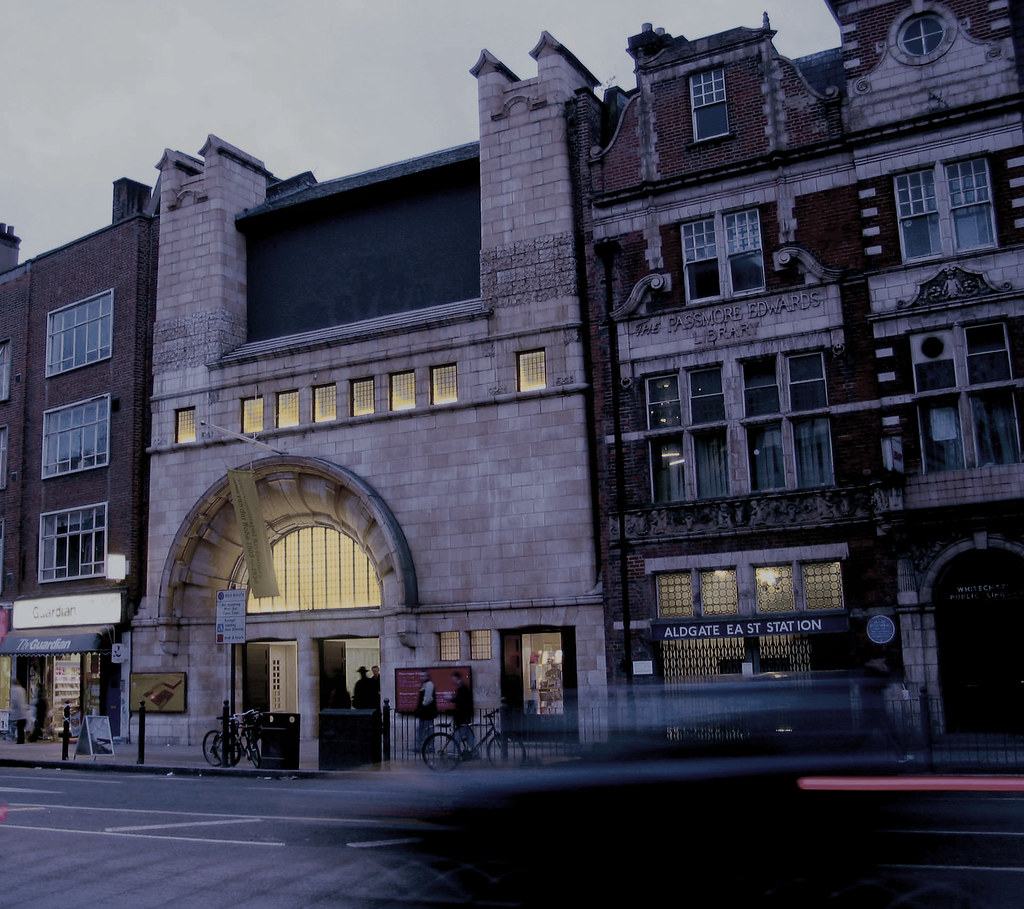
Last night I spoke at the Whitechapel for Love Art London on the subject of Robbrecht+Daem's Whitechapel Gallery extension and renovation. Perhaps the only downside was the fact that I delivered my bit, then had to repeat it twice more over a three hour period. During the second iteration a piece of sonic sculpture started singing next to me, and just before the third an old architect came and asked me some really intense questions, which threw/bored me. Unlike wine, but very much like humous, the subject did not improve with ageing. Here is the kernel of what I said:
There is almost perpetual conflict between the artist and the architect, though most of this can be put down to envy on the part of the architect. Never is this more true than when the architect is commissioned to design an art gallery. The temptation for the architect is to simply construct such a fantastic piece of sculpture than the building itself becomes art, and everything within it becomes somehow secondary to its housing. I'm thinking of Bilbao.
If the opportunity to really get in there and make a statement is non-existent, then the architect will prefer to design an art museum rather than a gallery. The contents of a museum are depoliticised, making the art safe for public consumption – and certainly no threat to the architecture. There is a feeble excuse sometimes given: since the word museum pertains to the muses, and therefore art is the product of divine inspiration, the proper place for art is in a temple. Hence the fact that most art galleries built up until the end of the 19th century were Neo-Classical, with steps running up to a large plinth and imposing collonnade. I'm thinking of the British Museum, the Tate, etc. While quite formal, at least everyone knew their place. The destruction of formal distinctions between art and architecture is what leads to the collapse of one onto the other. I'm thinking of Anish Kapoor's monstrosity for the London Olympics.
The Whitechapel is a heritage listed building. So is/was the adjacent 'Whitechapel Free and Public Library' which was bought by the gallery in 2001, with a view to expanding the relatively small exhibition space. Because the whole structure sits on top of Aldgate East tube, there wasn't that much room for architectural intervention. What remained for Robbrecht and Daem was principally a question of circulation.
The firm compared their proposal to a type of Art Internet: rather than the traditional sequence of lineally organised galleries, with coherently collated art, here the viewer can choose their own trajectory (backtracking, sidestepping and allowing intuition to guide them from one room to the next). Boredom was a big factor, the idea that someone could just pop in, have a coffee, do a quick swing into one, but not necessarily all, rooms and then whip out again.
I was pretty horrified by the analogy. If the Whitechapel acts, or is supposed to act, like the Internet – why on earth would I go it? If we look to print media, the newspapers and publications that are surviving and thriving (the Guardian, for example) are doing so by providing good critique, not simply news (which is omnipresent). If the art gallery fails to add anything to the experience a user might otherwise have clicking through their site, what is the difference? Why not virtualise the institution? I have to say I've been a couple of times since the Whitechapel reopened and I've found it each time pretty tame, maybe digitisation is the answer, an easier way to radicalise the art experience?
Top: the oil rig in the Gulf of Mexico, shortly before it sunk. Bottom: visualisation showing the resuming of air traffic across Europe in the wake of the Volcano. Airspace Rebooted (related: Flightradar24 where you can see all flights in Europe in real-time).
When it rains it pours: some news.
What seems to be going on in the world? Volcanoes, oil spills, the economic bankruptcy of most of Europe, and now Britain has a hung parliament. It's like we're copping it from all angles (which is exactly what she said). Luckily the Royal Guards are still able to instil some sense of normality. Oh, wait, they're busy marching in Red Square to celebrate conquest of the Nazis...
Related, as a kind of cultural exchange programme: Lenin in London. Same theme: Verso's Marxism conference. It's coming back into fashion again, that old Marxism. Yes sir, Marx my words, it has yet to make its full Marx. Dad jokes. Of course, the popular conception that ex-KGB lurk around every Moscow street corner couldn't be farther from the truth. Possibly related, Orwell on the principles of Newspeak. Back to London, but on a sombre note: Ghost Bikes. I've seen two people die as a result of bike accidents since I arrived in London a year ago, and I see a new ghost bike every few weeks. If you cycle in the city, do take care. Last thing on the capital: "London's Poor now no different from slaves"...
Let's hop on over to the oil rig shindig: a professional engineer in the field explains how monumentally fucked up all that shit is, in a no doubt hastily named article: mother of all gushers. Related, workers describe the methane explosion. Apocalyptic scenario? Who knows. But I'll invoke the imagery of the sky before Katrina as a visual metaphor for the global condition. A political metaphor might be Kanellos, the Greek protest dog.
Let's keep it a bit positive shall we? I'm not bothered by the oil escaping, since we've now got a petrol producing bug. When you factor in declining fuel reserves and Icelandic tectonic activity (not to mention the fact that vacationing is now a human right, according to the UN) then it seems like the future in travel is airships. Ace. Here's MPs proposal.
To technology: the first ever non-latin web addresses have gone live (although it still displays in most browsers as a bunch of x--n, wgbii, characters). The reasoning behind creating non-english URLs was that otherwise the Internet was likely to split into multiple Internets (can you even imagine multiple Internets?), although I would have thought that it makes the web less unified, not more. A convincing ipad rival has been released, which of course now justifies the ipad's right to existence. Nice one, idiots. That said, what if I had bought apple stock instead of an apple product? Still Mac, Steve Jobs' thoughts on flash. My own: phase out that shit - I gots one acronym, one number for you buddy: HTML 5. It can do everything flash can do, and it's native to the browser. Sorry Adobe, but I still love your Creative Suite. Related, obsolete technology.
Few kickshaws for you: a cream designed to grow long lashes can permanently change eye colour (Brooke Shields is the product's figureface); DAYTUM, in case you didn't already have enough information about yourself. Comes from Nicholas Feltron, whose Annual Reports always cause such a stir; BLDGBLOG's theatre for one; radioactive toothpaste; 4,000 year old lentils grown from seeds; National Geographic got a Tumblr; BIG's Shanghai Pavilion (also check out Heatherwick's). Still China: the fantastically multifunctional Chinese army shovel. Those guys, what will they think of next?
They can't tell us though, Millennium People is blocked in China.
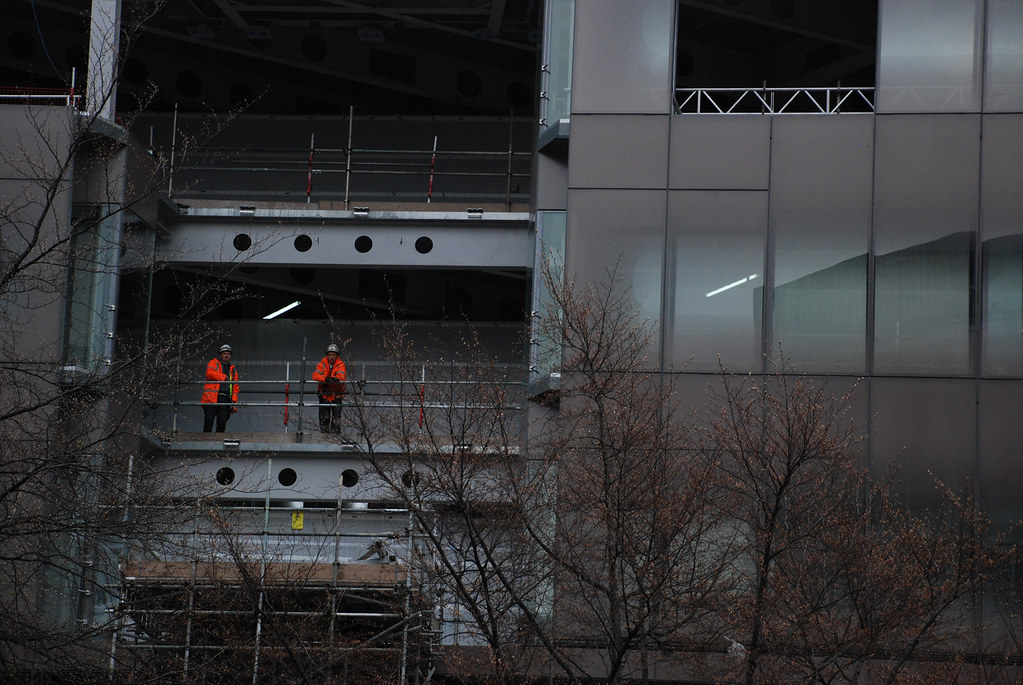
As I mentioned some time ago, I arrived in London in February 2009 expecting to work on Jean Nouvel's One New Change project. For reasons that are still too emotional to go into in any depth, I was not employed. It grieves me further that in spite of the absence of my creative input the building is nonetheless approaching completion. My only consolation is that the glass is pretty ugly (more here on Flickr).
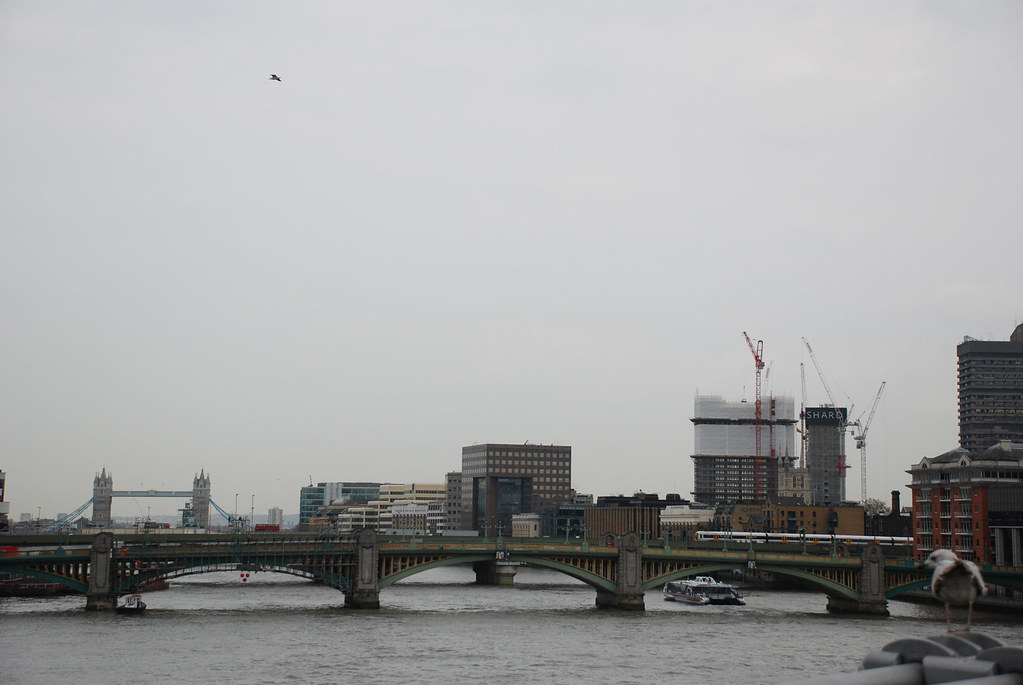
The building caused quite a lot of controversy when the valiant Prince of Darkness decided he didn't like it and was going to have it canned. This was shortly after his fiddling with the Rogers re-development over at Chelsea Barracks. Those same Qatari developers have their fingers in every pie and they are also responsible for the Renzo Piano monstrosity currently under construction near London Bridge. The core alone is the width of a 20 storey building.
Dark times lie on the horizon for London (literally, as the massive structure will be able to cast a shadow over all of Borough Market).
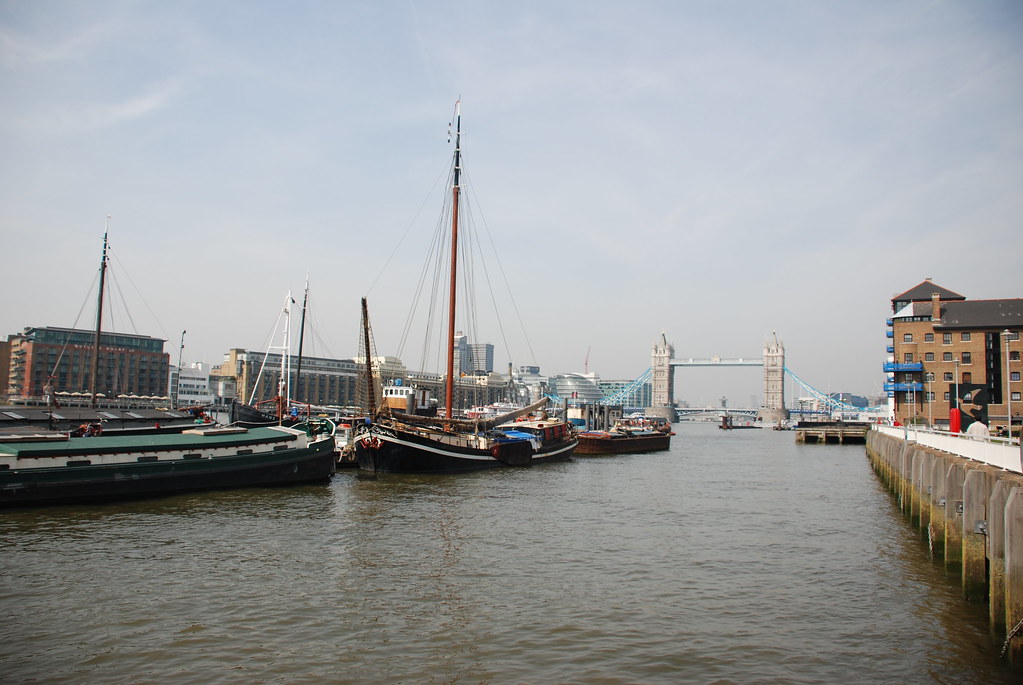
The Hermitage Mooring development is a beautifully executed architectural project. But it is also a proposition for the re-evaluation of the metropolitan citizen’s relationship to landscape. Perhaps most of all, it is a bold political statement – the result of a very personal struggle by its founders to demonstrate the possibility of individual will against established authority.
After getting a tan yesterday I awake to find the world capped under tupperware. And the rain comes down. London in spring I suppose: some Sunday ruminations...
A few months ago Geoff Manaugh (BLDG BLOG) tweeted about a 1919 disaster, the "Boston Molassacre". A large molasses storage tank burst, and a wave of treacle roared through the streets (apparently at over 50km/h) killing 21 and injuring 150. Wiki notes: "The event has entered local folklore, and residents claim that on hot summer days, the area still smells of molasses."
This put me on to the London Beer Flood of 1814. The whole strange tale begins with a party organised by Meux's Brewery (owned by the first Baronet Sir Meux, whose name is inexplicably pronounced 'myooks'), located on the junction between Oxford Street and Tottenham Court Road. The occasion was a grand dinner to celebrate the construction of a giant vat capable of holding 600,000 litres of the popular beer stout porter (now known simply as stout). It was allegedly two storeys high and had a diameter of 20 yards. 200 hundred people dined within it.
Subsequently it was filled to capacity and the full pressure of the porter put upon its 29 iron hoops. Shortly after a workman noticed a small crack in one of the hoops, but seeing as they each weighed more than 200kg, he thought nothing of it. At around 6pm the same day the vat burst, creating an explosion reportedly heard five miles away. The immense pressure from the first vat toppled the second, the weight of which fell through to the floor below. A chain reaction ensued, 1.4 million litres of beer tore through the building's facade.
At that time Tottenham Court Road was the boundary of the St. Giles Rookery, and the building was surrounded by low housing of a poor construction. Several of the buildings could not stand the force of the wall of porter and collapsed. Eight people are recorded to have died, drowning in basements, crushed by debris or subsequent alcohol poisoning.
Rescue efforts were greatly slowed by the drunken masses scooping the beer directly from the cobbles. An apocryphal story has it that as beer-soaked victims were rushed to hospital the smell of beer led patients on other wards to believe beer was being served for all patients except them. Not accepting this apparent injustice they started a riot, which increased the number of wounded.
After an investigation the courts ruled that the event had been an act of God, and that no one was responsible. The beer company continued on that site until the 20's when it was demolished and the Dominion Theatre constructed in its place. I would frankly quite like to see a tsunami of beer crush the home of the Queen Musical.
If you like what you read, join us on Twitter here.
ABOUT
Originally nothing more than a blog, MP is approaching a climax - to transform from the rambling reflections of Jack Self (AA, AR) into a think tank and collective.
Please get in touch and keep it real: info@millenniumpeople.co.uk
What (if any) is the role of architecture as an agent of social change? Are we more effective reformers (or revolutionaries) as citizens, or as architects?
Where are the limits of architecture? What is (or should be) the relationship between the citizen and the state, the individual and the metropolis, building and landscape?