Showing posts with label rant. Show all posts

Sunday, 23 May 2010

[in]decisive


When Millennium People becomes a collective (around its first birthday in July) it may or may not adopt the title of Think Tank. In order to justify such a term MP has to start having an influence. Here's a suggestion: no one should use square and round brackets to name projects anymore. That era is over.

The practise of hid[in]g words within words began sometime around the beginning of last decade, popularised perhaps by the increasing use of code (in particular Java and Python) to script architectural forms. For those of you unfamiliar with this as a design tool, the idea is basically to write a small computer programme that defines certain parameters (this might be about the shape, or the limits or the function) of a particular element (say, a facade). You then use this little programme (a script) to generate your architectural solution, or a million architectural solutions. I can only imagine that it was the syntax of these scripts, which often involve defining commands through (round) or [square] brackets that led teachers and students to apply it to their design titles.

For example, the 2005 student book produced by UNSW's Faculty of the Built Environment (located within a bright terracotta building) was "Re[a]d Centre". You see what they did there? This is banal, but fairly innocuous. Versions that really irritate me tend to suggest another meaning through the inclusion of the brackets: "[Re]thinking Architecture", "[De]sign ", "Mor[e]ph", "Tran[s]tasis", and so on. This format ranks up there in the idiocy charts with unneccessary triple slashes /// and NASA's weird acronyms ('CUM BLOW' = cumulative booster lift-off weight).

Back to the [], the problem stems from the basic indecision of this naming. Rather than making me think the authors are innovative or cutting-edge, it just makes me think they can't make up their minds. You are either reading architecture or you're re-reading it. You can't do both simultaneously.

Remember your first e-mail address? If you're like me it was probably something ridiculous like 'self_inspired' or 'groovy_gurl350'. The novelty of the e-mail address made this kind of acceptable. It was a pseudonym and never meant to be associated directly with the user. The Internet was a place of anonymity back then. Nowadays the trend has generally been away from yahoo and hotmail towards gmail, with straightforward and serious formatting: name.surname@gmail.com. The same is true of this naming technique. We're a bit more grown up now, and it's time to move away from these childish appellations.

P[ass] it on.

Friday, 14 May 2010

screens


By the time you read this, I will already be on my bike. Ah, automatic scheduling.

Just a quick (hopefully not too banal) observation on the development of the computer screen: I have often had teachers and employers (admittedly less with every passing year) that have had trouble 'reading' screens. Print that shit out, they say. And I say, fine, it's your time and money. As long as that is the case, otherwise I kick up a stink.

I've always maintained that the reason these people have been unable to read computer screens ("Jesus, Jack, stop whirling around for a minute and just stay still!") is because they are misunderstanding the purpose of the screen. A cinema or even a photograph is just a flat surface onto which an image has been projected. It remains clearly limited by the frame, we are not supposed to think there is anything outside it. Indeed, the joy of cinema can only come when one forgets the intense action that surrounds every minute action.

Not so with the map. When we look in an A-Z we are looking at some enormous, perfect, map of the entire world. It happens to be arbitrarily cut up into frames, through which we look at a portion. With the map there is a space beyond that of the edges, a map-reality we can peer into. The computer screen operates the same way, as a membrane separating us from some other, virtual, reality. My generation sees the membrane as wholly arbitrary because we believe in the reality of the image within. In other words, we believe it has space.

The confusion of reading a membrane like a flat surface means the image appears inconsistent, blurry and dizzying. Every moment it composes itself it changes again. So when Gramps struggles with your flash Japanese DS game, riddle it out to him in these terms.

+++++

This is just a paraphrased version of an opening paragraph to a veerry long piece I'm working on at the moment about the meaning of the architectural render. Watch this space. At least the movie is pretty cool, no?

Sunday, 18 April 2010

prometheus unbound


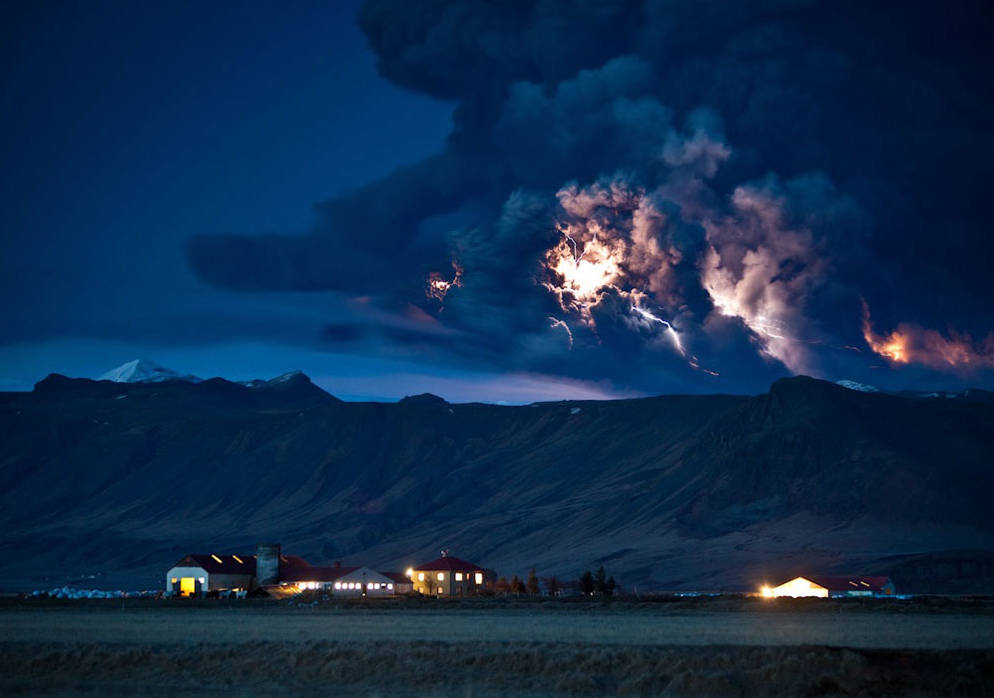
Ragnar Th. Sigurdsson in Iceland (via) - compare with my own shot (from last December)

Above me the full glory of the Northern Lights was spread across the night sky, a magnificent slow-moving dance of green haze. “I think this is a life-changing phenomenon,” I said. “It’s the tipping point in my understanding. When I moved from Australia to Europe I had to accustom myself to a completely unfamiliar sky, strange new patterns of celestial and solar arrangements, but it is only now, now! Here! That I really comprehend the full significance of what it means to stand on the surface of a spherical body moving through space!” There was an uncomfortable pause, then Borja looked up from adjusting his tripod “Man, it just looks like a slow Mac screensaver.”

Thursday, 15 April 2010

master of all i survey


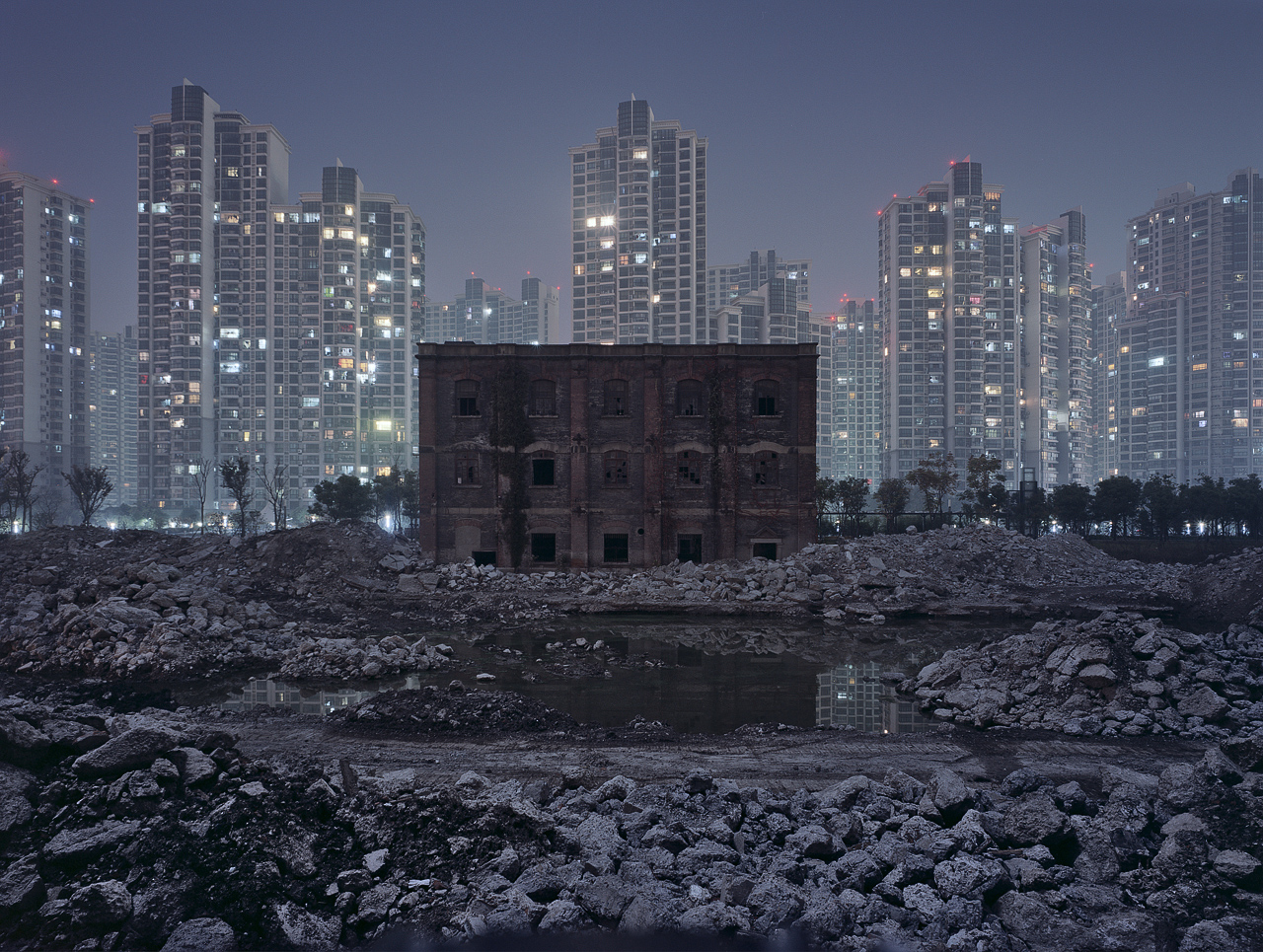
Shanghai, by Harry Kaufman

After the jump is a response to Mark Cousins' recent lecture series entitled 'the neighbour'...

Monday, 29 March 2010

the origins of my short attention span


I got my tea from the bar and shuffled over to the sofa near the window "Oh yeah, I remember Messenger" Bella said, in answer to my question "the thing I really hated about it was how everyone tried to talk to you at once. I could only have one conversation at a time, so I would block all the other contacts I wasn't talking to."

That's funny, I thought. Isn't multiple and simultaneous conversation the whole purpose of using a chat program? It started a train of thought that lead me to one conclusion: the origins of my digital multitasking was Messenger. In the days when my net connection was still only 2kb/s the idea of browsing was an impossibility. In any case, I'm not sure there was anything much to browse. The net was for e-mail and chatrooms... you remember, like, before the peodos got there?

Not only can we no longer concentrate on one thing for any appreciable period of time, but we can neither concentrate on one person – by spreading our attention across multiple discussions we fail to achieve any depth of communication with any of them.

Millennium People out.

Thursday, 25 February 2010

shooting the messenger


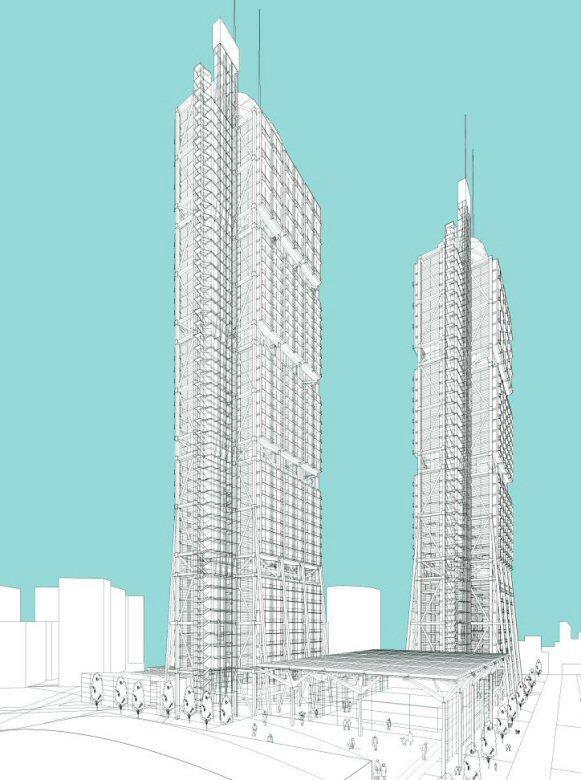
Lea Towers proposal, Stratford: Richard Rogers. Via SkyscraperCity

This short post owes much to a class discussion had this morning with Mark Cousins...

There is a temptation, when gazing up at the monstrosities of contemporary "post-architecture" (in the words of Sinclair), to let blame fall at the feet of the architect. Starting in earnest from perhaps the post-war period onwards, architects have been branded as cack-handed dreamers – belonging to a hopeless profession that is neither pragmatic nor artistic yet claims to be both. Their overpriced megalomanic schemes, fundamentally flawed at even the level of basic services and waterproofing, inflict upon every generation new social problems at ever-increasing scales. And yet it is rarely remarked that it is not architects that choose their site, their scale or their budgets.

Architects, and what is called architecture, is largely defined by the fulcrum of urban-planning and capitalist development. Neither of these forces is any less naive than the architect. Architecture's rise as a saleable commodity can be attributed, at least in part, to the transformation of the patron into the client. The patron, unlike the client, has no fiscal objectives in commissioning a project. In saying this I am perhaps extending my thoughts on Specular Architecture, which is both specular in a visual and iconic sense as well as being founded on financial speculation. Read: Zaha.

The scale of architecture responds to the scale of capital. And since a modern market economy demands constant growth, the scale can only increase. Larger and larger sites, larger and larger sums, larger and larger profits. I'm no apologist, but I think it is quite clear that architects, like any service profession, will rise to the expectations of whoever is footing the bill and giving the orders.

Sunday, 14 February 2010

v-day


I don't believe in Valentine's Day + I'm not single = no hypocrisy on my part.

Saturday, 24 October 2009

würsa


Last year I went to the Palais de Tokyo to see an exhibit. This is what I wrote.

“At a distance of 18,000km from the Earth," the guide notes "the elephant Würsa could balance on her trunk. It is on the basis of learned scientific calculations that Daniel Firman reached this conclusion, and came above all to produce this extraordinary work which confounds all our certainties regarding the gravitation of bodies.”

Wishful thinking at best, sophistry more likely. This phrase implies that the trick of the fibreglass cast on a pole is the logical end of a scientific investigation, it implies inevitability. The passage conjures the image of a diligent artist-scientist investigating gravity. Late into the night he pores over reams of calculations and suddenly, to his immense surprise, finds that the mass of an elephant… but this is a deception.

Fibreglass Würsa (herself not based on a real elephant, but the sum of images of elephants) surrounds a steel pole structure. The art is a trick, but the deception lies in the order of the art and the investigation. The passage implies that the art is inevitable, that it is nothing other than the logical outcome of scientific reasoning. In reality, it is the answer to an arbitrary question ‘how far from the Earth does an elephant have to be to balance on its trunk?’ In which case, why even ask the question? What is the difference between this and simply balancing the elephant on its trunk? Scientific validation to artistic whim. There is mystery and credibility to technology. I find this ‘technological’ approach to modern art flimsy, but ubiquitous. ‘I used technology as a tool to generate meaning and beauty’. This idea of the divinity of technology is false. It is controlled and predictable – the desired answer always dictates the technological question. In fact, this work is far more about ‘confounding all our certainties’ – not by presenting us with the unexpected, but the desired.

We live in an era in which the ease of technical generation (and extension by mechanical production) has rendered most art banal. The power of the virtual is such that we perceive homogenous space as virtual space. The ‘white cube’-style art gallery is the paramount example – it could be anywhere and anytime. The importance of the hidden structure in these places relates to their ability to suspend the laws of gravity, to generate the virtual manifest. Having conceptually idealised space in the virtual, a confusion or frustration results from the shortcomings of reality and our inability to arbitrarily control (consume) objects. The floating elephant, the semblance of a weight impossibly supported, is our desire, as it validates the virtual by manifesting it in the real. It is, of course, immediately recognisable as an illusion, and is therefore no longer such.

The moment of semblance lies only in the first fraction of exposure. Indeed, even this illusion does not whole satisfy our desires, this would involve the actual precession of the virtual, the actual suspension of gravity, the actual elephant actually floating. So we quickly lose interest in this ‘one-liner’. Semblance itself no longer interests us because the semblance of the virtual is perfect. In other words, the precession of the virtual means the real will always be catching up, the real will always be the virtual’s simulacrum.

To this extent, quite a lot of art and architecture concerns itself with ‘effects’. There is, however, one thing that remains meaningless in the virtual and meaningful in the real – violence. Hence the interest of Arcangelo Sassolino’s ‘Afasia 1’, “a sculpture that propels empty beer bottles [into a steel sheet] at more than 600km/h thanks to compressed nitrogen.” The mechanism is randomised, and a good deal of the spectacle lies in the anticipation of the loud bang and the instantaneous vaporisation of the bottle into a fine powder of green glass. But it is really a spectacle, a gratification of destructive desire. Not “physically compressed time… permanent memory, a dangerous equilibrium” but a gratification of the sole refuge of the real, violence, as it retreats from the primacy of the virtual.

Tuesday, 15 September 2009

fistful of links

"Remember the old Simon and Garfunkel song 'slow down, you're moving to fast'? Well that says a lot about life, and about cat massage." Related, 'Glorious Scarves'.

An iron fistful of the weekist links: some news.

CNN asks if there's going to be a 9/11 sequel: I agree, there were just so many plot holes in the first one. Controversial: America the gift shop. Raunchy: Pixxxel (safe for work). Of course, CNN are not the only people who have been making up film titles (Seinfeld). Also film: Creation, a film about Darwin, is not released in the US – supposedly because only 30% of Americans believe in evolution and studios think it will flop. Comments are a laugh.

Pictures of Nouvel's bust... Air France stewardesses like lactating on the great man, but Aer Lingus prefer to simply tell the French they're about to die. Vaguely related, I met one of the guys working on this last year when he passed by Jean's in Paris. I'm not even sure how to respond, to be honest.

A paragraph about social change: watching this video influences public policy, easy as that. Laser graffiti is used to fake a gaol breakout (made funnier because its in Dutch). Homeless man tazered, catches fire– oily skin thought to blame. Man in home oiled, catches fire – portion of Nando's chicken to blame. In the same vein, so to speak: 'fat kid loves bacon.' Related, a man makes some averagely ok art with hamburger grease, but I quite like a plane of strawberries hit by a bird. Bust some space. Related, bust a move: why don't we dress like Grandmaster Flash anymore?

No links, shake a fist. Ramble: I cannot stand women that lecture me on child psychology (for a man with no children, it happens remarkably more frequently than you might think). I really don't care whether a child is incapable of understanding the concept of death before the age of 8 – I'm just going to flat out tell him: Jimmy. Your. Dog. Is. Dead.

Nick Sowers indulges my love for bunkers and all architecture military– to my intense delight (good luck finding the Arrested Development version). An ex-Jockey helps the cops out by running down criminals on horseback. Similar, the amazing Hawaii chair. There are over 50 things that are being killed by the internet, including:

A man recently went through a mid-life crisis, but through quiet negation his wife manages to delude him into accepting his own happiness. What? Effective: one crime solved per 1000 CCTV cameras. Londoners unite: Meta Loca London. Unrelated, Lovefoxxx sells out to Vice, and gets a blog.

Finally, NSFW: after doing a google search for "christian dildo america teenagers" (to settle an argument about statistics, you understand) it lead me to: Christian teens being encouraged to use "saddlebagging" ("unprotected anal sex") as a means to preserve their virginity. Related, I also discovered that Dildo is a bay in Newfoundland, (Canada) just beneath the Spread Eagle, between Chapel Arm and Norman's Cove (map).

Wednesday, 9 September 2009

anti-object #2

Brett SteeleAA head honcho – writes in the introduction to Kuma’s text that he is against “self-centred architecture… deliberately distinct from its surroundings”.
He continues:
“‘My ultimate aim’, [Kuma] writes early on in his book, ‘is to “erase” architecture’. Such an ambition couldn’t be further removed from the majority of a younger generation of digital experiementalists today, pursuing a renewal of formalism not seen within architecture for decades.”
As founder of the AADRL, and therefore one of the driving forces behind the pursuit of neo-formalism, and the advance of digital experimentalism, this comment is not without a certain hypocrisy. The younger generation are largely that way because Steele made them so. I am not making a value judgement about the worth of digital experimentalism (which has obviously been a tremendously important force in the recent history of global architecture), I am simply noting my surprise that Steele would distance himself from a movement he helped create.
+++++

In the first part, Max mostly focussed on the division of subject and object as proposed by Kuma’s text: the possibility of relating the subject to the landscape through the power of the floor plane, and the ability to blur formal boundaries of architecture by the ‘particlisation’ of materials and elements.

Both of these main points relate to Kuma’s definition of an object as being something wilfully separate from the ground plane – a finite figure cut off from the earth (as opposed to the earth itself, which is continuous in all directions and thus infinite). However, this definition also excludes burying a building. The new millennium fad of concealing buildings in the landscape by submerging them, or employing other mechanical modes for hiding their structure, does not actually change the nature of the building's limits (a wall is not less definitive because it is underground).

Max discussed what it isn’t, but what is an architectural object?

“Kuma sees new digital and informational technologies as leading us to an aesthetics of disappearance, rather than image or form” Steele notes. Images and forms are the current architectural stock-in-trade, and Kuma makes the historical reason for this quite clear: communication. At a period in Modernism when only black and white images were being published in grainy magazines, the architects that succeeded in drawing attention (and subsequently more projects) were those who could capture the essential forms of their buildings and diffuse them through B+W photographs (Barcelona Pavilion, Villa Savoye, etc). The legacy of this period is the ubiquity of the ‘metalevel’ image: an imagined point of view that portrays the whole building. This manner of viewing architecture necessarily renders it an object for consideration.

Bruno Taut, according to Kuma, lost out to rival Modernists because he “failed to understand the twentieth-century paradox, that individuals as isolated subjects shunned groups in any form. They were sustained in their mediocrity through the possession of attractive products.” Modern architecture became an 'attractive product' by appealing first to the spirit of domestic rivalry – the Modernist home was an object that could be packaged, sold, and used as a means to escape the mediocrity that was the inevitable result of the era of machine reproduction.

I mention the escape from mediocrity because Kuma lets us know that the architectural object is not, whatever Corbusier might argue, for the people. It is the production of one-of-a-kind jewels, founded on capital. It is the Burj Dubai, the Walt Disney Concert Hall, the Phaeno Science Museum, the Gherkin, and a million other projects – today with no exclusion of function or program.

From the text, I can only conclude this: the architectural object is full of form, but empty of meaning; found in one location, but conceived independently of place; sexy without being in the least bit seductive.

Tuesday, 18 August 2009

under the pavement, the man.


The final destruction in Antonioni's 1969 Zabriskie Point

Even when the bourgeois Chelsea Marina mob set cars alight they return the next day to sweep the streets and right the burnt out husks. The protagonists of Ballard's Millennium People are the solid middle classes: doctors, lawyers, ad men, pilots. Their revolution, or more correctly their revolt, is orderly and well behaved. They are intellectually concerned with the symbolism of their act, but eager to avoid actually hurting anyone.

Ballard, who is arguably the most imaginative writer of the last 50 years, was nonetheless firmly rooted in reality – Will Self noted, “Other writers describe; Ballard anticipates.” So it says a lot about contemporary society that Ballard chose to describe revolution and reform in our own time as being limited by the self-imposed social order of the middle class. It was perhaps the most he could hope for…

So what happened? What happened to the riots, the demonstrations, the manifestations of the 60’s and 70’s? What happened to the spirit of ’68, or the civil rights movements? Were they real, did people feel that way, or is it only fabricated nostalgia? How did it all get so bad that the best hope for social reform became a fictional tale about a moderate and localised Chelsea hiccup?

My generation had anti-war marches too; I took part in them. A million Australians (1/20th of the country) walked across the Sydney Harbour Bridge. In London, New York, Paris and other global capitals people (I hesitate to say the people) had similar responses. Their effect was less than negligible, and no further evidence of the fact that democracy has failed us is necessary.

My teenage years neatly coincided with the Decade of Terror. The culture of fear, the untrustworthiness of the government, the duplicity, the unbridled economic growth, all came together to produce in this teenager an intense sense of outrage. Not a moral outrage, and not directed at any agent in particular, but at society as a whole. Typique.

Over time the outrage cooled to become disappointment, as I realised that it was my parent’s generation that had conscientiously crafted the world of helicopter parents and bubble-wrapped children. The dissidents that smoked dope to Pink Floyd got jobs, made money, had families, gentrified. They donned the shoulder-pad suits of the 80’s and became the Man.

I don’t want you to think this blog is deteriorating into a series of sporadic film reviews, nor that it is touting some idealist line. As I said in my first post: ‘I am not interested in architecture as an activity of object-making. I am completely fascinated by architecture as a legitimate tool of social change.’

In this case, it is the architecture of the film Zebraskie Point. The Breathless of its time, it recounts the futile struggle of youth against social processes that are beyond their influence. Whether you view it as a trip down memory lane or as an access into a bygone era, the film does well to capture something of the eclectic spirit of the late 60’s.

The conclusion to the film is probably the most beautiful sequence of celuloid I have ever seen. Sometimes, when the frustration with other people becomes too much, we all secretly dream of mass-destruction, of wiping the slate clean and starting again...

Monday, 17 August 2009

re-burbia


The future of the suburbs: a desert cult of cars.

Sometimes you don't quite get round to doing something, and afterwards you really wish you had. Now that the finalists are up for the Re-Burbia competition (to propose the future of the apparently futureless suburbs), I feel a lot less insecure about my own proposal, which I did not submit because I decided to go on holiday instead.

"It was the urban regeneration schemes of the mid-21st century that spelled the beginning of the end for the concept of the suburbs. Re-zoning into ultra low-density rural and hi-density metropolitan effectively polarised the state, and the suburb as an architype was neither profitable (from an agricultural standpoint), nor sufficiently flexible to keep up with rapidly changing trends in social, and technological organisation. Of course, there was no mass-exodus, no overnight evacuation, no one abandoned their homes (although several economic waves of foreclosures certainly aided departures), only a gradual waning of the suburbs' political and social significance over several generations.

At first, it was simply a question of not having the power. Global production of power dipped significantly, and the cities were prioritised. The countryside had been self-sufficient for decades, leaving the suburbs to suffer. Community groups lobbied for aid, but within a few years the fringes of most cities were managed on a lottery system, determining which streets would be without electricity and for what periods. The rich grouped together to fund their own power plants, implementing elaborate security measures to keep the once-bourgeois proletariat from their stations. Eventually, the wealth of a suburb could be measured simply by counting the bulbs at dusk.

The next crisis was water: it became evident to the cities that the suburbs were occupying too much of the water catchments. Wholesale, but strategic, clearing of houses began with a view to raising the water tables, and reducing the amount of run-off disappearing into the sea. Salvageable materials were stockpiled, but most was left to rot. Urban centres that were not sufficiently dense were re-classified as suburbs – resulting in massive re-settlement plans. Riots broke out amongst those who refused to leave, the peasant children of businessmen quibbling for access to artesian wells.

Sometimes whole cities would burn, with no water or willing manpower to extinguish them. The descendents of these vast suburban landscapes took refuge in the sole infrastructure that endured: the highways. Long since emptied of cars, the mighty roads nonetheless provided order and communication. The suburban refugees restructured themselves into linear societies. Forms that had been designed for speed, efficiency, circulation, now took on other meanings: defence, visibility, advantage. A neo-medieval architecture suggested itself, in the wonderful patterns of a turnpike, or the graceful rise of an on-ramp."

Thursday, 13 August 2009

casios and bombs


Detonation of seized weapons in Afghanistan, via militaryvideos.net – by the troops, for the troops...


Last night I went to the Dalston Superstore for a Diesel U:Music party (my brother is a sometimes radio presenter there). I got talking to this one girl, about the relative efficiency of various makes of timepiece (fascinating) and she said "you ought to get a Casio, like me". I looked at the watch and had a sudden flash of recollection.

"When I was 15, they invaded Afghanistan" I said "and of course I watched it live on TV. About a week into the war I remember seeing a heap of dead bodies – the first enemy victims of the invasion. At the bottom of the pile was an arm and a hand sticking out, and the camera zoomed in on his watch – the same Casio you've got there – and I thought, how poignant" I paused for dramatic effect "how poignant that this watch keeps on ticking, probably for years, long after the man that owned it has ceased to be."

I got a bemused, if somewhat cold, stare. I needed to turn this one around, and fast.

"So what I'm saying is, they're pretty reliable, and if you get American's all up in your business, invading and shit, well... you know what time it is."

A chuckle. Saved. Barely. Still, funny the things that obviously mark you but lie dormant, a silent bank of influence.

Wednesday, 12 August 2009

non-immediacy


The star-forming region LH 95 in the Large Magellanic Cloud, via Hubble (also, hi-res 2mb)

No one really supposed that light had speed, but we now know it takes 8 minutes to reach us from the sun, and two and a half years from the nearest star. When we look up at the stars we are seeing a live show taking place 30,000 years ago. An aggregate of non-simultaneous and only partially overlapping events. Change is normal. The physical universe is forever changing.
This is Buckminster Fuller talking about Einstein's theories, from a video playing at the Barbican's new one (I'll write again on the exhibit itself). The video is called "Modeling Universe", and its a 1976 doco on Buckminster Fuller, by Jamie Snyder. The reason I labouriously copied down this passage was because of that one line : an aggregate of non-simultaneous and only partially overlapping events.

Baudrillard writes a lot about our obsession with real time, our desire for information to be instantaneous. He says there is no point in trying to identify the world as it happens, because it is already out of date and distorted (through the lag of the eye to brain, or some other instrument of perception like a mirror). He says, in the Perfect Crime:

Thus all things offer themselves up without a hope of being anything other than illusions of themselves. Fortunately, nothing appears to us in real time, any more than do the stars in the night sky. If the speed of light were infinite, all the stars would be there simultaneously and the celestial vault would be an unbearable incandescence. Fortunately, nothing takes place in real time. Otherwise we would be subjected, where information is concerned, to the light of all events, and the present would be an unbearable incandescence. Fortunately, we live on the basis of a vital illusion, on the basis of an absence, an unreality, a non-immediacy of things.
Of course, if you suggest that there is a value to temporal setback you may as well tattoo the term Luddite to your forehead and be done with it. It seems a commonplace in contemporary architecture to try to portray the temporary, the fluid and flux – to design an architecture that is maleable and adaptable. But isn't that really a cop-out, a sidestep of the issue. By refusing to impose will into the formal (or other) structure of a project, and claiming that it will define itself, the architect avoids the responsibility to produce a formal response to a given situation.

An aggregate of non-simultaneous and only partially overlapping events... What would an architecture be like that, rather than responding quickly to the ephemeral conditions of the present, attempted to (re)present the past (as a statement that the present is only the temporal offset of history): a modern stadium designed to host gladiatorial battles, a condo highrise with stables and slaves? Given how long it actually takes to construct a building, what is the maximum acceptable offset (no one, after all, complains about Sagrada Familia being out of date)?

Well. Gees, let's lighten things up a bit with a Roman joke (via Mary Beard, who is the authority on all ancient humour): A man meets a friend of his in the street and says "that's funny, I was told you were dead". The friend replies "well, you can see perfectly that I am still alive". The first man furrows his brow and says "I have to dispute that, the man who told me you were dead is much more reliable than you." Its not that bad really, when you consider that I (like many) don't get Punch at all, and that it was conceived by a whole different kind of Millennium People.

I promise tomorrow's post will be less cerebral.

Wednesday, 22 July 2009

lebbeus woods

Sleep-deprived, I had a bit of a rant about a Steven Holl project over at Lebbeus Woods' blog, and to my surprise Lebbeus posted it- thanks Lebbeus.