Showing posts with label AA. Show all posts

Tuesday, 18 May 2010

the end of the world


Just a quick notification: the Architecture Association's Intermediate Seven unit, run by Kate Davies and Liam Young, and titled 'The end of the world, and other bedtime stories' has just released its first publication for this academic year (a second is forthcoming). It's not expensive and is available from the AA Bookstore. If you want to keep your fingers on the pulse, this is one to watch. Also good for aspiring anarchists, the millennial avant-garde, and anyone looking to buy a gift for the man that has it all...


This year the unit went to Iceland to study the end of the world. If you missed Millennium People's coverage, it was intense and ace.

Tuesday, 23 February 2010

iain sinclair on nostalgia & forgetting


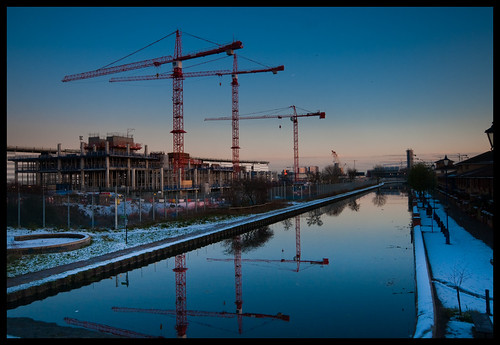
Olympic Park Cranes – Hackney, by Sam Cadby.

“Architect’s are very interesting because they’re on the brink of obsolescence…”

So saying, Iain Sinclair – psychogeographer, author, and self-nominated figure for the perpetuation of East London’s history – grouped architects with similarly defunct notions like ‘the spirit of place’, industry, integrity, common sense, community, etc, etc, etc. In short, everything that was once good and noble and is now rotten to its core. Boo, hiss, down with the modern world.

While I think the man is right about architects (I will elaborate presently), I am suspicious of anyone who would dissimulate a wild nostalgia (in which he seems veritably marinated) as a “fear of forgetting”. Certainly there is a fine line between wishing to engage meaningfully with the past and simply invoking history as a means to bombast an audience about the piteous state of the present. For me, this really distinguishes him from the other great psychogeographical author of our time, Will Self. Unlike Sinclair, Self is no moral pedagogue…

Sinclair’s subject was East London, its history, its architecture – a rose-tinted people fighting the good fight against the idiot developers and villainous politicians. In black and white terms he outlined the clear superiority of the city “as a human entity, as an organic entity” over the “post-architecture” imposed on the East by the coming Olympic-scale fuck-up. While I found his tone vaguely self-righteous, I nonetheless found his content interesting and his arguments extremely convincing (in several cases indisputable).

Readers from outside of London may not be aware of the Olympic situation, in a nutshell: the site is a vast tract of ex heavy-industrial land falling between Stratford and Hackney Wick (think fairly far east), towards the lower end of the Lea Valley (a rambling and beautiful wildlife park composed of marshes and canals). As Sinclair noted, it has always been thought of as an ‘edge’ of London – and it is psychologically disturbing to now realise that Stratford’s development will turn the nature reserve into an island, besieged by an ocean of urban nightmare.

The site beforehand, subject of the pamphlet referred to in this post on Cedric Price, was littered with industrial ruins, leftovers from a time when London still manufactured on any appreciable scale. What I did not know is that over 12,000t of radioactive material has been retrieved and re-buried at the site (evidence of a business that made glow-in-the-dark watch dials during the 60’s).

Like all Olympic games there has been scandal: £40million of “missing” funds, cost (and corner) cutting measures abound– the UK is in full recession mode after all. And yet the ridiculous promise of the developers is that they are attempting to give back a park to the public realm. This debased simulation of the wild beauty that existed before is indicative of modern ‘regeneration’ methods (e.g. an artistic drinking-hole is demolished to make way for an art-themed hotel, as at Old Street).
It would be hard to overstate either the incompetence of the architects or the stupidity of the clients involved in this venture. I’m not even going to touch that sensitive subject in this post, but simply let history validate my words. Sinclair could not find words to describe the process by which the client approaches an architect in the same way they would a hairdresser or a plastic surgeon, saying, “yeah, I like it, but I want a bit more of a curve over here – hey presto!”

Two final points, I had intended to write a short post, but the subject really fires me up:

was recently told that a town hall in Stratford was demolished in order to make way for a Tesco’s supermarket. I am now shocked to discover from Sinclair that there is a plan to extend the site to include apartments – residential zoning as an appendage to commerce: the possibility of perpetually living inside a mall. What then, mused Sinclair, is to stop all of Hackney from becoming an inner suburb of a supermarket?

the architect, that figure in decline, no longer has any control over the built environment, then what is his domain? This observation is not at all unique to Sinclair, and it is obvious that the profession is approaching a critical turning point. I would argue what we have to salvage is an architectural mode of thinking, a way of looking laterally at problems (the solutions to which often do not include buildings). The role of this coming generation of architects is to convincingly establish their dominance as the only and supreme profession of holistic thinkers… or else face professional extinction.

Saturday, 6 February 2010

the state of the union, by peter eisenman


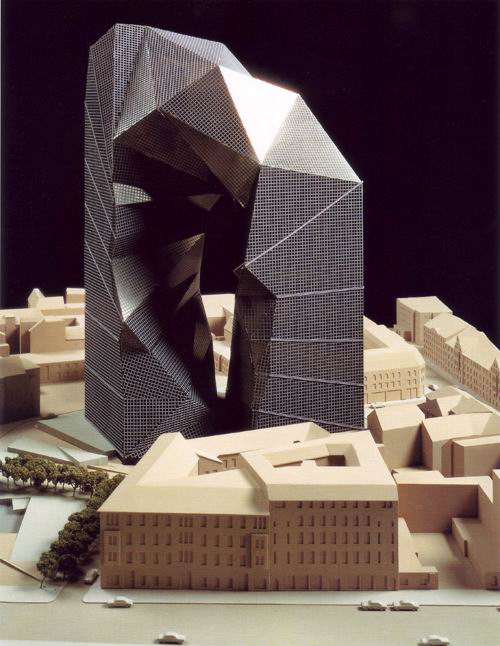
Galicia City of Culture model, Eisenman Architects.
“When I was a boy I used to buy my clothes at Brooks Brothers on Madison Avenue. Not especially because it was Brooks Brothers, but because if you wanted the best clothes in New York, everyone knew they were to be found on Madison. But the genius loci of Madison Avenue has been destroyed: I can now buy Brooks Brothers in any place, in Newark Airport, in Macau, and so on…”
Eisenman, who spoke at the AA on Friday, made a convincing argument for the non-existence of place, or as he put it “the dissolution of the Hegelian dialectic of Zeitgeist versus Genius Loci” through the destruction of the latter by capital. And in this sense he essentially prolonged the arguments of Fukuyama’s Death of History (and to a lesser extent also those of Derrida).

The absolute dominance of capital as the driving force of contemporary global society is indisputable, and it has been the case for some decades. Saarinen’s TWA building at Newark (a magnificent structure even today) has been abandoned for no other reason than that it fails to serve capital any longer. A more contemporary example would be that of Dubai.

In Rem Koolhaas’ Junkspace he tells us explicitly what capital inevitably produces: ubiquitous, atopical detritus.

+++
Eisenman recently won a competition in Milan, and the client came and asked him for a 40-storey building. The size of the site did not necessitate it, nor the context of the city lend itself to such a proposal. “Does the desire for a tower stem from theories of living?” he asked, and the client replied, “No, we want to make a statement.”

There can be no spirit of place to a 40-storey tower, or a 100,000m2 mall, because the scale upon which the building is founded is not that of architecture, but that of global capital. This demand requires larger and larger projects from larger and larger firms, with a necessary homogenisation of planning and degradation of detail quality. Additionally, we do not have a grammar to describe this contemporary situation: what is the grammar of a 40-storey tower?

Eisenman paused. “At what point do you refuse? Have I sold out? Is this the end of Eisenman as an architect? I don’t know…” In any case, the result will be a shed with signage, where the signage is the word ‘Eisenman’.
This degradation leads to an architecture that abandons space and concerns itself only with surface (he gave Zaha in the front row a pointed look).

+++
When Denise Scott Brown and Robert Venturi flew to Las Vegas in 1968 they classified the architecture they found into two categories: the ‘decorated shed’ (a block volume with elaborate signage) and the ‘duck’ (a building whose form resembles its economic purpose, as in the giant duck that sells ducks). The two terms subsequently became widely accepted metaphors to broadly describe the approach of contemporary architectural projects.

“If you were a young Scott Brown or Venturi today where would you go to re-enact ‘Lessons from Las Vegas’? You couldn’t go anywhere, because Las Vegas is everywhere – it is New York, it is Milan, it is Singapore, and we have to ask ourselves… Is this where we want the world to go?”

Rem argued that, since Junkspace was unavoidable, better to embrace it. As a consequence his more recent projects (CCTV, Seattle, Casa de Musica) are really nothing more than ducks, albeit somewhat decorated-ducks. Although, and Eisenman didn’t mention this, it could be said these were conscious decisions on Rem’s part, foreshadowed in S,M,L,XL.

Ultimately the main problem with the dominance of capital in architecture remains the question of scale. Architects trained in the design of domestic-scale buildings struggle to imagine the scale of modern capital.

For Eisenman’s City of Culture in Galicia he was asked to design not one building, but six: “how can an architect conceive of 6 buildings simultaneously?” He mentioned a man he knows building a city in China for three million and he wondered how such a thing could be possible.

+++
The other day Gehry was around Eisenman’s place trying to hawk his Catia program, saying how a program designed to realise architecture was indispensible for a practise like Eisenman’s. This set Peter on a rant: the younger generation behave like computers – they have lost the capacity to develop creative response, and instead limit themselves by the programs they use, like rhino, or maya, or max. These programs are not designed to describe space and time, but for film animation, or for other media, or whatever. He calls this thinking the “Parametric disease”, which is spreading, and whose origin is found under the thumb of capital… At one student crit recently a young woman had produced a script to generate a certain type of building, and Eisenman asked her which one she was going to choose. She responded “but choice is no longer the issue, any one will do!”

+++
Peter’s comments about the spirit of our age, and particularly the prolongation of Hegelian history, seemed too good not to pick out and roll into Millennium People’s second post on the Digital Dialectic, scheduled for the 10th Feb. Be sure to check back on us then…


Cultural City at Galicia, under construction.

Friday, 5 February 2010

supercritical #2

AA Words series 1-4.

I don't want readers thinking I'm being overly supercritical – even though the meeting between Rem and Peter (see below) was a poor excuse for a conversation, this is neither indicative of Supercritical as a volume or the AA Words as a series. Millennium People reviewed Anti-Object (the second book in the series) September last year, and thoroughly enjoyed it (featuring two guest reviews by M. Rosin-Melser – late of ETH, recently returned to Sydney). In a sense, the failure of Koolhaas and Eisenman to establish a dialogue is practically inevitable given the intensely complicated history of these two figures. This is all by-the-bye, and I am no apologist.

The series aims to "deflect" the force of an architectural culture dominated by the endless production and consumption of images by means of "direct language, concise editing and beautiful, legible graphic design". As a concept it works – as much for its visual appearance as its content. I suspect (and in several cases this suspicion has been confirmed) that quite a lot of the students I've seen buying the Words series do so initially for the Underground typo and bold primary colours, only to find that the text is pretty alright too.

That said, in response to Brett Steele's claim that it's "really a magazine in disguise", its really only issue one, Supercritical, that feels like a miniature magazine, and I think this is due to the diversity of its content, even if it does largely revolve around Rem and Peter. Apart from the disastrous dispute there is a great discussion between Robert Somol and Jeffrey Kipnis, moderated by Mark Cousins, (the highlight of which is when the two critics impersonate Koolhaas and Eisenman and have the "conversation they might have had if they had been honest with each other"), a really interesting discussion between Alvin Boyarksy and Peter from 1975 (broadcast on AA radio, which, though fascinating, shows that Peter was just as difficult back then as today), a 1976 interview between Koolhaas and Peter Cook, and a 100 point document by Brett Steele analysing the nature of Peter and Rem's work, rise and success, writing, as individual entities and in comparison to each other.

The result of these varied chapters is to present a snapshot of the two architects not just at one moment (one discussion, one night) but over time. The nature of the starchitect is to have their popularity reinforced by the present – this method of displaying a timeline of vignettes goes a long way to removing something of the aura of the two men and presenting them in a more critical light. What becomes very evident from the 'miniature magazine' is that Koolhaas and Eisenman are only human after all...

I highly recommend the series.

Wednesday, 3 February 2010

supercritical #1

“I wouldn’t want you to cry for having had to come here tonight for this conversation, because nobody dragged you here.”
Peter Eisenman to Rem Koolhaas.

So ends Supercritical, a little volume that documents the rare meeting of two architect friends/enemies/rivals/(whatever) – Rem Koolhaas & Peter Eisenman. It accurately transcribes the two’s complete inability to say anything meaningful to each other, and their ultimate decline into dressed-up name-calling. This spectacular failure on the part of their dialogue has forced me to split this review into two posts: one on the discussion itself, and one on the novel medium through which this piece presents itself (“its really a magazine in disguise” says Brett Steele).

While I was really disappointed by Eisenman, I don’t want you to think that Koolhaas – who preaches a type of internationally-informed, nationally-dictated, culturally-sensitive, global-metropolitan architecture – is any less narcissistic or arrogant.

Eisenman constantly compares himself to Koolhaas, at times absurdly, almost farcically so: he compares Delirious New York to his own 1963 thesis The Formal Basis of Modern Architecture; S,M,L,XL to his forthcoming Eisenmanual. Then he spins off into reflecting on this discussion as comparable to Corbu meeting Mies. Rem’s response is blunt: there is no comparison to be made, the terms are not exchangeable.

Further, Koolhaas is not interested in discussions of semiotics or form, and does not engage in the tallying up of personal achievements. Eisenman compares his Max Reinhardt Haus to the CCTV on formal grounds, and Rem interjects: “For us [OMA] the diagram is no longer only a device that triggers architecture [that is, it is no longer simply intellectual]. It is also a device with which to look at the world and to try to represent some of the bizarre conditions we observe.”

Left: CCTV by OMA (Rem Koolhaas); Right: Max Reinhardt Haus (Eisenman Architects).


Koolhaas defends CCTV not formally, but programmatically. The importance of the building, he says, is not its iconic form, but its role as informing a new era of Chinese media communications. “We’re interested in people… not in an intellectual, humanist or architectural sense… but simply how they exist in flows and behaviours of global culture today.”

The contradictions run thick and fast: “Peter is arguing for an optical, thinking individual–” “no, I am against opticality.”… “Peter you just said you see yourself withdrawing from things like magazines and journals to focus on buildings?” “No, no, no. Let me make sure that we get this straight…”

The discussion ends with Eisenman saying he conceives of every building as a one-off, unlike Richard Meier, who has a signature, reproducible and intellectually vacuous style. “We’re dummies, you and I” says Rem, and asks Peter not to intellectually belittle Meier. He reminds him that they met for the first time at one of Meier’s lectures, and that Peter’s dismissal of Meier makes him want to cry… “every time Meier gave a lecture at that time he came to Peter’s office beforehand so that Peter could basically prepare the lecture and write the script for him. And the reason Peter was angry with me was that I was attacking the script, not the dumbness of Meier.”

Friday, 22 January 2010

if these walls could talk


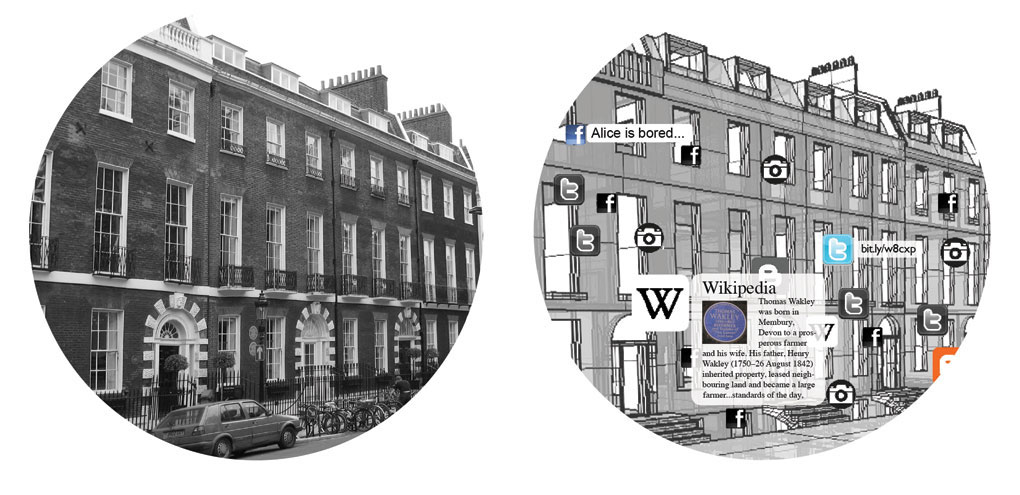
The real Architecture Association on the left, and the perceived digital AA on the right... via Flikr.

When the richness of a place, its history and aura are better captured in the imaginary spaces of a virtual city, what good is the building itself? When my home network password is more important than my front door key, when my door has become nothing more than an icon and an option list… Why not knock it all down? Why not remove the physical obstacle that prevents us from seeing the building?

Monday, 9 November 2009

toyo ito talks it over


When I got home to Battersea the fog had completely permeated the suburb, leaving nothing but the orange halos of streetlights and massive neon 'Tescos' sign to guide my navigation. I shudder to think what it was like when this was all still swampland. That's right, I shudder.
+++
I spent the evening at the Architectural Association, listening to a talk by Toyo Ito entitled 'my first and most recent works'. This was a confusing title, because his first works seemed to encompass 1964 to 2002, and his recent works 2006 to 2009. I can't remember what he did in 2003,4 & 5, but he must regret it. He arrived, and bowed to everyone, and then just launched into an explanation of his beginnings in Japanese, with translator: the end of the 60's/early 70's, when rapid technological advances clashed with student political ideologies. He worked on Tange's Olympic Stadium, and Kikutake's Expo 70 Tower. Ito took inspiration from the Metabolists, particularly the Nakagin Capsule Tower, but also from less influential architects like Shinohara. He described Japan as being divided between Metabolism and another school that focused on minimalism, interiority and isolated space. This, he said, led to the current Japanese architectural trend of closed boxes [What We Do Is Secret] .

In 1971 he wanted to go back to university, but because of the revolts all universities were closed. So he was forced to open his own practise. His explained his first work, the Aluminium House, [unusually I can't find any good images of this building] as being founded around two Nagakin capsules that had fallen to the earth. This grounding, for him, signified the end of Metabolism, but also a new beginning. He purposely chose aluminium for its disposable connotations, as opposed to the solid durability of the Metabolist modules.

After his famous White-U building, where he had tried to create a completely isolated and socially disconnected space, he tried to re-engage with society and community through a Dom-ino mass produced housing system. They only sold one, which went to Sejima's parents. Towards the mid-eighties he tried to revisit some questions of traditional ephemerality in modern Japanese architecture. The Japanese house, he said, is like an empty stage [Kuma]. It only remains to bring in the furniture, which will immediately imply certain relationships – relationships brought to life through rituals.

He touched briefly on the 90's, ending with the Serpentine and Brugge pavilions, before brushing over completely the Sendai Mediatheque and concentrating on his Tama Art University Library. "I try to avoid becoming reliant on high quality finishes, because if you become too used to Japanese quality, you find it very hard to build elsewhere." In this building, through the furniture and the shelving, he tried to explore what the positions of the body associated with learning might be. What is the physicality of education?

Several questions were asked after the lecture: first Jencks rambled for a bit, really boring everyone with a long winded discourse, and finally with no question. If he hadn't been Charles Jencks I'd have reminded him whose lecture it was. Brett Steele asked a good one: Ito mentioned that he wanted to reject traditional symbolism in architecture, but, since his Dom-ino system he had in fact been rejecting some of the most fundamental elements of architecture: the column and the grid. None of his buildings after the Dom-ino possessed columns at all, nor a regular grid. Was this purposeful? Ito smiled and said, in broken English, "this is a subject of current research."

I asked "You mentioned several times the fact that this lecture is mostly translated, how would you say the language, or vocabulary, of Japanese space influenced your work?" He paused. At length, he said "Language is about an ambiguity, and there can often be a contradiction of expectations in translation. I find this metaphor useful: you go to the water temple, the surface is of still water. You pick up stones of different sizes, and you throw them. Each one creates different ripples. The meaning of the shape comes not from any single pattern of ripples, but through the collection and association of the sum. This is the Japanese language."

One other student asked "how do you conceive of ephemerality in your buildings?" Ito responded "The notion of ephemerality may not lie in the structure itself, but in its occupation, as at Sendai..." He spoke in English "But, generally, I should wish any architecture to not rest too long."

Certified Millennium Person.

Thursday, 15 October 2009

sir ken adam


Sketch for Submarine Lair in the classic Bond 'The Spy Who Loved Me'.

On Tuesday night I was at the AA, just hanging around the bar, minding my own business, when I heard that Sir Ken Adam was going to give an interview downstairs. I was incredibly excited. If you're not aware of who he is, I will just say this: every James Bond set, gadget and gimmick – from machine gun headlights to volcano lairs– were his idea. As were the sets of Dr. Strangelove, much of Star Wars, Hornblower, Around the World in 80 Days, Chitty Chitty Bang Bang and he also consulted (apparently in a fairly involved manner) for 2001: a space odyssey (although he said that after Dr. Stangelove he didn't get on so well with Kubrick).

Further, he was the only German national to fight for the RAF during the Second War, and helped to provide air cover for the D-Day invasions: "Zthey said 'you juzt fly down zther, and fiare all your rockits' and I zthought 'that zounds simple' but... it vwas.... a lot more complicated than that."


Sketch for Dr. Strangelove's War Room (dir: Kubrick).

For the most part he reiterated the things I have heard him say elsewhere, which is why I won't be reiterating them here: go elsewhere. I'm just going to touch on one or two things that stood out. At one point he showed a slide of a drawing, and said "I had no idea who could have been doing a glass tower block like this one in 1928 in Berlin for my father's sports shop. And then, of course, I discovered it was a Mies. It was one of his forgotten projects. Even Moma didn't know about it." Needless to say a million architects reached for their pens. His photograph is not online, but the project is briefly described here.

He also postulated that the reason American Modernism was so strong and English Modernism so weak was because all the German exiles emigrated to the States – before the War the English had not taken a fancy to Modernism, and found it even unattractive as a style. He refered to 'Highpoint' in Highgate in particular. When he studied architecture at the Bartlett in 1936, he said, they were still teaching him to use Georgian and Edwardian styles. 1936. Shame. He wondered what would have happened if the English had embraced Modernity, instead of encouraging all the German Modernists to move further West.

The final point I'm going to write up is one he made about the Flowmaster pen. It was the first pen to have a felt nib and a transluscent replaceable bulb. Not only, he said, did it change the way he drew (up until that time only charcoal had provided him with the fluidity he desired) but it changed the way he designed. Later on he said, in reference to a modern render that had been done from one of his drawings, "I can tell, you kno, if a design hasz bin started by haand or as a computer architecture." He didn't express a preference, but I think the lesson is obvious: we are both limited, and afforded capabilities, with each new technology.

In the case of digital technology, the question must always be asked: are you designing that way because you can (that is, arbitrarily, because the technology allows for it)? Or, if given a blank piece of paper, or a charcoal stick, would you be trying to describe similar forms? What I really mean is, do you design digital architecture because you have digital means, or is the digital a design ideal in itself, unique from technology?

Roll that one over, Millennium People.

Tuesday, 13 October 2009

fistful of links


Ballard's Drowned World as bankers' swimming pool, via Transatlantis.

Slicing it up and dishing it out – the 'net, just like yo'mama used to make: some news.

We are living in times of universal bru-hah-ha: Obama has been politically castrated by the Nobel peace prize, and them old sea-levels just don't seem to be getting any lower. We're also running out of oil much faster than we thought (last two via Liam Young). But anyway, who can concentrate on the fact we've discovered the missing link, when we're going the way of the mammoth?

Jesus certainly can't save us, he can't even stop His signs getting nicked. And the only known immortal animal isn't giving up its secrets either. On the upside, when the apocalypse does come those of us living in sin will be able to get past Peter by faking our own virginity. Related, I'm not sure how this is going to work out for lesbians, who can't even fool the army. Also related, I wonder whether the fake blood in the virginity pack will work in the blood-powered lamp? Not related, worm sick could be the answer to underwater glue (I naively didn't even realise it was a question).

We're bombing the moon, in case you hadn't heard. Related, turns out playing God is a lot like an insect version of Gran Turismo. Also related, perhaps these radio-controlled insects will live in miniature homes carved out of IBMs. Not related, the geography of unemployment. Kind of related, Ford are doing their bit for our children's future. Tangentially related, the 'photography' of Levi van Veluw (I know how he did that). Gratuitously related, bunker Shots. Also in the world, a book cover design based on Dazzle, a really interesting form of camouflage. There's an AA studio devoted to it this year. Related, Themepark Heterotopia (there's another studio being run on that). Not related, I tracked down Stewart from Time Team – who is employed as a 'landscape investigator', though everyone else calls him the 'lumps and bumps man'. I think I would quite like to be a landscape investigator.

Finally, the sexist (or sexiest?) PUMA Index, via Sociological Images:

Monday, 12 October 2009

inter seven

To prevent Millennium People from being press-ganged into becoming a mouthpiece for my AA work (MP has a goal which is similar, but separate) I have started a new blog called Inter Seven. While at the moment it only represents my own feeble forays into the confusing world of contemporary architecture, I hope, over time, to reinforce its status with the work of my peers, and possibly professors.


Otherwise, this Millennium People directional hiatus is well and truly over – to prove it, here's what the week holds:
  • Tuesday has a fresh new fistful of links, including directions to a company that specialises in faking your own virginity.
  • Wednesday asks what would happen if you started un-burying some of the underground rivers in London.
  • Thursday recounts Tuesdays' Sir Ken Adam lecture.
  • Friday takes war into the air.
  • Saturday turns to the Turner exhibit at the Tate.
  • Sunday finds MP once again in space.


Thursday, 1 October 2009

post: apocalyptic futures


'Mike', 1952, via zvis.

I was recently interviewed for a "cult", and, to my surprise and delight, I was accepted. They call themselves Intermediate 7, and they are one of the 13 units being run as part of the second and third year design studios at the AA school of architecture, here in London. Inter 7's other title is: The End of the World and Other Bedtime Stories, and the focus for the year-long studio is visions of the future, post-apocalyptic societies, etc. Think ballardian fiction, sci-fi flicks. Their modus operandi is to slip in and out of the real and imagined, to produce falsified verity (by means of media or objects). For me this seems like a great excuse to re-watch old favourites like Forbidden Planet (hopefully more on that one day, I've got a killer angle on the plot), re-read the Red Mars trilogy, the War in the Air, and so on. This will all hinge around a unit trip to study emerging environmental and political tensions in Greenland (supposedly in November, although what we are likely to see in the unending night of the Arctic winter, I'm not sure).

But I also see this studio as an opportunity to sit ourselves down, take stock of our bearings and have some deep-and-meaningfuls about not just the future (and post-future) but also the present. I believe we will use our visions of the end of the world to perhaps give some shape to the embryonic Zeitgeist of this new decade, as we all become truly New Millennium People. This is a rather happy coincidence given the rubric of this blog, of which I need hardly remind the regular reader (if you're not one now, carpe diem is all I can say).

As an outburst of over-excitement and puerile anticipation of the day the real work begins, I thought I would make the bulk of this post a summary of my initial reflections on the 'Apocalypse'.

My first instinct is to examine a problem through its etymology A problem well articulated is a problem solved, as I believe Einstein once said (quiet nod to A.Verge, M.Tawa and S.Fung). The etymology of Apocalypse comes from 'kaluptein' which means 'to cover'. Apocalypse is therefore the act of 'uncovering'. In the medieval sense, this referred to the coming of JC and the era of Zion (see Revelations).

This set me thinking about a Heidegger paper about the origins of the word 'light' (amongst other things). He talks about heavy, then light, lightness, illumination (bringing oneself to light) and finally the word 'leathe'. This means 'to conceal, to cover' and its opposite 'aleathea' is the Greek word for 'truth'. Truth is an act of 'unconcealment'. The Apocalypse is an act of 'uncovering'. The Apocalypse is an act of truth.

And since it lies beyond the imagination ('ability to be depicted') of the present day, it is also an evidence (evidentia = ex + videre, or "out of sight"). The Apocalypse is evident, and its prediction is an act of previewing. It is to search for patterns in history, to define the present, to project into the future. 'Post-Apocalyptic' accordingly means 'after the unconcealment' – and could refer to either utopic or distopic situations. It could of course refer to neither, and simply mean 'the era following the unforeseen truth'.

So the core of the Apocalypse is not to fabricate or falsify the future, but to reveal, to expose and uncover... the truth, or a truth. This definition hinges on, and leaves open, the dimension of time. The Apocalypse is not a single occurrence (28 Days Later; The Day After Tomorrow; Deep Impact, etc) but can be any period of time necessary to unconceal a truth: the demise of the Roman Empire; the collapse of the Soviet Union; the end of petrol; the decline of the offline...

My goal for the studio-cult is, in no naive terms, to gestate an Apocalyptic truth.

Friday, 25 September 2009

back to basics


The retrospective epochal terminator, an MP orginal (more or less).

Millennium People. It is as it sounds: a blog for the People of the New Millennium.

But I thought I would just recap, for those latecomers at the back, and reiterate what MP is really all about: the uncertainty of the current architectural (and epochal) situation. Zaha's on the out, Dubai is quickly becoming a sandblasted stillborn, and I can faintly hear Ballard's Chelsea housewives murmuring into their martinis "someone really ought to do something".

Its a bad situation. Architects and theorists everywhere, lets take a moment to prop ourselves up on our unemployed elbows and take stock of the situation: the sub-prime crisis has come, and the boom has gone. Like so many Rip Van Winkels we naively now awake to the fact that China, the Gulf, and the endless stream of dubious commercial constructions we merrily knocked up, were morally moribund white elephants (or ivory towers).

Worse, the favourite pastime of so many students and young professionals – I am referring to digital formalism – has been murdered in its bed. No longer is there any hope that it will one day dominate the world of architectural construction, it has been relegated to nothing more than a stylistic dead end, like those typical of the beginning of last century (art nouveau, etc). On the upside, at least now when I speak out against meaningless form-finding I don't sound like a Luddite.

How are we rallying ourselves? MP is seeing two general trends in architectural thought emerge: the retrospective and the reactionary (I am simplifying by presenting the extremes, but I think the spectrum generally holds true).

The former have decided to seamlessly splice 1968 (and the years directly after it) to the present day. Through the re-examining of groups like archigram and the infamous lessons from Las Vegas they aim to by-pass all of that post-modernist, post-post-modernist, bullshit and reconnect with their roots. Soggy with nostalgia, they lovingly recount tales of simpler times – utopias were only a few years away and for a young architect anything seemed possible. Glorified is the architect-citizen, who told the Man where he could stick it (there is of course no mention of the architect's subsequent punishment, doomed to a half century of quibbling over occupational health and safety).

Then there is the reactionary camp, who seem to be led by the unlikely figure of Kengo Kuma (though there are certainly many others). This camp is following Toyo Ito's Digital Tarzan theories (of the city as the interface between the digital and physical realms) to their logical conclusion: by treating architecture as both a membrane for the individual/virtual and individual/real. In other words, a thinking founded in Heidegger's forest clearing (see The End of Philosophy and The Task of Thinking) and Levinas' Other.

I find this the more attractive of the two, and the discussion revolves mostly around the 'architectural object' (see Rosin-Melser's and my own exchange) and the notion of 'specular/speculative architecture'. The only problem with this movement is that it is a reaction to the current conditions. As such, it limits itself to merely describing the present. Where are the architectural revolutionaries? Where are the forward thinkers and dreamers for tomorrow?

In closing, I make mention to MP's wordy manifesto (as soon as the blog gets a regular editor it will probably be rephrased).

Tuesday, 22 September 2009

fistful of links


Map of the deforestation of Bolivia, via Earth As Art (a NASA initiative).

My life's love, architecture, absorbed my week – seven days of preparing for the AA. Not posting frustrated me, and worse, I fear that in the future this love, love will tear us apart. Again.

By contrast, the links will bond us back together: some news.

"Maybe now I'll get the respect I so richly deserve", says Wayne White. He also recently told Esquire to "Run down the road to your mamma's house and tell her I'm back." In a swine-flu fuelled rage Cairo slaughtered all its pigs and is now paying the porcine price. Not related: Norman Foster is forced to work on space-architecture in a bid to find a low-gravity solution to the immense weight of his own ego. Related, How Many People Are In Space Right Now? Not related: the CNN/FOX debate heightens with a poorly acted piece of drivel: shame on both of you. Further distanced still: after all this time Carl Jung's Red Book is going to be published.

Iran was having some UFO problems earlier in the week, but they now confirm that fortunately they managed to shoot them down. The Telegraph asks whether it might not have been ET tourism? Talking of alien technology: Tomy's talking dog collars (via Designboom) allow you to have a conversation with your dog – puts me in mind of the new one from Pixar. Also techy (but in a geeky way) Microsoft have launched a tupperware party spin-off to introduce people to Windows 7. Why can't they just go back to copying mac like they used to?

A video thats doing the rounds: TED & Bjarke (another BIG ego, also apparently with a big.dk) Related: Nouvel gets his icon chopped off (hopefully soon I will stop including a Jean link in every bunch). Not related: apparently religious piety = teen pregnancies. Although I have suspected this for some time, ever since I found out that medieval pilgrimages were mostly excuses for crazy orgies – in Middle English the expression "Going to Jerasulem" meant getting pregnant while unmarried. In design news, Hermes have designed a yacht, but its really a floating building. Unrelated: National Geographic do a special on the Geoducks who look a lot like something out of Dune – the formers' wiki entry here.

Other blogs getting a nod this week: What We Do Is Secret (they went off for a bit, but they're now back on form with top archi-porn); Landezine, a landscape architecture weblog; old powerstations (part 1; part 2) over at beloved Dark Roasted Blend; some amazing Feral Houses (via Architecture My Ninja Please); Sweet Juniper! Worst themepark in the world!


The net is almost as awash with images as Sydney is with dust – the city is shrouded by a red cloud of desert particles. Drought and wind is thought to blame. Makes sense. Many are comparing the atmosphere to Mars, but I heard it wasn't always that way. The amazing way news travels to London: facebook updates only narrowly beat Dan Hill's tweet (City of Sound), both well in advance of the mainstream media (NY Times, BBC, New Scientist). The SMH had some pretty great pics, and there are some roundups on flickr. By chance, I spotted Godzilla making an appearance, over at the Japanese Scientists. Related, if somewhat less spectacular, one of my favourite artists Olafur Eliasson installs some Yellow Fog.

Finally,

Via Vintage Ads.

Monday, 20 July 2009

start at the end

I was interviewed for the AA the other day, and at the end of the meeting a member of the panel asked me if I had any questions. ‘I read Kuma’s Anti-Object recently’ I said, ‘and I found the introduction by Brett Steele very interesting. Given his, and the AA’s, role at the forefront of the digital revolution in architecture, his support for an architecture that is, if anything, adigital, seems quite a striking change of position. Is this symptomatic of the change in contemporary thinking? What do you think is the future of the digital revolution, and more specifically, what will be the future role of the AA in this field?’ None of the three replied, then after a few seconds a man who I sensed was least impressed by my presentation said: ‘the revolution is over.’

This reminded me of something I read in Log magazine recently, (run by Cynthia Davidson, Eisenman’s wife). Mario Carpo writes: “In the early 90’s, the digital revolution in architecture had no clearly identified course of history to call into question: in true post-modernist fashion it had no preset destination - no target, as it were, and almost no end in mind. Indeed, 15 years later, some may reasonably claim that as the digital turn had nowhere to go, it went nowhere.”

Yeah, alright, fair enough, I dislike the vocabulary of digital architecture as much as the next person. The projects mostly resemble neo-baroque fretwork, objects of unnecessary complexity just plonked down wherever their site might be (with no thought to landscape, to human scale, to the modality of perception), and then these architects claim to not have produced architecture at all, but programmable elements that in themselves are generic, but which can be adapted to the hyper-specific conditions of program. It makes me ill.
However, I hardly think its fair to search out a scapegoat in these times of global financial crisis. I first noticed this bitter approach when Zaha was balled out by one and all at the Barbican in April. Her style of digital architecture epitomises the fundamental ethos of Modernism: that we produce architecture we are technologically capable of, and not morally responsible for.

Does this perhaps mean that the Modern era is done with? Probably not. But the aim of this blog is, at the end of the digital revolution, to propose new directions for the profession. This does not mean abandonning digital techniques, but it does mean carefully examining the ontological legitimacy of what we produce. Or, if you prefer, asking again ‘why do we make architecture?’.