Showing posts with label Digital Revolution. Show all posts

Sunday, 23 May 2010

[in]decisive


When Millennium People becomes a collective (around its first birthday in July) it may or may not adopt the title of Think Tank. In order to justify such a term MP has to start having an influence. Here's a suggestion: no one should use square and round brackets to name projects anymore. That era is over.

The practise of hid[in]g words within words began sometime around the beginning of last decade, popularised perhaps by the increasing use of code (in particular Java and Python) to script architectural forms. For those of you unfamiliar with this as a design tool, the idea is basically to write a small computer programme that defines certain parameters (this might be about the shape, or the limits or the function) of a particular element (say, a facade). You then use this little programme (a script) to generate your architectural solution, or a million architectural solutions. I can only imagine that it was the syntax of these scripts, which often involve defining commands through (round) or [square] brackets that led teachers and students to apply it to their design titles.

For example, the 2005 student book produced by UNSW's Faculty of the Built Environment (located within a bright terracotta building) was "Re[a]d Centre". You see what they did there? This is banal, but fairly innocuous. Versions that really irritate me tend to suggest another meaning through the inclusion of the brackets: "[Re]thinking Architecture", "[De]sign ", "Mor[e]ph", "Tran[s]tasis", and so on. This format ranks up there in the idiocy charts with unneccessary triple slashes /// and NASA's weird acronyms ('CUM BLOW' = cumulative booster lift-off weight).

Back to the [], the problem stems from the basic indecision of this naming. Rather than making me think the authors are innovative or cutting-edge, it just makes me think they can't make up their minds. You are either reading architecture or you're re-reading it. You can't do both simultaneously.

Remember your first e-mail address? If you're like me it was probably something ridiculous like 'self_inspired' or 'groovy_gurl350'. The novelty of the e-mail address made this kind of acceptable. It was a pseudonym and never meant to be associated directly with the user. The Internet was a place of anonymity back then. Nowadays the trend has generally been away from yahoo and hotmail towards gmail, with straightforward and serious formatting: name.surname@gmail.com. The same is true of this naming technique. We're a bit more grown up now, and it's time to move away from these childish appellations.

P[ass] it on.

Friday, 14 May 2010

screens


By the time you read this, I will already be on my bike. Ah, automatic scheduling.

Just a quick (hopefully not too banal) observation on the development of the computer screen: I have often had teachers and employers (admittedly less with every passing year) that have had trouble 'reading' screens. Print that shit out, they say. And I say, fine, it's your time and money. As long as that is the case, otherwise I kick up a stink.

I've always maintained that the reason these people have been unable to read computer screens ("Jesus, Jack, stop whirling around for a minute and just stay still!") is because they are misunderstanding the purpose of the screen. A cinema or even a photograph is just a flat surface onto which an image has been projected. It remains clearly limited by the frame, we are not supposed to think there is anything outside it. Indeed, the joy of cinema can only come when one forgets the intense action that surrounds every minute action.

Not so with the map. When we look in an A-Z we are looking at some enormous, perfect, map of the entire world. It happens to be arbitrarily cut up into frames, through which we look at a portion. With the map there is a space beyond that of the edges, a map-reality we can peer into. The computer screen operates the same way, as a membrane separating us from some other, virtual, reality. My generation sees the membrane as wholly arbitrary because we believe in the reality of the image within. In other words, we believe it has space.

The confusion of reading a membrane like a flat surface means the image appears inconsistent, blurry and dizzying. Every moment it composes itself it changes again. So when Gramps struggles with your flash Japanese DS game, riddle it out to him in these terms.

+++++

This is just a paraphrased version of an opening paragraph to a veerry long piece I'm working on at the moment about the meaning of the architectural render. Watch this space. At least the movie is pretty cool, no?

Wednesday, 10 February 2010

flattr


We first got the Internet in our house in about 1996 – a 2kb/s dial-up. By the late 90's it became evident to me that what had essentially been simply e-mail (at 2kb even browsing for text information just wasn't time efficient) was evolving. The public gaze had turned to Silicon Valley and the Dot Com boom, with an expectation that what was going on there was going to revolutionise... something. Oddly, even though people began to speak openly about the Internet Revolution (also Digital Revolution) and already refer to it in its historical context next to the Industrial Revolution, what this so-called revolution was overturning remained obscure and indeterminate.

The Dot Com Bubble can be largely attributed to the failure of these web companies to find a convincing way to make money from the Internet – the sentiment that "everything on the Internet should be free" had already taken deep roots. The Internet failed to fit into a market-based capitalist system because the fundamental basis of producing valuable information for free was economically nonsensical. And yet it exists. Further, today you can't stop people from doing it – as I am right now in this blog post.

So for several years the struggle to find a way to make money from the web continued, culminating in web2.0 and an acceptance that the only way to make money was from advertising. Simultaneously to this was a sharp rise in Internet piracy as peer-to-peer filesharing networks (napster, kazaa + limewire will always hold a special place in my heart) began to become endemic. But the direct sharing of files had its problems, it relied on parties being connected directly to each other for as long as the download took to complete, which could be quite a while back then. In the early 2000's the other major problem was the great inequality in Internet speeds – my own connection had barely gone up (~25kb/s) while those in the States and Japan had greatly improved.

The invention of large online storage hosts (rapidshare, megaupload, etc) largely solved these problems. However, I feel it was the torrent that really revolutionised peer-to-peer sharing (a torrent works by dividing a file into, say, 1000 pieces and then allowing a user to download multiple pieces from multiple users, effectively multiplying the speed of the download, and removing a dependence on the downloader of remaining connected to a stable uploader).

Flattr comes from the creators of the infamous Pirate Bay (one of the largest torrent sites) and I think its power to shape the future of the web (either directly, or through copy-cat and subsequent developments of the idea) is obvious. With all this talk about the death of the newspaper, I wonder if the fate of the print-media isn't going to be some sort of Flattr future, where content producers are equalised, where a good blogger can earn as much as a NYT writer...

There's a speculation on the new now for you.

Friday, 22 January 2010

if these walls could talk


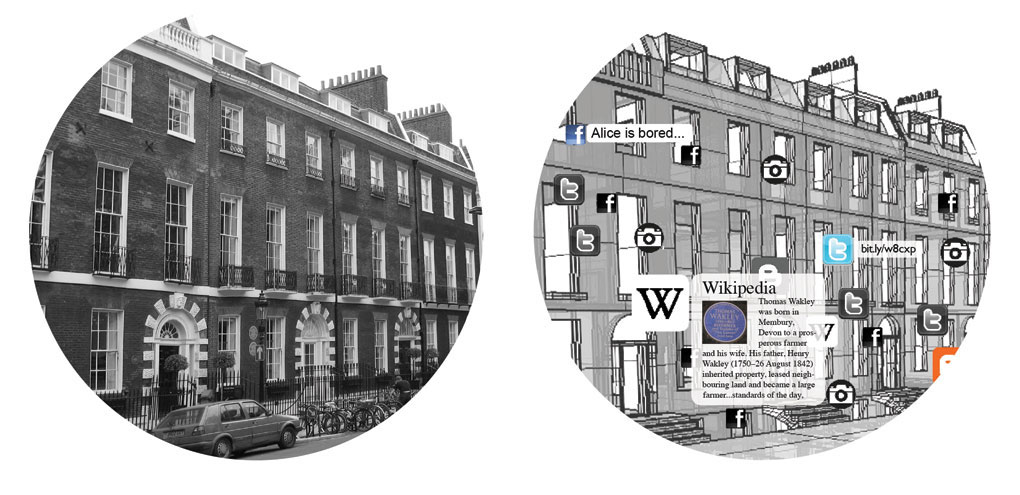
The real Architecture Association on the left, and the perceived digital AA on the right... via Flikr.

When the richness of a place, its history and aura are better captured in the imaginary spaces of a virtual city, what good is the building itself? When my home network password is more important than my front door key, when my door has become nothing more than an icon and an option list… Why not knock it all down? Why not remove the physical obstacle that prevents us from seeing the building?

new millennium


The London Eye, modified from this image, and the cover of Ballard's novel 'Millennium People'.

Millennium People has moved – our new url is:

www.millenniumpeople.co.uk

Although we are no longer at www.millenniumppl.blogspot.com all traffic will automatically redirect.

Monday, 11 January 2010

how big is the internet?


The Internet, via.

There are somewhere in the order of 4.2 billion unique Internet addresses (IPs), housed on 44 million servers. These consume about 5% of all the world’s electricity and produce about 2% of all carbon dioxide emissions. This amounts to roughly 80 megatons a year and is similar in output to the emissions of Argentina or the Netherlands.

It is comprised of about 40 million gigabytes of information, which, in its simplest form, would weigh something in the order of fifty-six millionths of a gram.

Here the contradiction: the Internet might, theoretically, occupy less space than a single grain of sand, and yet its contribution to global warming is equal to a small country. It is both an immense geographical entity and a miniscule atomic whisper. It exists in a time and place, and yet transcends that to become timeless and aspatial.

It is an emergent system, where a highly-engineered, yet simple, set of rules has allowed for the creation of a massive network sprawling across the planet. The structure of the Internet is a hub and spoke system, in which information is hoarded at central servers and trickled down to individual IPs, making it, in technological terms, far from democratic.

Thursday, 24 December 2009

unfinished 2009 drafts #1: data visualisation


From top: Dan Hill's 'The Cloud'; 'Sound as object' via Generator X; Toyo Ito's 'Tower of Winds'; Weather Bracelet from The Teeming Void.

This is an unfinished draft from 2009, there are two others which have been chronologically placed into the archive (#2 & #3)...

The precipitation of the digital into the real has been accelerated by a virulent new wave of 'data visualisation', through which digital data and statistics are presented either through real-time displays or objects, mostly made by 'rapid prototyping' (which, as anyone who has ever used the process knows, is far from rapid).

I don’t know if you heard about it already, but Dan Hill (of City of Sound fame) recently posted about his new project: The Cloud. I won’t go into details, nor cast an opinion, but simply group it together with several other projects as examples of a New Millennium Spirit: data visualisation. In times-gone-by the problem was collecting the data, not representing it. Researchers developed speculative manners of presentation (graphs and specialist charts) and then went out into the world to collect the information. What I'm really saying is that modes of data visualisation were propositional about a certain reality.

Today, there exists way too much data: insensible and unreadable. Understandably, the challenge is in creating new ways of presenting that data. Unfortunately, very few of these modes are intuitively comprehensible. In the world of arbitrary employment of technological tools (Za … what was her name?) data visualisation has remained ‘meaningful’. But in reality, it’s just a new tool for the generation of forms and images. And yet there is something rather banal about all these works (with perhaps the exception of Ito – not out of favouritism, but simply because he was so far ahead of his times).

Baudrillard wrote: “It is the difference that constitutes the poetry of the map and the charm of the territory, the magic of the concept and the charm of the real.” This difference belongs to the order of representation. Though it might equally be the order of transduction: the conversion of one physical quality to another (as light to heat, kinetic energy to electricity, magnetic impulses to sound, etc). The map is in some sense a translation of the territory, from a space through the hand & mind onto the page.

Data visualisation is not the same as cartography (although cartography could be seen as a type of data visualisation, it is at its foundation a conceptual visualisation, since our perception of landscape is not a data operation) – the difference is that there is no difference between the source data and the presented data. There is no abstraction of the information, only an abstraction of the presentation of that data. The reification of the digital only produces a physical version of the electronic dross. Nothing about the information has changed, only its mode of presentation.

This goes beyond Baudrillard’s notions of simulacrum and simulation in the sense that his hyperreality had no counterpart in the real. The visualisation of the digital has recently moved from the ethereal to the real – 3d printing, and any number of other manners for turning data into objects. But what is the meaning of these objects? And what are their purposes? A map is a practical document related to the revelation of the real, but a bracelet of the year’s weather?

Monday, 23 November 2009

riding the wave


Apparently the world's best surf photographer: Clark Little.

Over the last three months or so I've been researching the idea of the 'open plan internet'. In the 19th century homes were designed in a hub and spoke manner – a central entry leading through corridors to rooms with single functions: bedrooms; bathrooms; dining rooms, etc. Robin Evans explained how the relationship between these rooms was highly limited, most rooms only had one door, or, in exceptional cases, two (kitchen/dining, for example). The open plan rooms of the 20th century, rather than being simply the sum of the older rooms, became a new and different type of space. There was a spatial gestalt effect.

The Web: today the internet is comprised of monofunctional internet programs or sites connected in fairly linear ways: e-mail; social networking; chat and phone programs; video and image sharing, etc. Youtube, Myspace, Facebook, Gmail, Hotmail, Skype, MSN Messenger (if anyone still uses it), Flickr, Picasa, are all examples of 'rooms' on the internet. These were either created by one of the two internet giants (Yahoo/Google – Goohoo as I call them) or quickly absorbed into their families. The clan-like collection of these sites was the first step towards the 'open plan internet' – an internet that will be other than the sum of the applications and sites that make it up. A digital gestalt.

Today I joined Google Wave (many thanks to Will Wiles), which is what I would consider to be the first open-plan web browsing application. It differs from previous feed amalgamation programs (where you can view twitter and facebook at the same time, for example) in the same way that putting a doorway between the dining and kitchen is not the same as knocking down all the walls to make an open space.

In what looks like an e-mail window, the user can 'start a new wave' and then add to it using 'blips'. The only way I can think to describe a wave is like a massive, informal, wikipedia page, or possibly a blog: it can contain chats, videos, images, references to external sites, in both real-time (like googlechat or ICQ) and delayed-time (like hotmail or flickr). It seems at first like a mess. Especially when you consider that all the elements are editable, and all edits are saved and able to be reviewed. Imagine receiving an e-mail from a friend only to find that the next day the message has been changed. Unlike the world of 1984, for the moment the changes are traceable.

I think something should be said about the rise of real-time editing. The ability to doctor information (images, text, etc) as it is in the process of being created has far-reaching philosophical ramifications. There can be no 'original' – simply a series of second order simulations (or worse, a chain of simulacrums). More to folllow...

Wednesday, 4 November 2009

nature versus technology


A natural landscape. See also: 14, by David Bickerstaff.

Technology, as I wrote yesterday, means only ‘to assemble’ (and shares this root with 'tectonic'). The traditional misconception, however, is that nature is somehow atechnological. Nature is pure, it precedes humanity and is complete without it. So there is a dichotomy established- that technology is dangerous, that it will threaten nature. In light of the original meaning of ‘technology’ nature is most certainly a technological creational force. The dichotomy disappears.

Human technology, as opposed to natural technology, is distinct only in the manner by which the product comes to being: the body must always be the mediator for its creation, while nature generates itself. Hence the association that the root of technology is the tool, and the belief that if the tool is made big and dangerous enough it will one day turn back on its maker and pummel him.

The etymology of 'nature' is the Latin 'nasci' meaning birth (the root trickles down to 'renaissance'). The Roman notion of birth is that it occurs when the baby is complete - which is why nature carries implications of being finished, perfect and balanced. The sense of these two terms opposite each other is: the perfect, finished world versus the constructive, unfinished assemblage. And so the point I am making is that the meaning of 'nature' is misconstrued, and that it is also technological, it is also in a state of construction and evolution, and is not a static, finished thing. There can therefore be no such thing as 'tampering' with nature, or 'playing God', since all our actions are essentially natural.

Let's just assume that global warming stems from human activity. It remains nonetheless a natural process. But it is also a technological process, since it occurs over time and through the coming together (arrangement, assemblage) of innumerable sub-processes. This distinction carries through to all of our current experimentation with 'nature'. Growing an ear on the back of a mouse, cloning a sheep, stem cell research, each of these is both technological and natural.

Tuesday, 3 November 2009

digital dialectic


It was eerily silent at Oxford Circus last night. It had been on Sunday night too. I waited in front of the Tube exit for my father while a constant stream of empty buses rolled past, flicking up wakes in the gutters. The pavements were deserted. Then I suddenly had the irrational sensation that London was concealing itself in preparation for some imminent event and only I remained unwarned.

+++

Fukuyama famously announced the Death of History a couple of years after my birth (I don't believe the two were connected). The Death of History? The end of all history? His basis for this statement was a worldview he had extrapolated from Hegelian thinking. Hegel basically saw the spirit of any epoch (zeitgeist) as being defined by the struggle between two principal opposing entities. The neutralisation of this great struggle signals the end of the age.

The first epoch is supposedly the human struggle for mutual acknowledgement; to be recognised and recognisable to ourselves and by each other. Perhaps less opaquely, the late 19th century might be seen as the struggle between worker and master - the resolution of which signalled the end of the Industrial Revolution. The mid to late 20th century might be seen as the struggle between Communism and Capitalism.

Fukuyama's argument is that when the USSR packed up it ended the Communist/Capitalist struggle, allowing for global free-market Capitalism. The idea of the opposing entities is that they are fundamental. Capitalism is a fundamental organisation of society, as is Communism. The vacuum of the struggle, the absence of a dialectic, apparently signals the end of all history, since no major struggle replaced it.

Fukuyama's basic problem was that he was considering the 'spirit of the times' from a strictly economic standpoint. I find his dramatism about the end of history pretty absurd. Although it is true that the collapse of the USSR did signal the end of the Communism/Capitalism struggle – and Capitalism, having no opposition to keep it in check, ran out of control. The '07 crash (which we are apparently climbing out of) signalled the actual end of this mighty struggle. Which is part of my argument for why we are only now at the beginning of a new decade, new century and a new millennium, people.

To define the new age, to find the spirit of the times, in Hegelian terms is a lot easier than it sounds. It only requires the defining of the two opposing entities. Some people would say that the principal struggle of our times is technology versus nature. I'm not going to get into it too much (perhaps in another post) but this is a false division. If you look at the root of technology - tekne - it means simply 'to assemble'. Technology is an assemblage. Nature, however, is also an assemblage. That is, nature is technological. When we talk about nature and technology as opposites we are really talking about the differences in the manner of assembly. Nature assembles itself, while human assembly is always mediated. Our technology has to be assembled by our own hands.

The nature versus technology struggle can be excluded. For me, the strongest alternative is the struggle between the real and the digital. This is for several reasons - firstly, it would seem to be a logical historical progression: we have moved from the manual revolution (industrial) to the digital revolution. But a digital revolution cannot be without purpose, it has to have something to revolt against. And that subject is the real.

More to come on the subject...

Saturday, 24 October 2009

würsa


Last year I went to the Palais de Tokyo to see an exhibit. This is what I wrote.

“At a distance of 18,000km from the Earth," the guide notes "the elephant Würsa could balance on her trunk. It is on the basis of learned scientific calculations that Daniel Firman reached this conclusion, and came above all to produce this extraordinary work which confounds all our certainties regarding the gravitation of bodies.”

Wishful thinking at best, sophistry more likely. This phrase implies that the trick of the fibreglass cast on a pole is the logical end of a scientific investigation, it implies inevitability. The passage conjures the image of a diligent artist-scientist investigating gravity. Late into the night he pores over reams of calculations and suddenly, to his immense surprise, finds that the mass of an elephant… but this is a deception.

Fibreglass Würsa (herself not based on a real elephant, but the sum of images of elephants) surrounds a steel pole structure. The art is a trick, but the deception lies in the order of the art and the investigation. The passage implies that the art is inevitable, that it is nothing other than the logical outcome of scientific reasoning. In reality, it is the answer to an arbitrary question ‘how far from the Earth does an elephant have to be to balance on its trunk?’ In which case, why even ask the question? What is the difference between this and simply balancing the elephant on its trunk? Scientific validation to artistic whim. There is mystery and credibility to technology. I find this ‘technological’ approach to modern art flimsy, but ubiquitous. ‘I used technology as a tool to generate meaning and beauty’. This idea of the divinity of technology is false. It is controlled and predictable – the desired answer always dictates the technological question. In fact, this work is far more about ‘confounding all our certainties’ – not by presenting us with the unexpected, but the desired.

We live in an era in which the ease of technical generation (and extension by mechanical production) has rendered most art banal. The power of the virtual is such that we perceive homogenous space as virtual space. The ‘white cube’-style art gallery is the paramount example – it could be anywhere and anytime. The importance of the hidden structure in these places relates to their ability to suspend the laws of gravity, to generate the virtual manifest. Having conceptually idealised space in the virtual, a confusion or frustration results from the shortcomings of reality and our inability to arbitrarily control (consume) objects. The floating elephant, the semblance of a weight impossibly supported, is our desire, as it validates the virtual by manifesting it in the real. It is, of course, immediately recognisable as an illusion, and is therefore no longer such.

The moment of semblance lies only in the first fraction of exposure. Indeed, even this illusion does not whole satisfy our desires, this would involve the actual precession of the virtual, the actual suspension of gravity, the actual elephant actually floating. So we quickly lose interest in this ‘one-liner’. Semblance itself no longer interests us because the semblance of the virtual is perfect. In other words, the precession of the virtual means the real will always be catching up, the real will always be the virtual’s simulacrum.

To this extent, quite a lot of art and architecture concerns itself with ‘effects’. There is, however, one thing that remains meaningless in the virtual and meaningful in the real – violence. Hence the interest of Arcangelo Sassolino’s ‘Afasia 1’, “a sculpture that propels empty beer bottles [into a steel sheet] at more than 600km/h thanks to compressed nitrogen.” The mechanism is randomised, and a good deal of the spectacle lies in the anticipation of the loud bang and the instantaneous vaporisation of the bottle into a fine powder of green glass. But it is really a spectacle, a gratification of destructive desire. Not “physically compressed time… permanent memory, a dangerous equilibrium” but a gratification of the sole refuge of the real, violence, as it retreats from the primacy of the virtual.

Thursday, 15 October 2009

sir ken adam


Sketch for Submarine Lair in the classic Bond 'The Spy Who Loved Me'.

On Tuesday night I was at the AA, just hanging around the bar, minding my own business, when I heard that Sir Ken Adam was going to give an interview downstairs. I was incredibly excited. If you're not aware of who he is, I will just say this: every James Bond set, gadget and gimmick – from machine gun headlights to volcano lairs– were his idea. As were the sets of Dr. Strangelove, much of Star Wars, Hornblower, Around the World in 80 Days, Chitty Chitty Bang Bang and he also consulted (apparently in a fairly involved manner) for 2001: a space odyssey (although he said that after Dr. Stangelove he didn't get on so well with Kubrick).

Further, he was the only German national to fight for the RAF during the Second War, and helped to provide air cover for the D-Day invasions: "Zthey said 'you juzt fly down zther, and fiare all your rockits' and I zthought 'that zounds simple' but... it vwas.... a lot more complicated than that."


Sketch for Dr. Strangelove's War Room (dir: Kubrick).

For the most part he reiterated the things I have heard him say elsewhere, which is why I won't be reiterating them here: go elsewhere. I'm just going to touch on one or two things that stood out. At one point he showed a slide of a drawing, and said "I had no idea who could have been doing a glass tower block like this one in 1928 in Berlin for my father's sports shop. And then, of course, I discovered it was a Mies. It was one of his forgotten projects. Even Moma didn't know about it." Needless to say a million architects reached for their pens. His photograph is not online, but the project is briefly described here.

He also postulated that the reason American Modernism was so strong and English Modernism so weak was because all the German exiles emigrated to the States – before the War the English had not taken a fancy to Modernism, and found it even unattractive as a style. He refered to 'Highpoint' in Highgate in particular. When he studied architecture at the Bartlett in 1936, he said, they were still teaching him to use Georgian and Edwardian styles. 1936. Shame. He wondered what would have happened if the English had embraced Modernity, instead of encouraging all the German Modernists to move further West.

The final point I'm going to write up is one he made about the Flowmaster pen. It was the first pen to have a felt nib and a transluscent replaceable bulb. Not only, he said, did it change the way he drew (up until that time only charcoal had provided him with the fluidity he desired) but it changed the way he designed. Later on he said, in reference to a modern render that had been done from one of his drawings, "I can tell, you kno, if a design hasz bin started by haand or as a computer architecture." He didn't express a preference, but I think the lesson is obvious: we are both limited, and afforded capabilities, with each new technology.

In the case of digital technology, the question must always be asked: are you designing that way because you can (that is, arbitrarily, because the technology allows for it)? Or, if given a blank piece of paper, or a charcoal stick, would you be trying to describe similar forms? What I really mean is, do you design digital architecture because you have digital means, or is the digital a design ideal in itself, unique from technology?

Roll that one over, Millennium People.

Sunday, 4 October 2009

the data city + jules verne


Stark images of LA by David Maisel.
"The modern city is the data city. Architectural renderings and monographs present case studies in the context of information, with statistics and graphs supplementing the traditional projected view. The utopia of tomorrow will be saturated with information, and it is how we navigate this space that is the focus of so much contemporary speculation on technology and the city."
Via Things

A two part post today: if you don't like what you're reading, scroll down past the +++

There's an interesting post over at the much-loved Things, which might be summarised thus: urban interaction is becoming increasingly non-physical as we experience the city more and more through technologies of its representation (GPS, Twitter, Google Maps, etc) than through the actuality of its corporeal fabric. Nonetheless, Things recognises that our relation to the city is as a simulacrum – we are not replacing the real with the informatic, we are simply poorly imitating it: "the way virtual interfaces mimic physical spaces – desktops, pinboards, tables and surfaces you can post, pin, pinch and scatter content across – acknowledges our hunger for the tangible." They conclude: "The data city of the future will be unnavigable without technology, granted, but as a species we seem to be crying out for help remembering, unable to find things with the arsenal of digital tools and reliant, instead, on other people's recollections."

Contemporary data, being instant and always accessible, is also instantly forgettable. Couple this with declining attention spans (I wonder how many readers even make it to this point) and you arrive at an inescapable conclusion: in the future we will either learn to forge more ephemeral relationships to information (we won't remember, but we won't need to) or we will learn to handle information in a very different way.

Since, and this is my real point, the future is never merely a prolongation or projection of the conditions of the present, I would definitely consider the latter as more likely. The future is the data city, but it won't be accepted by people as the city of the future. To a certain extent the city has always been a 'data city', the possibility for the exchange of information (and obviously goods and services) is what intitially permitted for fixed settlements. And yet the way that data is handled by the city's citizens changes all the time, and to envisage the city of the future in the digital or informatic terms of today is as redundant as the utopias of the steampunk clique. To extend Things' conclusion – the rise of digital information might be weakening the reasons for the city's existence at all. In this future, the metropolis itself may one day become physically irrelevant.

In explaining the goals of Millennium People I often compare 2009 to 1909. When the people of this time envisaged the future they merely projected forward the industrialism of the late 19th century (not unlike the Steampunks). They could hardly have foreseen processes like computerisation, miniaturisation, post-Fordian society, globalisation, contemporary financial systems, because they lay so far outside their realm of reality as to be inconceivable. For them, the flying machine, made of canvas and wood, seemed like a pretty far-fetched idea.

By the same, to consider the metropolis of the future in traditional utopian terms – and especially to become overly fixated with the rise of the digital, is to limit oneself to a future that is really only a hi-tech version of today. This is not to say that the future is unimaginable: but it requires a very special mind, perhaps even greater than H.G. Wells or J.G. Ballard.


+++

My benchmark of futuristic thought is Jules Verne's novel Paris in the 20th Century. Considered too radical by his publisher in 1863, the book was locked away in a family vault for over a hundred years, and was only re-discovered by accident in the late 80's. Which is how I plucked my own copy from a box of freshly printed American first editions in 1996.

I won't spoil the plot, but in this remarkable story set in the year 1960 Verne envisages a city of glistening skyscrapers, each one air-conditioned. The streets are crammed with gas-powered cars, with rapid public transit covering the sub-terranean city. And yet these are only the more mundane visions: he foresees a worldwide 'telegraphic' communications network (the internet), a type of screen for viewing from a distance (television), elevators and an electronic, telephonic, document copier (fax machine).

Returning to the present day, it is this type of Vernian imagination that will carry us into the future. And the first step is to move beyond the 'data city', move beyond the delights of the digital and start scratching our heads about what is to come next. That's how we will become New Millennium People.

Friday, 25 September 2009

back to basics


The retrospective epochal terminator, an MP orginal (more or less).

Millennium People. It is as it sounds: a blog for the People of the New Millennium.

But I thought I would just recap, for those latecomers at the back, and reiterate what MP is really all about: the uncertainty of the current architectural (and epochal) situation. Zaha's on the out, Dubai is quickly becoming a sandblasted stillborn, and I can faintly hear Ballard's Chelsea housewives murmuring into their martinis "someone really ought to do something".

Its a bad situation. Architects and theorists everywhere, lets take a moment to prop ourselves up on our unemployed elbows and take stock of the situation: the sub-prime crisis has come, and the boom has gone. Like so many Rip Van Winkels we naively now awake to the fact that China, the Gulf, and the endless stream of dubious commercial constructions we merrily knocked up, were morally moribund white elephants (or ivory towers).

Worse, the favourite pastime of so many students and young professionals – I am referring to digital formalism – has been murdered in its bed. No longer is there any hope that it will one day dominate the world of architectural construction, it has been relegated to nothing more than a stylistic dead end, like those typical of the beginning of last century (art nouveau, etc). On the upside, at least now when I speak out against meaningless form-finding I don't sound like a Luddite.

How are we rallying ourselves? MP is seeing two general trends in architectural thought emerge: the retrospective and the reactionary (I am simplifying by presenting the extremes, but I think the spectrum generally holds true).

The former have decided to seamlessly splice 1968 (and the years directly after it) to the present day. Through the re-examining of groups like archigram and the infamous lessons from Las Vegas they aim to by-pass all of that post-modernist, post-post-modernist, bullshit and reconnect with their roots. Soggy with nostalgia, they lovingly recount tales of simpler times – utopias were only a few years away and for a young architect anything seemed possible. Glorified is the architect-citizen, who told the Man where he could stick it (there is of course no mention of the architect's subsequent punishment, doomed to a half century of quibbling over occupational health and safety).

Then there is the reactionary camp, who seem to be led by the unlikely figure of Kengo Kuma (though there are certainly many others). This camp is following Toyo Ito's Digital Tarzan theories (of the city as the interface between the digital and physical realms) to their logical conclusion: by treating architecture as both a membrane for the individual/virtual and individual/real. In other words, a thinking founded in Heidegger's forest clearing (see The End of Philosophy and The Task of Thinking) and Levinas' Other.

I find this the more attractive of the two, and the discussion revolves mostly around the 'architectural object' (see Rosin-Melser's and my own exchange) and the notion of 'specular/speculative architecture'. The only problem with this movement is that it is a reaction to the current conditions. As such, it limits itself to merely describing the present. Where are the architectural revolutionaries? Where are the forward thinkers and dreamers for tomorrow?

In closing, I make mention to MP's wordy manifesto (as soon as the blog gets a regular editor it will probably be rephrased).

Wednesday, 9 September 2009

anti-object #2

Brett Steele – AA head honcho – writes in the introduction to Kuma’s text that he is against “self-centred architecture… deliberately distinct from its surroundings”.
He continues:
“‘My ultimate aim’, [Kuma] writes early on in his book, ‘is to “erase” architecture’. Such an ambition couldn’t be further removed from the majority of a younger generation of digital experiementalists today, pursuing a renewal of formalism not seen within architecture for decades.”
As founder of the AADRL, and therefore one of the driving forces behind the pursuit of neo-formalism, and the advance of digital experimentalism, this comment is not without a certain hypocrisy. The younger generation are largely that way because Steele made them so. I am not making a value judgement about the worth of digital experimentalism (which has obviously been a tremendously important force in the recent history of global architecture), I am simply noting my surprise that Steele would distance himself from a movement he helped create.
+++++

In the first part, Max mostly focussed on the division of subject and object as proposed by Kuma’s text: the possibility of relating the subject to the landscape through the power of the floor plane, and the ability to blur formal boundaries of architecture by the ‘particlisation’ of materials and elements.

Both of these main points relate to Kuma’s definition of an object as being something wilfully separate from the ground plane – a finite figure cut off from the earth (as opposed to the earth itself, which is continuous in all directions and thus infinite). However, this definition also excludes burying a building. The new millennium fad of concealing buildings in the landscape by submerging them, or employing other mechanical modes for hiding their structure, does not actually change the nature of the building's limits (a wall is not less definitive because it is underground).

Max discussed what it isn’t, but what is an architectural object?

“Kuma sees new digital and informational technologies as leading us to an aesthetics of disappearance, rather than image or form” Steele notes. Images and forms are the current architectural stock-in-trade, and Kuma makes the historical reason for this quite clear: communication. At a period in Modernism when only black and white images were being published in grainy magazines, the architects that succeeded in drawing attention (and subsequently more projects) were those who could capture the essential forms of their buildings and diffuse them through B+W photographs (Barcelona Pavilion, Villa Savoye, etc). The legacy of this period is the ubiquity of the ‘metalevel’ image: an imagined point of view that portrays the whole building. This manner of viewing architecture necessarily renders it an object for consideration.

Bruno Taut, according to Kuma, lost out to rival Modernists because he “failed to understand the twentieth-century paradox, that individuals as isolated subjects shunned groups in any form. They were sustained in their mediocrity through the possession of attractive products.” Modern architecture became an 'attractive product' by appealing first to the spirit of domestic rivalry – the Modernist home was an object that could be packaged, sold, and used as a means to escape the mediocrity that was the inevitable result of the era of machine reproduction.

I mention the escape from mediocrity because Kuma lets us know that the architectural object is not, whatever Corbusier might argue, for the people. It is the production of one-of-a-kind jewels, founded on capital. It is the Burj Dubai, the Walt Disney Concert Hall, the Phaeno Science Museum, the Gherkin, and a million other projects – today with no exclusion of function or program.

From the text, I can only conclude this: the architectural object is full of form, but empty of meaning; found in one location, but conceived independently of place; sexy without being in the least bit seductive.

Monday, 31 August 2009

specular architecture


The Guggenheim effect – where specular/speculative architecture really began.

Today I am going to build upon the thoughts of Mark C. Taylor – who said that over the last century there has been a general correlation between forms of capitalism and architectural styles: Industrial capitalism had Modern architecture, Consumer capitalism had Postmodern architecture and Financial capitalism has (or had) Specular / Speculative architecture.

He was not the first to divide up capitalism into these three phases. At the end of the last millennium, the 'Great Man' of economics J.K Galbraith wrote extensively about the shift that was taking place. In one of his last works, entitled 'The Economics of Innocent Fraud', he pointed out how far we had come since the early days, when the economy was driven by actual capitalists – individuals with money who controlled the means of production.

Over time the cost of manufacturing goods fell, and subsequently so too did their value. Maintaining a dominant position in the market by simply controlling the production of something became increasingly difficult (and I am not really even referring to the activities that prompted legislation specifically targeted at breaking monopolies). So the impetus of the leading economies naturally shifted from the people who made the most to the people who sold the most. Above all were valued those individuals who could turn a superfluous luxury into a perceived necessity.

But with the global unification of markets, the digitisation of trading, and the new era of instant communications between financial institutions, it suddenly became possible to speculate in radically new ways. Money was capable of making lots more money, loans backed by securities that themselves were backed by other loans. And the market grew, and everyone won, and (almost) no one thought it would ever end.
And so when Fannie Mae went A-over-T, and kicked off all this business, it came as a bit of a shock.

So I think Taylor is drawing a fair, even predictable, comparison between architectural styles and the economic factors that produced them: the machine and industrial aesthetic of Modernism stemming from the factories and silos; the cultural critiques and pastiche styles of Postmodernism likewise finding their root in an increasingly global society absolutely saturated by the advertisement.

The real goal of this blog is to attempt to capture an epochal philosophy before the relentless wave of progress wipes it from our minds: a time that really began in the late 70's – before I was even born – and may still not have finished, but whose peak was undeniably between the collapse of the Towers and the collapse of the Sub-Prime.

The reasons for wanting to capture this essence are manifold: architecture is my profession, and it was treated as a bitch: the speculative scapegoat. That smarts. A profession that at the time was becoming increasingly image-based, and therefore itself increasingly speculative, began to be manipulated by the financial world – as an agent of financial speculation. How many luxury apartment blocks did architects really think the world needed? But need didn't come into it. Architecture had imploded into itself, there was no moral element, simply a quest to find a new look, and a look to sell more than the competition. And this quest essentially produced the same types of stylistic dead ends that were seen at the beginning of the 20th century (art nouveau, Gaudi, Hunterwasser, and so on).

Zaha is a prime example, though she still tends to divide opinions. But I think it is fairly safe to say that her time has come and gone. She is no longer (if she ever was) at the forefront of architectural discussion. It is nonetheless undeniable that she was an architect that rose to prominence not for actually constructing anything, but simply threatening to construct anything. Her powerfully iconic (but ultimately meaningless) forms epitomise this 'object' architecture – an architecture unrelated to humanity except by the coincidence that it was us that produced it. Always seen from a bird's eye view, it is an architecture of visual appeal (specular) and conjectural possibilities (speculative).

For the next month or so Millennium People is going to tackle the meaning of the architectural 'object', and its relevance to the future of architecture (the discussion will be mainly prospective rather than retrospective).
In particular the focus will be in the fields associated with the blog: psychogeography, landscape and the city.

Saturday, 29 August 2009

composite memories


The Parthenon.

After seeing Jason Salavon's 'Every Playboy Centerfold' series, in which he overlayed a decade of sexy pin-ups at a time, I was inspired to write my own little photoshop droplet and produce these images – which I will call 'composite memories'.


A game of tennis with two close friends. Australia.


The Barbican.


Sparklers and fireworks. Woy Woy.


LCD Soundsystem, Sydney 2007.

Monday, 10 August 2009

research architecture


A mapping exercise I executed on the zoning and usage of Gennevilliers.

Today's post primarily consists of excerpts from an article by Mark Foster Gage (Assistant Professor at Yale), entitled 'In defense of design' – from Log 16 – and the subject is the demise of architectural precedents in contemporary design theory. It struck a particular chord with me, and it touches on one of the questions Millennium People is most interested in: to what extent (if any) does architecture have the power to shape society? Is even the most daring utopic design merely a reactive solution to pre-existing social (or other) problems? Can architecture ever really be a revolutionary expression of a civilisation's desire for improvement?
The architectural line is now defensible only if it is the direct result of an act of analysis, of a process, a mapping exercise, or just about any manipulation of data emerging from any body of factors. This contemporary emphaisis on process and analysis is largely the product of a drift in architectural theory from linguistic and poststructural models to what... is commonly being referred to as "research architecture".
While nobody was watching, the actual research of "research architecture" as a theory intended to reinforce our understanding of architecture in larger globl contexts – whether geospatial, social, political, economic, ethnic, or other – was diluted, mixed with artificial sweeteners, packaged with witty icons and hairline vectors, and sold cheaply in the world's design schools, not only as a new line of thought, but also as the newest and most harmonious of architectural chorus lines.
There are clearly historical arguments to be made for "research architecture as theory, however few the precedents may be. But there is no such precedent for the trickle-down Reaganomics of "research architecture" as practice, which is only a reflection of a wholly contemporary architectural culture based on the easy, the quick, and the convincing, and on the frequent – at times even sincere – yet mistaken assumption that we are always more powerful in dealing with social injustice or inequality in our role as architects than in our roles as citizens or activists.
It should also not be forgotten that architecture has functioned historically not only as a record of change but also as an instigator of change, and any architecture dedicated to solving problems discovered within an existing organisational system is therefore partially complicit in sustaining the status quo of that system – or at the very least relegates itself to the weaker position of subverting existing standards instead of optimistically endorsing new ones.
When I was at school I was told, by dusty relics of the post-war Modernist push, that they were surprised to discover their architecture had a lot less influence on society than they had expected. Will it be the same for those of the profession that have strayed too far into the meaningless end of "research architecture"? Gage states that "research architecture" demands only information, "which today is as ubiquitous as asphalt", while the use of architectural precedents requires knowledge and "a dedicated understanding of the historical lineage of architecture – hard things to come by with a quick Google search." The real point Gage is trying to make is that while the collective informatic resources of the profession are growing exponentially, those of the individual are waning. This is not unique to architecture. As access to information becomes ever more instant and easy, so our propensity to forget what we consider superfluous becomes more puissant. That is, we do not retain the results of our searches: we are erasing (or blocking) our own internal cookies.


A map of the Ile-de-France region indicating the plateaux, cliff edges and valley bottoms. I did this image while working on the competition for Grand Paris.

Monday, 20 July 2009

start at the end

I was interviewed for the AA the other day, and at the end of the meeting a member of the panel asked me if I had any questions. ‘I read Kuma’s Anti-Object recently’ I said, ‘and I found the introduction by Brett Steele very interesting. Given his, and the AA’s, role at the forefront of the digital revolution in architecture, his support for an architecture that is, if anything, adigital, seems quite a striking change of position. Is this symptomatic of the change in contemporary thinking? What do you think is the future of the digital revolution, and more specifically, what will be the future role of the AA in this field?’ None of the three replied, then after a few seconds a man who I sensed was least impressed by my presentation said: ‘the revolution is over.’

This reminded me of something I read in Log magazine recently, (run by Cynthia Davidson, Eisenman’s wife). Mario Carpo writes: “In the early 90’s, the digital revolution in architecture had no clearly identified course of history to call into question: in true post-modernist fashion it had no preset destination - no target, as it were, and almost no end in mind. Indeed, 15 years later, some may reasonably claim that as the digital turn had nowhere to go, it went nowhere.”

Yeah, alright, fair enough, I dislike the vocabulary of digital architecture as much as the next person. The projects mostly resemble neo-baroque fretwork, objects of unnecessary complexity just plonked down wherever their site might be (with no thought to landscape, to human scale, to the modality of perception), and then these architects claim to not have produced architecture at all, but programmable elements that in themselves are generic, but which can be adapted to the hyper-specific conditions of program. It makes me ill.
However, I hardly think its fair to search out a scapegoat in these times of global financial crisis. I first noticed this bitter approach when Zaha was balled out by one and all at the Barbican in April. Her style of digital architecture epitomises the fundamental ethos of Modernism: that we produce architecture we are technologically capable of, and not morally responsible for.

Does this perhaps mean that the Modern era is done with? Probably not. But the aim of this blog is, at the end of the digital revolution, to propose new directions for the profession. This does not mean abandonning digital techniques, but it does mean carefully examining the ontological legitimacy of what we produce. Or, if you prefer, asking again ‘why do we make architecture?’.

Friday, 17 July 2009

nouvelle vague

I was fourteen when the Towers came down, and the long twin shadows of Iraq and Afghanistan essentially defined my development of global awareness. It is an event I refer to frequently when attempting to describe the nature of the new millennial zeitgeist, and while it is a subject that has gone out of vogue in recent years (perhaps as a result of the spectacular conspiracy theories that surround that tragedy, with varying degrees of plausability) it remains unequivocally the real marker of the new millennium. If epochs are less defined by periods of time than by events, then the bookend to the era that began with September 11 would be the sub-prime lending collapse, and the subsequent Global Financial Crisis of 2008.

The crash really signifies the end of the decade, and what we are experiencing now is the slack water between tides – the dead calm of reflection. Particularly within architecture there is a feeling of bitterness, a recognition that the good times are over, and they were largely squandered. There is a desire to seperate, in all senses, from the past. The scorned lover destroying correspondance, the defeated army burning bridges in its wake. There is a searching for a new architecture. But it is somehow more profound than this; it is not simply a search to redefine themselves, but above all to define a new zeitgeist. That is, the will is essentially positive.

I am not interested in the ungainly shapes and non-existent scales of the Digital Formalists – I feel the greatest failing of Modernism is that we do because we can, and not because we should (even this question is enough to brand one a Luddite, or at least retrospective). I am not interested in architecture as an activity of object-making. I am completely fascinated by architecture as a legitimate tool of social change.