Showing posts with label Iceland. Show all posts

Tuesday, 18 May 2010

the end of the world


Just a quick notification: the Architecture Association's Intermediate Seven unit, run by Kate Davies and Liam Young, and titled 'The end of the world, and other bedtime stories' has just released its first publication for this academic year (a second is forthcoming). It's not expensive and is available from the AA Bookstore. If you want to keep your fingers on the pulse, this is one to watch. Also good for aspiring anarchists, the millennial avant-garde, and anyone looking to buy a gift for the man that has it all...


This year the unit went to Iceland to study the end of the world. If you missed Millennium People's coverage, it was intense and ace.

Sunday, 18 April 2010

prometheus unbound


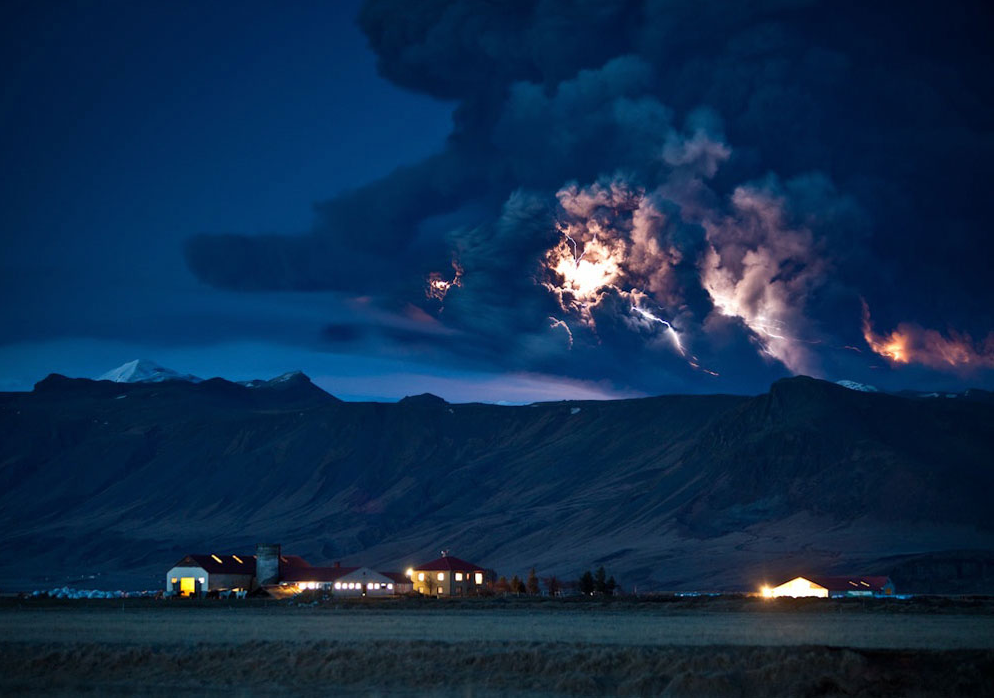
Ragnar Th. Sigurdsson in Iceland (via) - compare with my own shot (from last December)

Above me the full glory of the Northern Lights was spread across the night sky, a magnificent slow-moving dance of green haze. “I think this is a life-changing phenomenon,” I said. “It’s the tipping point in my understanding. When I moved from Australia to Europe I had to accustom myself to a completely unfamiliar sky, strange new patterns of celestial and solar arrangements, but it is only now, now! Here! That I really comprehend the full significance of what it means to stand on the surface of a spherical body moving through space!” There was an uncomfortable pause, then Borja looked up from adjusting his tripod “Man, it just looks like a slow Mac screensaver.”

Friday, 16 April 2010

carbon


Via information is beautiful.

In case you missed Millennium People's trip to Iceland last December and you want the inside story on the nation:

Saturday, 23 January 2010

iceland #4: sudeyreri


This is the final post in my Icelandic Saga... and the post is likely to be a saga in itself...

There is a magnificent approach to the village of Sudeyreri, which is found on the farthest tip of Iceland's West Fjords. During the winter the fastest way (weather permitting) is to fly from Rekyavik, in some sort of modernised Short's 360. Anyone who flew Aer Lingus across the Irish Channel in the 90's would probably recognise the aircraft by the name 'vomit comet'.


The descent into the West Fjords is a treacherous one. At an altitude of only several hundred feet, the plane races up and down the valleys in a very particular pattern, zipping over warning beacons and performing tight turns around lit poles. There is something of the aerobatic race about it. Then suddenly the engines throttle back completely, and you drop the last few feet onto the icy runway at Thinkery.

The little arrivals building was mostly crowded with parents and families waiting for their returning children; and so tight was the space, and so intimate the atmosphere, that it took on the appearance of a living room with a conveyor belt running through it. Outside, a massive Swedish truck from the 70's painted a dashing red and upholstered in several tints of brown took us up into the tunnel. Until relatively recently Sudeyreri was completely cut off for about four months every year. A mammoth construction project... a tunnel several miles long cut through the mountains... was the solution. Perfectly straight, its vaults lit up like a medieval banquet hall.

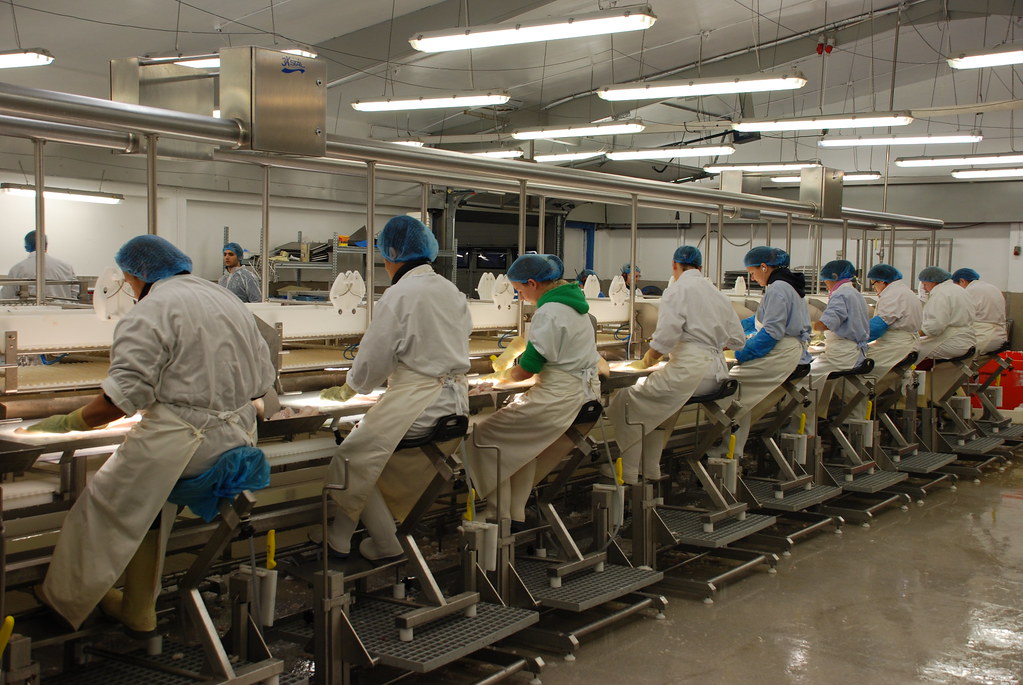
The village, only 350 people, is completely centred around the fishing industry, and is run by a type of benign protector – Odin – the owner of the fish factory and fish drying house. He employs only couples, in an effort to build up the population of the village, and owing to the fact that in his experience men make better fishermen, while women have better attention spans for skilfully de-boning fish for hours on end. "There are no men on my factory floor" he said "they just lose concentration and mess things up." They do however employ the local kids, who, when there is a large haul of fish, will work for a few hours after school to make up the numbers. These same kids, with nothing much to do, have discovered the joys of putting your back flips on youtube, and composing black metal music (brot were practising in the church when we arrived).


The all-female factory workforce. De-boning takes place on thick perspex light boxes, the rhythmic flick and swish of the knives barely audible over the hum of the central conveyor belt.

There is such a rationally organised system to the village: everyone works for the company, which invests in the school and donates money for local amenities. The whole place is powered by the hydroelectric plant installed on a local farm, and by a small geothermal plant in the town centre. There was something vaguely socialist about the single party equal distribution of profit. One night I had dinner with a local family and asked, bathed in the glow of their enormous television, would it not be a good idea to make the fish factory a union-run venture, organised by the people of the village? But they seemed against this: it was wiser and more efficient to have Odin at the helm (so to speak).

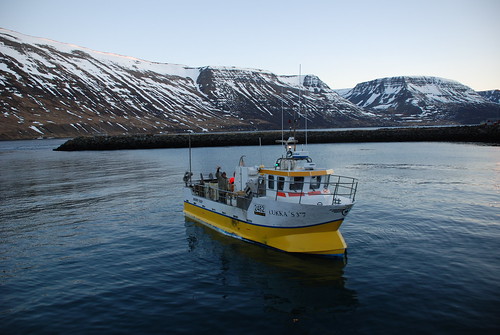
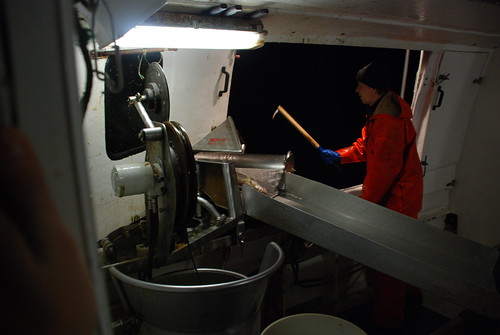
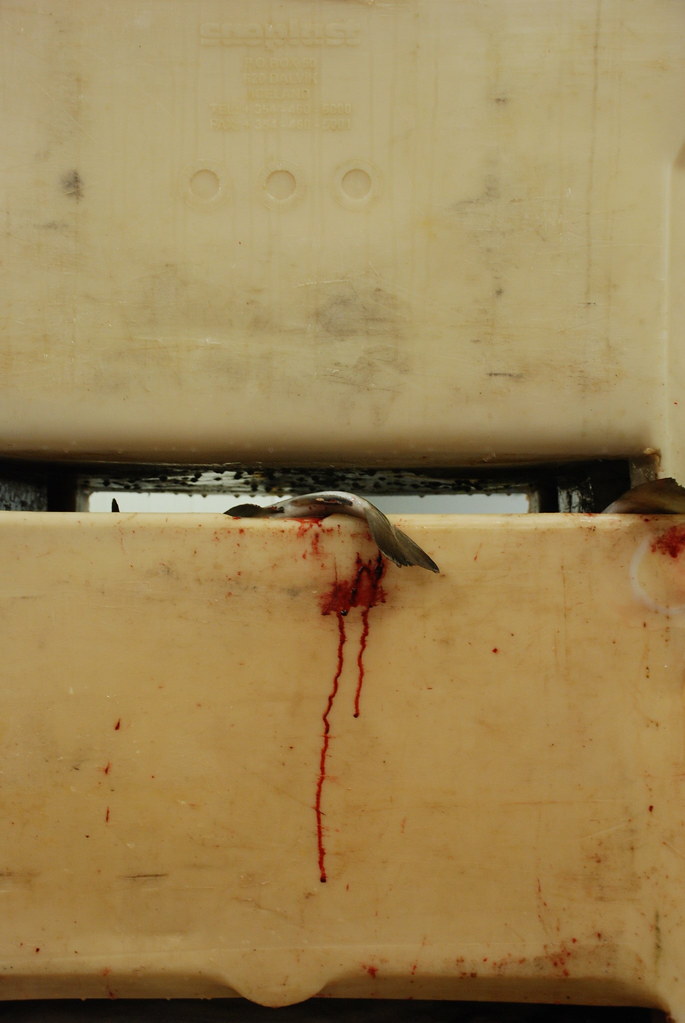
Another time, I went out on one of the small fishing boats. Myself and two friends, an Italian and a Swede, packed into the tiny vessel, and set out for the Arctic circle. The system of fishing, which is conducted in the eternal night of Arctic winter, is done using a long line (comprised of 24 segments) onto which bait is tied. The line takes about 3 hours to spool out, and then 6 hours to reel in. The two fisherman stand at an open hatch, waiting for the incoming line to present whichever fish it has caught. These are stabbed with a hook on the end of a stick and flicked into a large tray. Here they are killed by the other fisherman and slung into the hold (being sorted by species). A good haul would be about 4 tons.


The weather was particularly violent when we went out (though I am proud to say that of the 15 in my group that went out in several boats, I was one of only 3 that were not constantly ill), with the swell over 3 metres. It was so rough that we had to abandon a spot where it was known there were plenty of fish. While turning south to shallower waters the swell caused our line to snap, and we spent a good hour roaming around the outer Arctic circle looking for the flashing buoy – a pinprick of red in an ocean of black. The line had dragged along the bottom, and had picked up a wild assortment of sea-creatures, some of which I don't really even know how to describe. Amongst them was a giant crab, with a pincer the size of a child's hand, at least 50cm across. Due to the weather we pulled in just under two and a half tons.


The last buoy coming in, around 1pm, after 10 hours at sea. The waters had irritatingly calmed by the time the light came, making photographic evidence of the storm impossible. At its height, the boat had switched on a search lamp to see how bad it was – the beam cut straight through the high waves rolling over the deck, lighting up crystal turquoise mountains all around us.

Thursday, 14 January 2010

iceland #3: growth


Greenhouses at the Icelandic Agricultural University in Hvanneyri.

This is a continuation of Millennium People's Icelandic Saga...


The first question to come out of every Icelander's mouth on hearing that we were a group of architects from London, and that we were interested in the end of the world, was "why on earth did you come to Iceland?" This apparent self-deprecation in fact masked a rather bizarre understanding of the current global condition: they didn't think Iceland was a very good place to look for the end of the world.

Economic ruin, melting glaciers, massive deforestation and dwindling supplies of fish (the only real product to come out of the country in any appreciable quantities) and yet the people of Iceland were irritatingly blasé about everything. The economic woes will pass, they felt, and if the glaciers melt, well, that's just how it is. Rising sea levels? Iceland sits at the junction of two continental plates, and is growing all the time.

'Do you realise', I said 'that the world is quickly running out of oil?' They smirked into their hardfiskur (fish dried to resemble balsa - mine gave me a paper cut). All they have to do is a dig a hole and practically unlimited amounts of power and hot water come out. The vast majority of this energy goes into refining aluminium, but, so scientists at the Agricultural University told us, if this energy was diverted to agriculture Iceland could easily grow several times as much produce as it needed.

At their campus, rows of glasshouses cascading down a hill in Hvanneyri, the glowing warmth of sodium lamps shines out into bitter cold and eternal crepuscule that is Icelandic winter. Inside the hot houses: room after room of perfectly shaped tomatoes, enormous cucumbers, coffee, bananas, kiwis. Also one room, apparently without purpose, filled with examples of cacti. One scientist speculated on perhaps growing wheat next winter. The idea of vast fields of grain grown under an Eden-project like roof in the freezing north of Iceland does my head in a bit.

Sunday, 3 January 2010

iceland #2: power


Hellisheiði Geothermal Power Plant, at Hengill.

The landscape of southern Iceland is a vast treeless environment; a desert of lava flow, salt flats, and luxuriant mosses. It is so perfectly horizontal you would swear you could see the curvature of the planet. At certain points steam rises directly from the earth, whipped up by the wind into sulphurous slipstreams, backlit by the five hour sunrise that is hibernal day. The ground is warm to the touch at these places, and is marked by the brown stain of burned vegetation. Sometimes there is a puncture, a pool of bubbling water, sometimes just darkened soil.


This is the primary power source of the Icelanders, geothermal energy. At Hengill, in the south, bores have been sunk to a depth of 3000m, where the water is several hundred degrees in temperature. Through a complicated system of heat exchanges and turbines the plant produces an enormous amount of hot water and electricity, primarily to fuel the ever-hungry aluminium industry. Although Iceland has none of this metal itself, cargo ships will bring ore from as far away as Australia in order to benefit from the cheap electricity.

The over-abundance of power and hot water manifests itself in unusual ways. Graveyards are often lit up 24 hours a day. As you drive through the countryside, rolling through the twilight fog, suddenly a cluster of neon crosses will flash by… Also, everything is heated, the side-walks, the soccer fields. There can be two foot of snow all around a perfectly dry concrete walkway.


“We have so much energy,” a geothermal operator at Sudeyreri’s miniature power plant told me, “that at night we have to disconnect the generators. I’ve been thinking of solutions, and I think that if we could charge electric cars or boats at night we would not be letting so much go down the hill.” He gestured to the steaming rivulet cascading away from the plant.
Its hard to imagine, but if cities like London want to continue into the twenty-first century, they will have to put themselves in the same position…