Showing posts with label memory. Show all posts

Tuesday, 23 February 2010

iain sinclair on nostalgia & forgetting


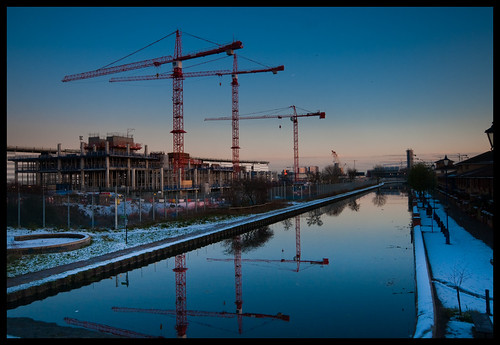
Olympic Park Cranes – Hackney, by Sam Cadby.

“Architect’s are very interesting because they’re on the brink of obsolescence…”

So saying, Iain Sinclair – psychogeographer, author, and self-nominated figure for the perpetuation of East London’s history – grouped architects with similarly defunct notions like ‘the spirit of place’, industry, integrity, common sense, community, etc, etc, etc. In short, everything that was once good and noble and is now rotten to its core. Boo, hiss, down with the modern world.

While I think the man is right about architects (I will elaborate presently), I am suspicious of anyone who would dissimulate a wild nostalgia (in which he seems veritably marinated) as a “fear of forgetting”. Certainly there is a fine line between wishing to engage meaningfully with the past and simply invoking history as a means to bombast an audience about the piteous state of the present. For me, this really distinguishes him from the other great psychogeographical author of our time, Will Self. Unlike Sinclair, Self is no moral pedagogue…

Sinclair’s subject was East London, its history, its architecture – a rose-tinted people fighting the good fight against the idiot developers and villainous politicians. In black and white terms he outlined the clear superiority of the city “as a human entity, as an organic entity” over the “post-architecture” imposed on the East by the coming Olympic-scale fuck-up. While I found his tone vaguely self-righteous, I nonetheless found his content interesting and his arguments extremely convincing (in several cases indisputable).

Readers from outside of London may not be aware of the Olympic situation, in a nutshell: the site is a vast tract of ex heavy-industrial land falling between Stratford and Hackney Wick (think fairly far east), towards the lower end of the Lea Valley (a rambling and beautiful wildlife park composed of marshes and canals). As Sinclair noted, it has always been thought of as an ‘edge’ of London – and it is psychologically disturbing to now realise that Stratford’s development will turn the nature reserve into an island, besieged by an ocean of urban nightmare.

The site beforehand, subject of the pamphlet referred to in this post on Cedric Price, was littered with industrial ruins, leftovers from a time when London still manufactured on any appreciable scale. What I did not know is that over 12,000t of radioactive material has been retrieved and re-buried at the site (evidence of a business that made glow-in-the-dark watch dials during the 60’s).

Like all Olympic games there has been scandal: £40million of “missing” funds, cost (and corner) cutting measures abound– the UK is in full recession mode after all. And yet the ridiculous promise of the developers is that they are attempting to give back a park to the public realm. This debased simulation of the wild beauty that existed before is indicative of modern ‘regeneration’ methods (e.g. an artistic drinking-hole is demolished to make way for an art-themed hotel, as at Old Street).
It would be hard to overstate either the incompetence of the architects or the stupidity of the clients involved in this venture. I’m not even going to touch that sensitive subject in this post, but simply let history validate my words. Sinclair could not find words to describe the process by which the client approaches an architect in the same way they would a hairdresser or a plastic surgeon, saying, “yeah, I like it, but I want a bit more of a curve over here – hey presto!”

Two final points, I had intended to write a short post, but the subject really fires me up:

was recently told that a town hall in Stratford was demolished in order to make way for a Tesco’s supermarket. I am now shocked to discover from Sinclair that there is a plan to extend the site to include apartments – residential zoning as an appendage to commerce: the possibility of perpetually living inside a mall. What then, mused Sinclair, is to stop all of Hackney from becoming an inner suburb of a supermarket?

the architect, that figure in decline, no longer has any control over the built environment, then what is his domain? This observation is not at all unique to Sinclair, and it is obvious that the profession is approaching a critical turning point. I would argue what we have to salvage is an architectural mode of thinking, a way of looking laterally at problems (the solutions to which often do not include buildings). The role of this coming generation of architects is to convincingly establish their dominance as the only and supreme profession of holistic thinkers… or else face professional extinction.

Wednesday, 7 October 2009

human geology


An everyday scene of a city during the apocalypse: London during the Blitz, via.

I was watching Time Team (a British archaeological television program) today – they were doing a special on the wartime defences of London (here, UK only). The site was Shooter's Hill, to the city's south east, which is one of the highest points in London. During the second war it comprised part of what was called the London Stop Line – military installations designed to slow down a Nazi Blitzkrieg invasion from Dover. These included bunkers, foxholes for anti-tank weapons, barrage balloons and a number of concealed traps. One in particular was a flamethrower disguised as a florists that could shoot a 100ft wall of flame across the main road, sending burning petrol rolling down the hill and into the forest.

Clue 1: While excavating a trench the team suddenly came across remnants of Bronze-age metalworking equipment (which is rare in Britain), with the possibility of a Bronze-Age hill fort underneath a foxhole. During the war they had dug into the hill and landed in the middle of another strata of history, so that separating the ancient and relatively modern finds became very difficult. The soldiers had compacted and superposed distinct epochs into a fused mess.

Clue 2: At a certain point a bunker was revealed that bore an uncanny resemblance to the National Theatre at Southbank. And I naively stared at it, thinking 'oh yeah, like London Brutalism was totally a re-interpretation of the local military architecture.'

Human Geology: The larger geological landscape is made up of stratified materials, granite under chalk under clay, and so forth, which each one having its specific period of time. At fault lines, there is a displacement that allows for two very different materials to be found very close to each other: closing the gap instantly between millennia. Cities are in a sense human geology, the various strata each being formed under different conditions and at different times, the Neolithic under the Roman under the Victorian, and so forth. Where we cut or dig into the urban territory we produce artificial fault lines, backfilled superpositions of history. Edwardian street lamps lighting Saxon longhouses, Georgian ballrooms within Roman villas. History becomes anachronistic.

Apocalypse: The AA's Inter 7 asks for a post-apocalyptic scenario that will tell us something about the world of today (don't they all?). And so my own tale is this: as the global trading power of China and India rises, and the power of the United States wanes, Europe will become economically marginalised. London will become a spent husk of its former self, and over several centuries immigration (there will be no reason to come to London, since better jobs will be found elsewhere) and declining birth rates will reduce the city to but a few million inhabitants. Vast, empty suburbs. With the unification of Europe, there will be no need for a capital of England, and as London declines in influence, the capital of Britain will be moved to its intellectual centre: Edinburgh. The centuries pass, and but for the hushed talk of when London was great, no one will think of it. It will become nothing more than the ancient capital of a defunct economic model.

But then there will be a new renaissance. And just as the thinkers of the Enlightenment turned to Greece and Rome for their precedents, so now will architect's turn to the untapped potential of London. Of course not much from its heyday will remain, just a few buildings, and the landscape will have changed quite drastically, but there will be at least several key buildings that will have survived, albeit in re-purposed forms (think about the Parthenon as a Turkish military stronghold). Because of the way we group history, we will no longer see the 19th as distinct from the 20th century. A period of several hundred years will be simply termed the 'British Golden Age' and architects will confuse Westminster Cathedral and the Barbican as contemporary, and misread their functions. The new hybrid styles that result from this cross-polination through the ages will form the basis of a neo-Londinian style: a baroque-brutalism, a neo-classical post-modernism. It will not be a poor pastiche of old styles, but a new style formed from an agglomeration of historical influences.

Houses of Parliament and the National Theatre and St. Pauls = What??

Friday, 11 September 2009

september 11: pruitt-igoe


Possibly you've seen this ad by the World Wildlife Fund (who'd have guessed?) kicking around the net recently. Possibly you haven't, because you are not yet incapable of unplugging from the digital world and have been off having 'face time' somewhere with someone. Lucky you. In any case, the ad sent people tropo (here, here, and here – 'oh no you di-unt'). The WWF's message is simple: the Boxing Day Tsunami killed 100 times more people than 9/11. Fair point. Well made. But even 8 years later people are still not really sure whether we can say those sorts of things. Apparently it takes 12.

I am fascinated by the Twin Towers – I don’t mind admitting that.

September 11, by contrast, is not a subject I indulge in, and for that reason I have decided to not make this a post about the towers (opening image excluded).

Of course I have my own ideas about the meaning, the causes and the results of those terrorist attacks, but that’s not for here. Buy me a beer and we’ll talk it all over.

Minoru Yamasaki, the architect of the Twins, is the real subject here. I'm going to start with his personal life: he is the only man I have ever heard of who married a woman, divorced her, married two more, and then re-married the first again. Weird. As far as his architectural skills go, he was clearly a man of great talent. However, his theories of urban planning were whack. To the question "why did you make two 110 storey buildings when you could have made one 220 tower?" he is quoted as reflecting a moment and responding (apparently sincerely) "I didn't want to lose the human scale".

The most extreme conspiracy theorists will tell you it was the government that destroyed the Twin Towers. If this is the case, then that makes 9/11 the second time the state has intervened to demolish Yamasaki's projects: the other famous one being the Pruitt-Igoe public housing complex in St. Louis.

Infamous amongst public and architects alike, Pruitt and Igoe were segregated projects (named after Pruitt– a black WW2 pilot, and Igoe– a white congressman) built in '55. Essentially, all his theories about how people would use the blocks were wrong. Apartments were purposely built small in order to encourage tenants to use the large public corridors and rooms, found on every second floor. Needless to say, these spaces became occupied by muggers, and the buildings became renowned for their violence and vandalism. The architect's drawings of smiling children rolling down the halls on tricycles never materialised. Like a lot of Modernists, Yamasaki was extremely naive about how the people actually lived, he said "I never thought people could be that destructive." Jencks famoulsy gloated that the projects' destruction marked the end of Modernism. Their demolition, less than 20 years after their construction, was captured in the film Koyaanisqatsi (music by Philip Glass). If you can spare 8 minutes of your life, watch the video below, its truly amazing.

Saturday, 29 August 2009

composite memories


The Parthenon.

After seeing Jason Salavon's 'Every Playboy Centerfold' series, in which he overlayed a decade of sexy pin-ups at a time, I was inspired to write my own little photoshop droplet and produce these images – which I will call 'composite memories'.


A game of tennis with two close friends. Australia.


The Barbican.


Sparklers and fireworks. Woy Woy.


LCD Soundsystem, Sydney 2007.

Friday, 28 August 2009

under the arches #1: euston approach

The Arch in the late 50's.

“The Euston Arch was a powerful symbol of the optimistic spirit of the Victorian railway. Its demolition in the 1960's confirmed that blandness and lack of imagination had replaced the heroic vision of the past. Since then, the enormous popularity of the restored St. Pancras, soon to be followed by a restored King's Cross, has shown that celebration of the past and potential for the future are not mutually exclusive. The restoration of the Euston Arch would restore to London's oldest main line terminus some of the character and dignity of its great neighbours.”

Last year I was having a beer with a Portuguese architect in Paris and we were talking over why English has become the global lingua franca. 'It can all be traced back to World War Two', I told him pompously, 'a war whose end was largely presided over by Americans.' He shrugged. As far as he was concerned it really started with the greatest technological invention of the 19th century– one that was pioneered and disseminated by Britain: the railways.

In trying to recapture some of the zeitgeist of that era I could only compare it with what I knew: flight. Surely the pleasure and excitement of flying must have been akin to the experience of travelling by train. Relatively speaking, the people found themselves effortlessly propelled fantastic distances at terrific speeds – and the change in thinking about the landscape and the world (and especially their connection to other people) must have been very similar. Are the railways responsible for raising an awareness of national unity– just as air travel impacted on the development of the global village? Is there a link to be drawn between the railways and the patriotism of the First War?

But then I thought about it further and I realised it wasn't at all the same. For this one reason: air travel is neither ceremonial nor ceremonious. At no point do we glorify the ritual of flight. It is said that airports are the gateways to the new metropolises. If this is the case they're pretty dire. One could argue that the mode of transport itself – the aeroplane – is responsible for this, in that it does not lend itself to being close to the centre of a city (sound and pollution). But I'm not convinced. Every aspect of flying is designed to desensitise the traveller. The sterility. The boredom. The waiting. The minuscule window, crap food, reticulated air. In short, an activity cramped and uncouth.

By comparison, the drama and ritual of arrival at London's first railway terminus seems remarkable. The sheer scale of the arch in comparison with its context, and the obvious reference to the temples of ancient Greece, must have been quite impressive. Initially (see below) the approach was open from various sides – but over time (see video) the densification of the city suggested a frontal approach with the concealment of the building up until the last moment.

For all the grandeur of Foster's Beijing Airport, it remains without a clear approach. It is all facade, yet there is no front – therefore there can be no ritual of arrival. I am interested less by the treatment of airports as necessary bi-products of the desire to travel, and more as legitimate destinations in themselves (and I do not mean simply as sterile temples to consumption).

While I don't agree with the date (the 60's in Britain, for example, produced some of the greatest Utopic projects of the century), I do agree with Palin that "blandness and lack of imagination [have] replaced the heroic vision[s] of the past". A bold idea can be the starting point of a conversation that leads to social change – while a beige idea begets only itself ad infinitum.


Euston station, probably around 1840.
A video showing the approach to Euston Arch. I managed to track down the author eventually.


Euston Arch during construction in 1837 – notice how closely it resembles the current state of the Propylaea.

Saturday, 22 August 2009

thames wading


Will, the powerstation in the background, and the Thames beach...

Word on the street is that there are between 80 and 100 bodies a year that float down the Thames. That's a gruesome statistic of 1 and little bit more than a half of a human per week. Apparently the majority are suicides. Or accidents, drunk people descend to the shore, get stuck in the mud and pass out. The tide – all 6 metres of it – then comes back in. Luckily, most cadavers get stuck in the U-bend before the Isle of Dogs, ending up at Limehouse – which is a favourite fishing spot for the River Po-Po.

If I had known this when my uncle proposed that we walk along the shoreline of the Thames, I might have refused, as it was I hesitated. Were there not diseases in the river? Couldn't I get tetanus, or tuberculosis, or typhoid (like all those kids back in the 70's, when the Battersea Park shore was a swimming beach)?

No, he explained, it was perfectly safe – the Spring Low Tide would make it possible to walk, well, he didn't know how far, but a fine distance. In truth I needed little convincing, and his 'you'll really be the best man for the walk' speech sealed the deal. Off we set.

You can re-live the whole adventure via my Facebook album, which I have made public (yeah, I feel we're at the Facebook level in our relationship), so I'm not going to try to recount everything now. Suffice to say, I don't know where my uncle got the idea of Spring Low Tide from, but the tide was not low. I have heard several claims about the actual date for the lowest tide of the year, ranging from about the 5th to the 12th of March. I have no idea which claim is correct, but I can tell you that at the 7th of July, our expedition could not be considered even an outlier of the group of possibilities. At one point, as we were negotiating around submerged industrial equipment in fecal-like mud, I sunk up to my groin. At Westminster, in view of Big Ben, the walk became something more of a swim.

But I am not one to complain, and in any case, I thoroughly enjoyed it all. In total we walked about 3 miles, and I would say about 10% of that time was spent in the water. But who can say they have waded in the Thames? As Will pointed out, this was the type of activity one is likely to do only once.

As I stepped off the greasy steps at Chelsea Bridge and onto the soft shingle of the shore I had a bizarre sense of having stepped under the city. When you are at eye-height with the river, on equal terms as it were, walking along a beach like almost any other (assuming all the others you know are scattered with the lost ephemera of 12 million people), and you see the bottom of walls and structures built directly onto the ancient rock of the Thames valley you get a very weird sense of being in a wild landscape. Suddenly the models in the Museum of London depicting Iron Age marsh people trekking over paths of compressed brambles seem very real.

At Vauxhall we passed by the oldest known bridge over the river, and looking carefully at the geography, I came to see why it was such an advantageous position, just as the water slows around the bend and the shores come a little closer together. They were no fools, our ancestors, they knew how to read the territory. I began to see the land like it was empty of human development. I began to already forget that the city existed – it was something that had retreated out of sight and thought, concealed behind cliffs crafted of crumbling Victorian brick.

And then under all this came a feeling of... not fear, but worry. I was reassessing my relationship to the river, but how did the river feel about me? Was this land hostile or merely ambivalent? I thought of Roman legionaries, spotting out the best place to build their new fort. Somehow the gap of two millennia had been closed, contracted just like that, and I was seeing London with new and very different eyes.


The old coal cranes used to provide the source of power for Battersea Power Station, which is going through yet another phase of design development. I heard yesterday that back in the day the piping hot water used as coolant in the plant was then fed under the Thames to heat the radiators of Dolphin Square, one of the most amazing estates I have ever seen.

Friday, 21 August 2009

london bridge is falling down


Old London Bridge, the drawbridge visible in the middle via.


Circa 1831, the new bridge having been completed, the old is being demolished, via. The scale is a bit out, but St.Magnus' can be seen on the left...

Now, I've noticed that traffic to Millennium People always drops off over the weekend. This may be something to do with the fact that I rarely post sat/sun– so today I am going to do several posts and then schedule them to appear over the course of the weekend, so do check back... Join me Saturday to wade in the Thames, and Sunday will find Millennium People discussing sharks on the moon.

After a comment (thanks Marc) about the Shifting Shorelines post on St.Magnus', I was forced to check my facts and do some more research into the history of Old London Bridge (it was a chronological error on my part), and I thought I would take the opportunity to herald the weekend with an architectural fantasy...

The origins of the nursery rhyme 'London Bridge is falling down' are contentious, some saying that it stems from a Viking attack in 1014 that pulled down the bridge (commanded by a king who would later become St.Olaf, or Olave, and whose church in London is now the final resting place of Mr. and Mrs. Pepys). Others believe the rhyme is in some ways connected with a legend that children sacrifices were buried alive into the foundations. Another version of the rhyme has the line 'Dance over the Lady Lea/Lee', and there is apparently an ancient story in the Leigh family of Warwickshire claiming remains of one of their ancestors are buried under the bridge.

After Olaf cleared out, several reconstructions took place – ultimately resulting in the famous 20 arches in stone that guarded the upper Thames from invaders and marked the northern reach of the Pool. Tidal variations in London are over 6m, and the narrow spans between the footings created an intense drag effect that could destroy small boats trying to pass. Most sensible people left their boats on either side during the worst times and would return when the waters were more settled, but there are tales of men "shooting the bridge", where the boat would ride the fierce swell and actually gain air as it was propelled out the other side (at terrific speeds).

I'm not going to transcribe the whole history of the bridge, the Wiki article on the subject is really well-written. My main focus for the post is the buildings built upon the bridge: a mill, initially used to crush flour but later adapted to become the first water pump for the city; shops; houses; two medieval stone towers (that displayed the heads of traitors on pikes) and several churches. Locked at night, it was essentially a self-contained town community. However the structures created a major fire hazard – at least two disasters are recorded, the worst was in 1212 when both ends of the bridge caught fire simultaneously and 3000 people died. The oldest example of pre-fab, Nonesuch House, was assembled on the bridge in 1579 (having been designed and built in the Netherlands), and the king's solution to congestion on the bridge is credited as why the English drive on the left, and not the right.


Towards the end of the bridge's life, the eclectic mash of buildings were replaced by stone townhouses, several with communal roof gardens.


Although several people have proposed inhabitable bridges, to my knowledge none have been actually constructed. Why is this? Watch this space for some proposals for a New London Bridge...


BIG's 'bro', one of the more interesting inhabitable bridge projects via.

Wednesday, 19 August 2009

Shifting Shorelines #3: Atlantikwall


A fragment of bunker that has toppled from a cliff above and is slowly being pushed into the sea by coastal erosion. Normandy, via Flickr.

Today’s post concludes the Shifting Shorelines posts and is a cerebral journey through time and space…
If you're new to the series, start at the beginning.

The goal of this mini-series was to examine Western conceptions of space, and hopefully to show how our understanding of place in time is really quite flawed. From London to New York, the final geographical focus is the shoreline of Europe between Norway and Spain.

I am talking about the Atlantikwall, the massive system of military reinforcements and installations that the Nazi’s built way-back-when, and the subsequent subject of several fascinating analyses, namely by Ballard and Virilio.

The metropolitan bookends of the Atlantic demonstrated what happens when an object (a building, say) is fixed, and the shoreline or city moves around it. By contrast, the action of time on the coastal defences is exactly the opposite. Hitler’s unintentional eternal architecture is moving. Shamed by its parent it is creeping year by year towards the sea, and out of the limelight of history. Since space and time (according to Einstein) are completely relative, the two processes are consequently identical; it simply depends on your point of view.

The basis of our understanding of space is the cardinal (or Cartesian) crosshair: a three-dimensional matrix of x, y and z co-ordinates. It relegates any particle in the universe to a very specific point in space (which is an ether, or a vacuum, that is then filled with matter). But there is an essential paradox: space is defined by its volume – which is abstract and empty – and not by the matter that occupies it.

69, the Hackney Road will always be 69, the Hackney Road, even if the shady striptease that occupies the site is demolished, because in occidental terms the place is defined by its point relative to another place, and not by the materiality of the building. The building, by contrast, is restricted by its materiality. If the striptease is demolished, even if the same owner builds another striptease, we call that a new building, and demarcate it as different from the ‘old’. This is called a cadastral mentality. In China, certain thinkers would tell you that when the new Freedom Tower is finished, it will be the same tower as the one that occupied the site before – that is, there is a continuity of building identity, even when there is no material continuity.

It is, therefore, a relative universe we live in. Our precision about the location of material in space (and its associated properties of volume, velocity, etc.) is dependent on where we set the 0,0,0 of out cardinal grid, which is arbitrary. The basis of all perception of space starts with two points. So it is that we navigate our own planet (longitude and latitude), where the two fairly arbitrary starting points (Greenwich and the equator) thus determine the identity of all places on the planet for all time.

Take a white room with no doors or windows – it could be anywhere, and for precisely that reason it is nowhere or everywhere. Its lack of referents renders it aspatial. By contrast, the smallest aperture immediately infers context and location. It positions the room somewhere and therefore permits for the conditions of genus loci, or the particularities of a place.

But, given that matter is in constant flux, and that everything in the universe is constantly moving, how can one choose an Ultimate 0,0,0? Even Greenwich is spinning round at over a thousand miles per hour (or a little bit faster than the speed of sound), and the planet itself is revolving around a star, and that star is moving in the galaxy, which is… and so on. So there can be no objective stationary point, and therefore no ability to claim that one point in space remains the same over time.

The eventual difference is between place and location in space. We tend to use the two interchangeably, but I think it is fair to make a distinction. A location in space is the occidental way of saying “a position relative to me and my body whose definition I understand and accept, and which I believe exists in time, immutable”, while a place is something we recognise as completely subjective, and changeable, susceptible to our experience and relation to it. It may be linked to personal associations or a sense of identification. The adult that returns to their childhood home to find it has become a ruin recognises that it is no longer the same place – that the place survives solely in memory. By contrast, once the house is restored that adult may be tempted to view it as once again the place of their childhood, even though materially it is quite different.

Finally, I think Borges excellently outlines the absurdities of our belief in the absolute referential system of space over time, by reversing the situation – by making time the constant and space non-continuous. I have mentioned the fable before, but it bears repeating:
"The hypothetical case of nine men who on nine successive nights experience a sharp pain. Would it not be absurd, they asked, to pretend that the men had suffered one and the same pain?"

The continuation of a similar pain in the same location over nine nights is coincidental, and not evidence that it is the same pain. The same would be true of an object: a coin seen in a room by nine men over nine successive nights is, materially, equally non-continuous. Further, to claim that a lost coin on monday and a found coin on friday (that bears the traces of having spent several days in the rain) are the same coin is nothing more than the 'association of ideas'. Classic Borges. This is why the spirit of place is non-continuous in time, but exists only for the moment it is experienced. Try returning to any childhood holiday site and see if the essence of the locale remains...

Thursday, 13 August 2009

casios and bombs


Detonation of seized weapons in Afghanistan, via militaryvideos.net – by the troops, for the troops...


Last night I went to the Dalston Superstore for a Diesel U:Music party (my brother is a sometimes radio presenter there). I got talking to this one girl, about the relative efficiency of various makes of timepiece (fascinating) and she said "you ought to get a Casio, like me". I looked at the watch and had a sudden flash of recollection.

"When I was 15, they invaded Afghanistan" I said "and of course I watched it live on TV. About a week into the war I remember seeing a heap of dead bodies – the first enemy victims of the invasion. At the bottom of the pile was an arm and a hand sticking out, and the camera zoomed in on his watch – the same Casio you've got there – and I thought, how poignant" I paused for dramatic effect "how poignant that this watch keeps on ticking, probably for years, long after the man that owned it has ceased to be."

I got a bemused, if somewhat cold, stare. I needed to turn this one around, and fast.

"So what I'm saying is, they're pretty reliable, and if you get American's all up in your business, invading and shit, well... you know what time it is."

A chuckle. Saved. Barely. Still, funny the things that obviously mark you but lie dormant, a silent bank of influence.