Showing posts with label psychogeography. Show all posts

Friday, 26 February 2010

redefining the landscape

Chris 'Blane' Rowat from Parkour Generations.

Guest post by Shaelena Morley

Somewhere there is a toe tapping to music on the tube, a ballerina is practicing her port de bras, a child is testing gravity in an effort to jump the highest off the swing set. There is grace and fluidity to the simplest of movements. And in these movements a fascination takes root when we take that first step as infants and begin to understand our body in relation to the space around us.
With adjectives such as bustling and fast-paced, the city, like the body, can be described through movement. Listen closely and you can almost hear her thrum as her individual components move about in the daily grind. Ironically, with traffic and people and queuing, the individual components (that’d be us city-folk) are rarely moving freely so much as constantly bumping into one another in a sometimes maddening staccato rhythm. We’ve all this energy and nowhere to go, and somewhere along the way we lose that spatial connection with the city.

And yet the “we” I refer to doesn’t apply to all city dwellers. A community dedicated to movement has been developing slowly over the years and more recently is coming to the forefront and establishing itself as its own culture. What began as le methode naturelle in France at the turn of the 20th century, a kind of physical training emphasising both body and mind, has evolved into l’art du déplacement more commonly known as parkour. Where the spatial connection of the city is lost, in parkour it is found by providing a new vantage point for engaging with the urban environment. For a parkour practioner, known as traceurs, the name of the game is efficiency of movement and continual engagement with the present and its surroundings. In moving from point A to point B in the city, the traceurs knows no obstacle, only the straight line in plan, the undulating line in section. Leap over the wall, onto the next, under the rail and over the path only to land with cat-like precision on the rail’s edge and drop almost silently to the ground far below. L’art du déplacement is executed with astounding agility (and certainly with more grace than I can muster).

I recently had the privilege of witnessing the discipline in action when I attended a “jam” in Southwark hosted by Parkour Generations for research. What became immediately apparent to me was the fact that this is very much a community. The morning began as an outdoor training session teaching very particular skills, but as the day wore on little by little people trickled into the abandoned estate from all directions for what would turn into an afternoon jam. With varied skill levels and virtually every demographic you can imagine, parkour veterans and newcomers alike practiced their skills, learning from and teaching to each other despite frigid temperatures and calloused hands.


Physical intensity is inherent in parkour and the nimble movement receives well-deserved attention. More than once I’ve heard parkour referred to as, “the jumping guys.” But with physical tribulation there lies mental trial, brain the foil of brawn. It is the mental discipline – the preparation, the focus, and the incredible awareness of the body and its surroundings, which is most impressive and likely the bigger challenge. It is with complete awareness that the mind can redefine its surroundings and the body can run free. And what does London look like through this new set of eyes? Why, like a psychogeographic playground, my good Millennium People. Suddenly the scale of the city revolves around the scale of the body - the grip of the hand, the breadth of the foot; distances are measured in human strides. And in continual oscillation from earth to building to wall to earth again, London is flat no more. She is a new landscape.

Here’s to new freedoms.

Tuesday, 23 February 2010

iain sinclair on nostalgia & forgetting


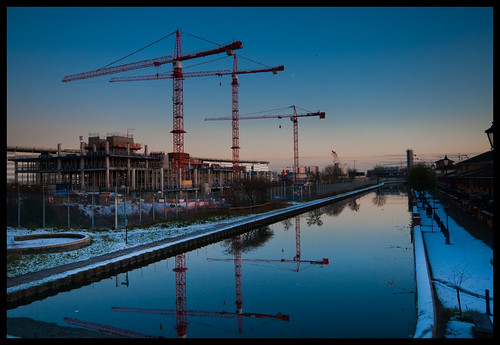
Olympic Park Cranes – Hackney, by Sam Cadby.

“Architect’s are very interesting because they’re on the brink of obsolescence…”

So saying, Iain Sinclair – psychogeographer, author, and self-nominated figure for the perpetuation of East London’s history – grouped architects with similarly defunct notions like ‘the spirit of place’, industry, integrity, common sense, community, etc, etc, etc. In short, everything that was once good and noble and is now rotten to its core. Boo, hiss, down with the modern world.

While I think the man is right about architects (I will elaborate presently), I am suspicious of anyone who would dissimulate a wild nostalgia (in which he seems veritably marinated) as a “fear of forgetting”. Certainly there is a fine line between wishing to engage meaningfully with the past and simply invoking history as a means to bombast an audience about the piteous state of the present. For me, this really distinguishes him from the other great psychogeographical author of our time, Will Self. Unlike Sinclair, Self is no moral pedagogue…

Sinclair’s subject was East London, its history, its architecture – a rose-tinted people fighting the good fight against the idiot developers and villainous politicians. In black and white terms he outlined the clear superiority of the city “as a human entity, as an organic entity” over the “post-architecture” imposed on the East by the coming Olympic-scale fuck-up. While I found his tone vaguely self-righteous, I nonetheless found his content interesting and his arguments extremely convincing (in several cases indisputable).

Readers from outside of London may not be aware of the Olympic situation, in a nutshell: the site is a vast tract of ex heavy-industrial land falling between Stratford and Hackney Wick (think fairly far east), towards the lower end of the Lea Valley (a rambling and beautiful wildlife park composed of marshes and canals). As Sinclair noted, it has always been thought of as an ‘edge’ of London – and it is psychologically disturbing to now realise that Stratford’s development will turn the nature reserve into an island, besieged by an ocean of urban nightmare.

The site beforehand, subject of the pamphlet referred to in this post on Cedric Price, was littered with industrial ruins, leftovers from a time when London still manufactured on any appreciable scale. What I did not know is that over 12,000t of radioactive material has been retrieved and re-buried at the site (evidence of a business that made glow-in-the-dark watch dials during the 60’s).

Like all Olympic games there has been scandal: £40million of “missing” funds, cost (and corner) cutting measures abound– the UK is in full recession mode after all. And yet the ridiculous promise of the developers is that they are attempting to give back a park to the public realm. This debased simulation of the wild beauty that existed before is indicative of modern ‘regeneration’ methods (e.g. an artistic drinking-hole is demolished to make way for an art-themed hotel, as at Old Street).
It would be hard to overstate either the incompetence of the architects or the stupidity of the clients involved in this venture. I’m not even going to touch that sensitive subject in this post, but simply let history validate my words. Sinclair could not find words to describe the process by which the client approaches an architect in the same way they would a hairdresser or a plastic surgeon, saying, “yeah, I like it, but I want a bit more of a curve over here – hey presto!”

Two final points, I had intended to write a short post, but the subject really fires me up:

was recently told that a town hall in Stratford was demolished in order to make way for a Tesco’s supermarket. I am now shocked to discover from Sinclair that there is a plan to extend the site to include apartments – residential zoning as an appendage to commerce: the possibility of perpetually living inside a mall. What then, mused Sinclair, is to stop all of Hackney from becoming an inner suburb of a supermarket?

the architect, that figure in decline, no longer has any control over the built environment, then what is his domain? This observation is not at all unique to Sinclair, and it is obvious that the profession is approaching a critical turning point. I would argue what we have to salvage is an architectural mode of thinking, a way of looking laterally at problems (the solutions to which often do not include buildings). The role of this coming generation of architects is to convincingly establish their dominance as the only and supreme profession of holistic thinkers… or else face professional extinction.

Wednesday, 6 January 2010

wireless fears

Digital Rising
A visual representation of the Digital Dialectic...

City people do not give a damn about their physical orientation. Urban dwellers do not know where they are. They could not tell you where north is, or at what angle the sun rises in winter. They will tell you that London is flat, because online maps have no topography. Almost no Londoners have seen the mouth of the Thames, nor even a photographic representation of it. Psychogeography is outmoded, depressingly retrospective.

The real has already become irrelevant.

The fear of city people, who make up more than half the world’s population, is not physical disorientation, but digital disorientation. Our eternal angst about social acceptance has been superposed into the digital realm. Belonging is about Facebook networks, Twitter followers, Blogger comments, and, to a lesser extent Myspace fans, ICQ & MSN Messenger contacts. Of course, the names of these programs will change, but the essence of online acceptance will remain. It may even get more extreme, as perhaps indicated by the rising popularity of Massively Multiplayer Online Role Playing Games (MMORPG).
Further, our fear is not only that the online community will accept us – in whatever guise we choose to present ourselves – but also that we will be able to connect to them.
Chat abbreviations like ‘do’ (dropped out) are becoming more and more rare. The era of the permanent threat of imminent disconnection is over. The fear of temporary disconnection had been replaced by a much greater fear of permanent disconnection...