Showing posts with label internet. Show all posts

Wednesday, 9 June 2010

post net art and the new now


Screenshot from Ian Andrew's 2002 net.art piece: Ether-1.

I know Millennium People has been quiet recently. But the summer is coming, and a bold prospect of speculation awaits us. In the meantime, a finally-finished draft:

'The New Now' is the term used in this blog's tagline. It's really just another way of saying 'spirit of the times' or 'zeitgeist' – which were not used for these reasons: the former puts one in mind of la belle epoque, and the latter smells a bit too much like Nazis and 9/11 conspiracies. The core business of this blog is the attempt to describe, if only in a lateral or fragmentary sense, the conditions that make life in the second decade of the third millennium the swell trip that it is. It pursues several fields: global and local economic trends; our changing relationship to technology (in particular the Internet); the city (as a psychogeographical, historical and political arena) – all primarily through the lens of architecture and the built environment. Except of course where that lens fails to describe anything of relevance, which is more frequently than you might think.

"Net art is seen as an archaeology of the future, drawing on the past (especially of modernism) and producing a complex interaction of unrealized past potential and Utopian futures..."
Julian Stallabrass
"Hype around Net-based art began in the early 1990s, before the Internet had become a commodity. It developed in skeptical parallel to the rise and decline of the new economy. In 1997, documenta X featured Net art. Around the same time, major museums in the US started online art commissions or virtual showcases. The first (and last) retrospective exhibition, “netconditon,” was held in 1999. Several books published in the first years of the new millennium give overviews of the practice and theory of this art. But since then, this particular chapter of art history appears to have closed. The final indication that Net-based art was not to become another genre in the contemporary art canon was perhaps the discontinuance of the “Net vision” category in the Prix Ars Electronica 2007."

So begins Net Pioneers 1.0, a book about contextualising early Internet art. I'm fascinated by Net Art – which is produced specifically for the medium of the Web – such that remains, like Blue Hyacinth or Seattle Drift. And while this book dates the death of Net Art to 1999, I think it is clear that art that can only be experienced through the Internet is flourishing. We are using information today in such remarkable ways, here are just three of my favourite examples of what I would call Post-Net Art (Po-NeAr?):

1. Solar Beat: an ambient music artwork that composes a score by assigning each planet a note and then having that note sound when the planet passes a datum. Art thanks to flash (oh what will happen when Flash finally dies?)


2.Moonbell: developed by the Japanese space agency JAXA this is a violent piano piece generated by the scans returned from Selene (one of Japan's orbiters that recently crashed into the moon). You are hearing a translation of the moon's surface into music.


3.Three Frames: surely the Internet's greatest .gif (sic) is the addition of time to mediums that were otherwise atemporal. Three Frames is not the only, but one of the best, examples of a blog dedicated to expressing minute slices of time in otherwise still images.

Tuesday, 18 May 2010

fistful of links


Latitude of Silence by You LI.

Sixpence an adventure and he'll take you home again: some news.

Every week I wrap up the world on the web, this week it's the web in the world that has got me in a tizzy.

Some ideas about surfing is a new zine by the young artist Joel Colover (available here as a pdf download) exploring the act of web-browsing as a type of Situationist derive – or passive drift. It is a nice return to the 90's zine aesthetic, featuring bold text and xeroxed sketches.

"Tab based browsing is surfing different waves at the same time. All the time. On the Internet we surf the currents left by other users. Old lost content and new data supply us with the momentum we need... The Internet is not a world, it is a city the size of a universe. It can be split into different quarters, not just based on content, but also on presentation, design, architecture of the pages. This is what the invisible walls are made of."

+++++

The Facebook/privacy debate continues. I can't say I'm too happy about Google's monopoly of the Web, especially when it turns out they were using Street View to capture information from people's wireless networks. That said, they are still miles better than Facebook – the "obnoxious drunk girl at the party/Internet". Related, the US still using a mercenary spy ring. Related, Cold War Paranoia. Maybe related, computers have replaced all your friends. The original lightweight portable telephone: $1499. (Wow, old technology is so attractively crap).

Left: Eventual Ghost. Net neutrality looks like its going to be a thing of the past real quick; Also things of the past: "Future Days" a book by Asimov describing turn of the twentieth century visions for the future. I actually own this book, it is a pleasure. Also books: OMA are exhibiting all of their books at the AA. Hear what the Sesquipedalist has to say about it. Also OMA: old Coney Island postcards.

Inevitable ending, when print meets the net: the 48hr magazine project. Same subject: the magazine of tomorrow (developed by Millennial Wunderkinds Berg London). If you don't know Berg, like, really, do yourself a favour and check that shit pronto: touch, here and there, olinda, the schooloscope (to mention just a few of their amazing projects); The Internet approaches its address limit. I think we should start erasing the weak and old websites to make more space. Controversial. What Google fears most; the continuity of inter-connecting relationships; cloud computing goes mainstream (WATCH OUT FOR THIS ONE). Our one hope for the future of the web (not to be over-dramatic): the Icelandic Modern Media Initiative. This is the opposite of the Patriot Act of the Internet: the Digital Millennium Copyright Act. Does anyone else feel like the present stumbled into Blade Runner? On a lighter note, the real is now irrelevant: Banksy returns in digital form. A tip off for MP: Geocitiesizer, make any website look like it was designed by a 13yo in 1996.

Dross: I love unhappy hipsters; big babies at the Shanghai expo; Universal Corrective World Map; Britain is being run by a coalition, in case you didn't hear. It's like the Uk has got two gay dads – Conservative/Liberal Democrat agreement; some of the world's oldest colour photos; 40 mind-blowing hubble pics; dope NASA images; oh, and I remember where all the fistfuls are to be found thanks to Instapaper.

Finally,


A day at Walmart, via Club Construct.


Christianese via Sociological Images.

Friday, 14 May 2010

screens


By the time you read this, I will already be on my bike. Ah, automatic scheduling.

Just a quick (hopefully not too banal) observation on the development of the computer screen: I have often had teachers and employers (admittedly less with every passing year) that have had trouble 'reading' screens. Print that shit out, they say. And I say, fine, it's your time and money. As long as that is the case, otherwise I kick up a stink.

I've always maintained that the reason these people have been unable to read computer screens ("Jesus, Jack, stop whirling around for a minute and just stay still!") is because they are misunderstanding the purpose of the screen. A cinema or even a photograph is just a flat surface onto which an image has been projected. It remains clearly limited by the frame, we are not supposed to think there is anything outside it. Indeed, the joy of cinema can only come when one forgets the intense action that surrounds every minute action.

Not so with the map. When we look in an A-Z we are looking at some enormous, perfect, map of the entire world. It happens to be arbitrarily cut up into frames, through which we look at a portion. With the map there is a space beyond that of the edges, a map-reality we can peer into. The computer screen operates the same way, as a membrane separating us from some other, virtual, reality. My generation sees the membrane as wholly arbitrary because we believe in the reality of the image within. In other words, we believe it has space.

The confusion of reading a membrane like a flat surface means the image appears inconsistent, blurry and dizzying. Every moment it composes itself it changes again. So when Gramps struggles with your flash Japanese DS game, riddle it out to him in these terms.

+++++

This is just a paraphrased version of an opening paragraph to a veerry long piece I'm working on at the moment about the meaning of the architectural render. Watch this space. At least the movie is pretty cool, no?

Wednesday, 12 May 2010

strangers on the web


A tip-off sent into MP, originally from I-Am-Bored.

gallery-as-internet


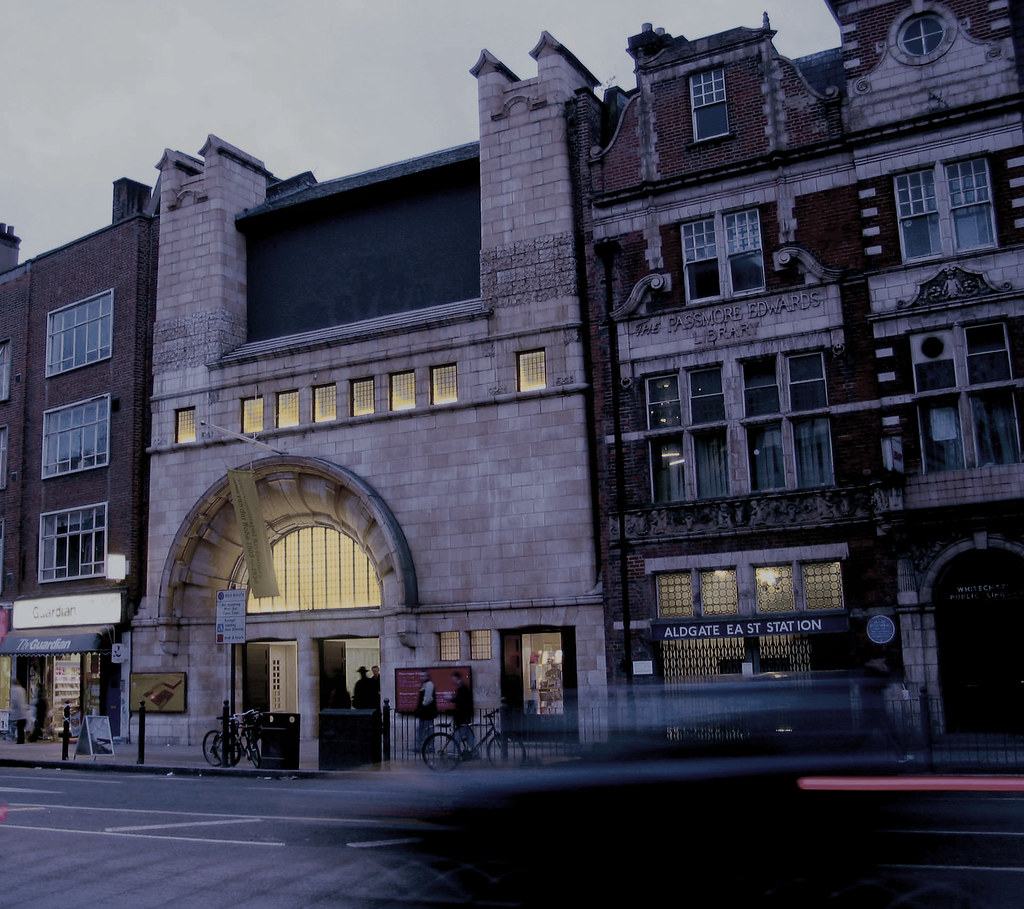
Last night I spoke at the Whitechapel for Love Art London on the subject of Robbrecht+Daem's Whitechapel Gallery extension and renovation. Perhaps the only downside was the fact that I delivered my bit, then had to repeat it twice more over a three hour period. During the second iteration a piece of sonic sculpture started singing next to me, and just before the third an old architect came and asked me some really intense questions, which threw/bored me. Unlike wine, but very much like humous, the subject did not improve with ageing. Here is the kernel of what I said:

There is almost perpetual conflict between the artist and the architect, though most of this can be put down to envy on the part of the architect. Never is this more true than when the architect is commissioned to design an art gallery. The temptation for the architect is to simply construct such a fantastic piece of sculpture than the building itself becomes art, and everything within it becomes somehow secondary to its housing. I'm thinking of Bilbao.

If the opportunity to really get in there and make a statement is non-existent, then the architect will prefer to design an art museum rather than a gallery. The contents of a museum are depoliticised, making the art safe for public consumption – and certainly no threat to the architecture. There is a feeble excuse sometimes given: since the word museum pertains to the muses, and therefore art is the product of divine inspiration, the proper place for art is in a temple. Hence the fact that most art galleries built up until the end of the 19th century were Neo-Classical, with steps running up to a large plinth and imposing collonnade. I'm thinking of the British Museum, the Tate, etc. While quite formal, at least everyone knew their place. The destruction of formal distinctions between art and architecture is what leads to the collapse of one onto the other. I'm thinking of Anish Kapoor's monstrosity for the London Olympics.

The Whitechapel is a heritage listed building. So is/was the adjacent 'Whitechapel Free and Public Library' which was bought by the gallery in 2001, with a view to expanding the relatively small exhibition space. Because the whole structure sits on top of Aldgate East tube, there wasn't that much room for architectural intervention. What remained for Robbrecht and Daem was principally a question of circulation.

The firm compared their proposal to a type of Art Internet: rather than the traditional sequence of lineally organised galleries, with coherently collated art, here the viewer can choose their own trajectory (backtracking, sidestepping and allowing intuition to guide them from one room to the next). Boredom was a big factor, the idea that someone could just pop in, have a coffee, do a quick swing into one, but not necessarily all, rooms and then whip out again.

I was pretty horrified by the analogy. If the Whitechapel acts, or is supposed to act, like the Internet – why on earth would I go it? If we look to print media, the newspapers and publications that are surviving and thriving (the Guardian, for example) are doing so by providing good critique, not simply news (which is omnipresent). If the art gallery fails to add anything to the experience a user might otherwise have clicking through their site, what is the difference? Why not virtualise the institution? I have to say I've been a couple of times since the Whitechapel reopened and I've found it each time pretty tame, maybe digitisation is the answer, an easier way to radicalise the art experience?

Monday, 29 March 2010

the origins of my short attention span


I got my tea from the bar and shuffled over to the sofa near the window "Oh yeah, I remember Messenger" Bella said, in answer to my question "the thing I really hated about it was how everyone tried to talk to you at once. I could only have one conversation at a time, so I would block all the other contacts I wasn't talking to."

That's funny, I thought. Isn't multiple and simultaneous conversation the whole purpose of using a chat program? It started a train of thought that lead me to one conclusion: the origins of my digital multitasking was Messenger. In the days when my net connection was still only 2kb/s the idea of browsing was an impossibility. In any case, I'm not sure there was anything much to browse. The net was for e-mail and chatrooms... you remember, like, before the peodos got there?

Not only can we no longer concentrate on one thing for any appreciable period of time, but we can neither concentrate on one person – by spreading our attention across multiple discussions we fail to achieve any depth of communication with any of them.

Millennium People out.

Wednesday, 10 February 2010

flattr


We first got the Internet in our house in about 1996 – a 2kb/s dial-up. By the late 90's it became evident to me that what had essentially been simply e-mail (at 2kb even browsing for text information just wasn't time efficient) was evolving. The public gaze had turned to Silicon Valley and the Dot Com boom, with an expectation that what was going on there was going to revolutionise... something. Oddly, even though people began to speak openly about the Internet Revolution (also Digital Revolution) and already refer to it in its historical context next to the Industrial Revolution, what this so-called revolution was overturning remained obscure and indeterminate.

The Dot Com Bubble can be largely attributed to the failure of these web companies to find a convincing way to make money from the Internet – the sentiment that "everything on the Internet should be free" had already taken deep roots. The Internet failed to fit into a market-based capitalist system because the fundamental basis of producing valuable information for free was economically nonsensical. And yet it exists. Further, today you can't stop people from doing it – as I am right now in this blog post.

So for several years the struggle to find a way to make money from the web continued, culminating in web2.0 and an acceptance that the only way to make money was from advertising. Simultaneously to this was a sharp rise in Internet piracy as peer-to-peer filesharing networks (napster, kazaa + limewire will always hold a special place in my heart) began to become endemic. But the direct sharing of files had its problems, it relied on parties being connected directly to each other for as long as the download took to complete, which could be quite a while back then. In the early 2000's the other major problem was the great inequality in Internet speeds – my own connection had barely gone up (~25kb/s) while those in the States and Japan had greatly improved.

The invention of large online storage hosts (rapidshare, megaupload, etc) largely solved these problems. However, I feel it was the torrent that really revolutionised peer-to-peer sharing (a torrent works by dividing a file into, say, 1000 pieces and then allowing a user to download multiple pieces from multiple users, effectively multiplying the speed of the download, and removing a dependence on the downloader of remaining connected to a stable uploader).

Flattr comes from the creators of the infamous Pirate Bay (one of the largest torrent sites) and I think its power to shape the future of the web (either directly, or through copy-cat and subsequent developments of the idea) is obvious. With all this talk about the death of the newspaper, I wonder if the fate of the print-media isn't going to be some sort of Flattr future, where content producers are equalised, where a good blogger can earn as much as a NYT writer...

There's a speculation on the new now for you.

Sunday, 31 January 2010

poster series (#2)


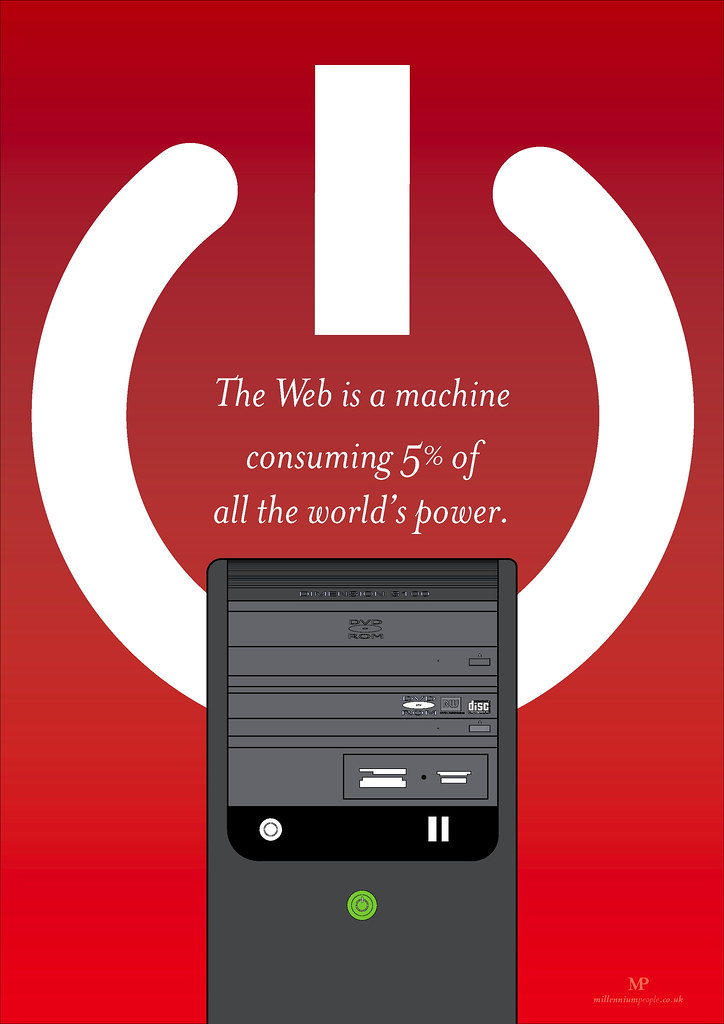
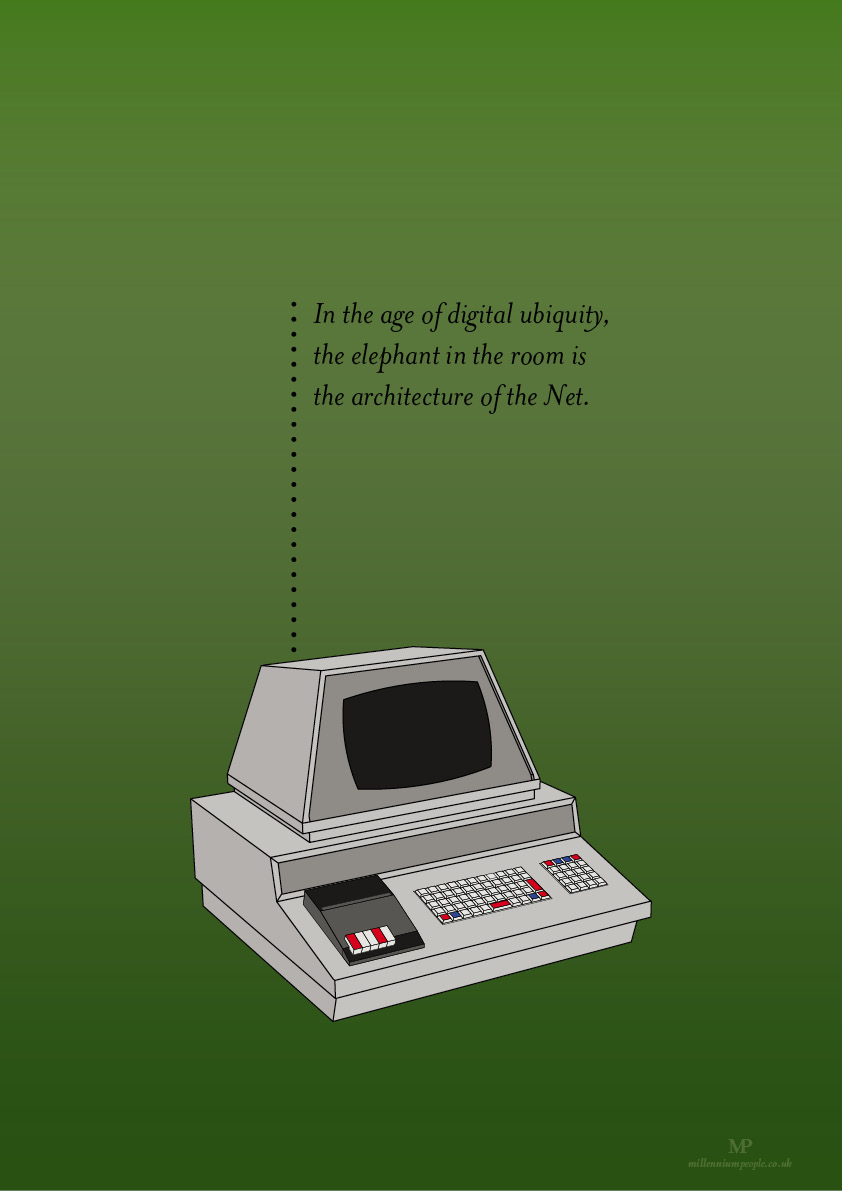
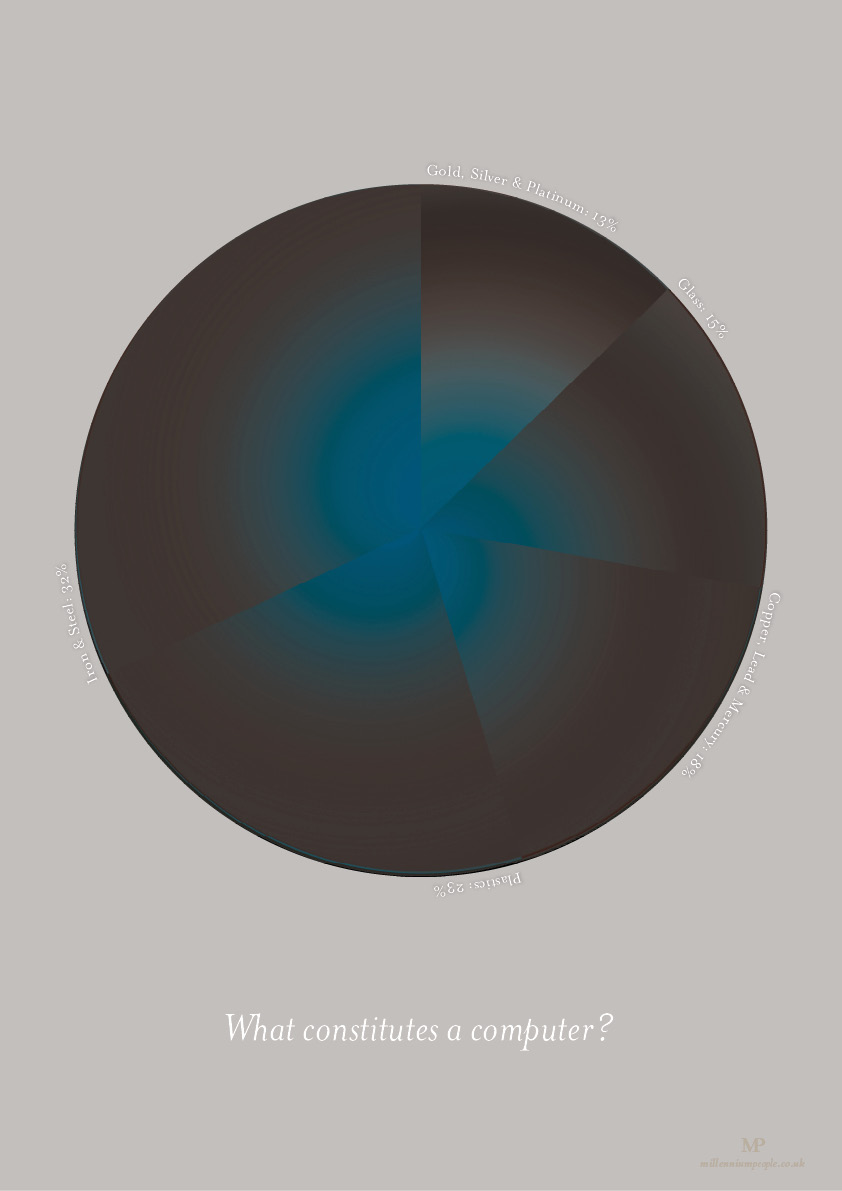
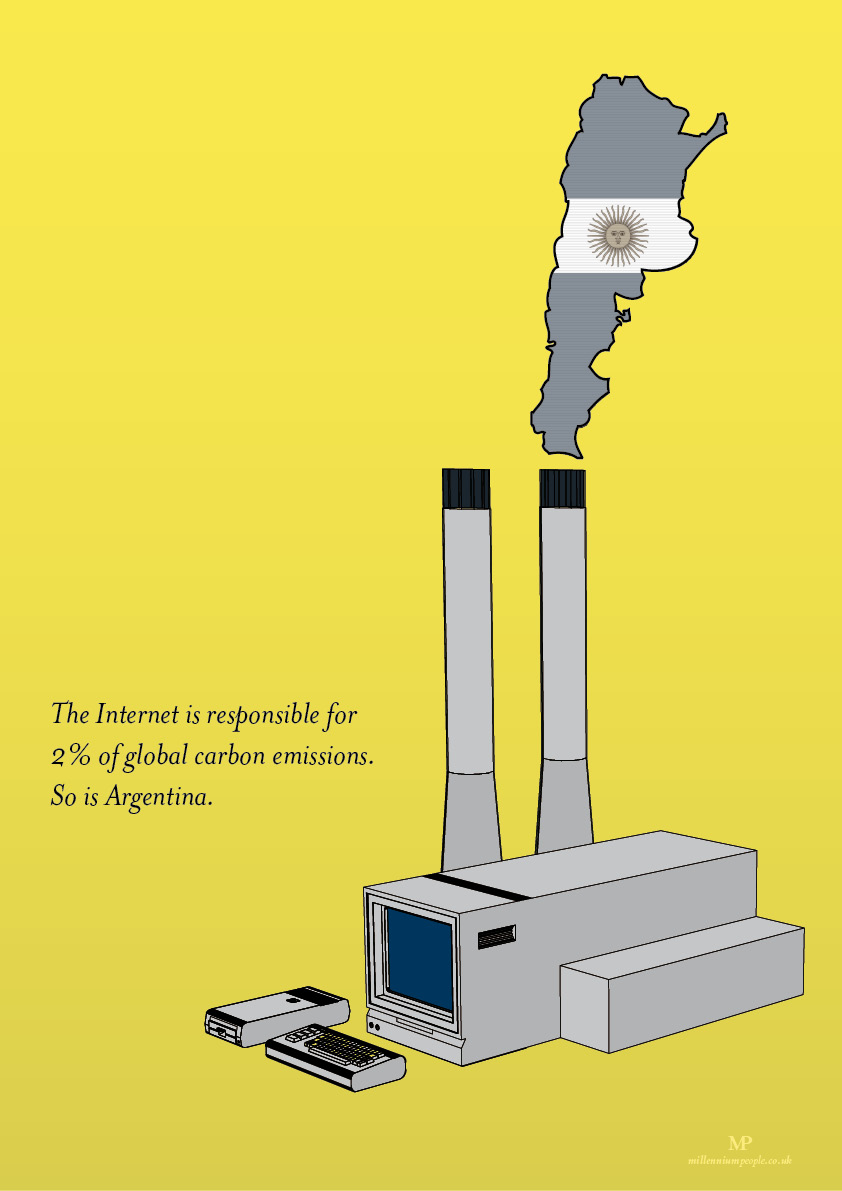
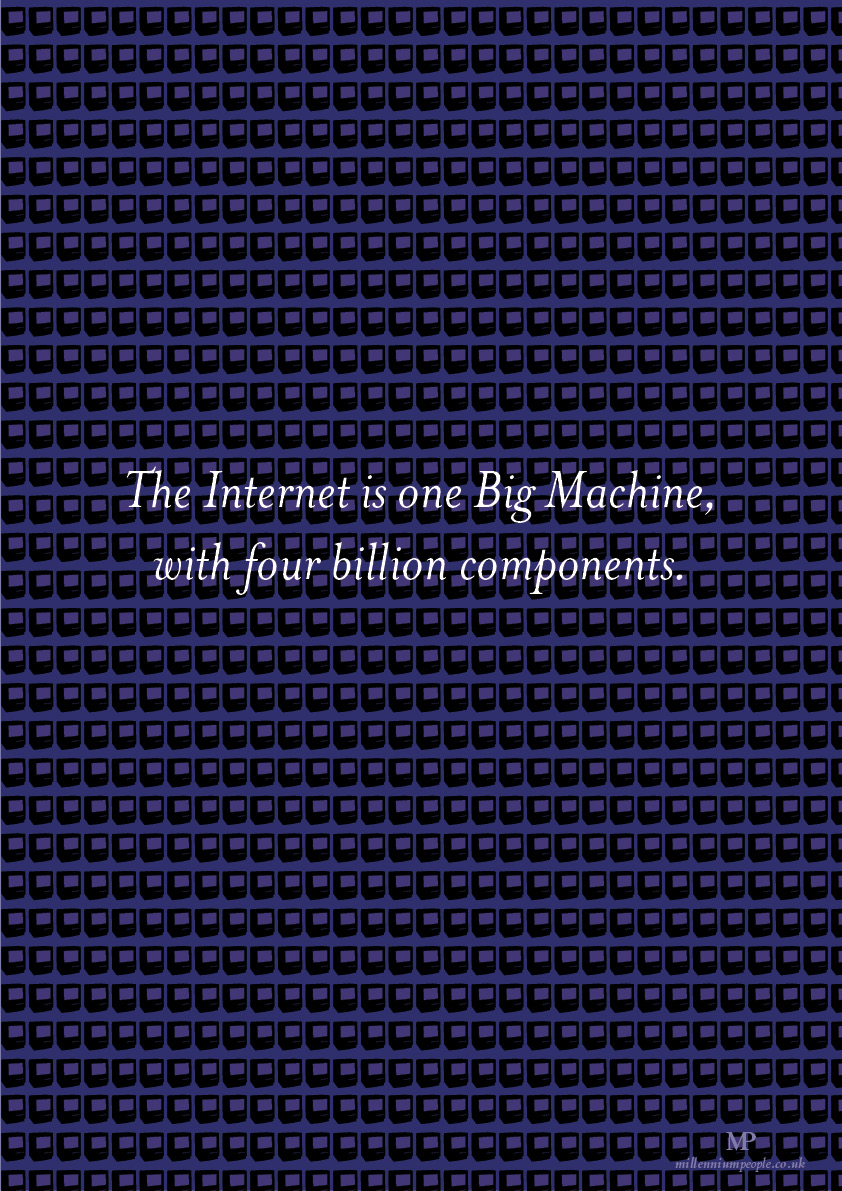
The final two posters in the Millennium People Internet series (find the other 5 down the page, on flickr, or here)

Monday, 25 January 2010

millennial escapades


If virtual space is treated as seriously as real space, then at a certain point the design of wireless fields comes into play. But how to design with an invisible medium? My aim was to influence the virtual, so I built a room within a room, a network within a network....

I went to the Apple store with a wireless broadband dongle and changed the network of the computers from Apple to myself, then set the network homepage to be my blog. The Apple red-shirts tried to work out what was going on... it took them some time, during which all Apple store customers were obliged, upon opening the safari browser, to read my blog. I was discovered and ejected.


Observant readers will notice this took place at the end of last year, during the hiatus, before MP got its makeover.

Sunday, 24 January 2010

poster series


A new Millennium People poster series aiming to bring to light some interesting facts about the Internet, question our relationship to it and the portals we use to view it. Viewable on Flickr.

Monday, 11 January 2010

how big is the internet?


The Internet, via.

There are somewhere in the order of 4.2 billion unique Internet addresses (IPs), housed on 44 million servers. These consume about 5% of all the world’s electricity and produce about 2% of all carbon dioxide emissions. This amounts to roughly 80 megatons a year and is similar in output to the emissions of Argentina or the Netherlands.

It is comprised of about 40 million gigabytes of information, which, in its simplest form, would weigh something in the order of fifty-six millionths of a gram.

Here the contradiction: the Internet might, theoretically, occupy less space than a single grain of sand, and yet its contribution to global warming is equal to a small country. It is both an immense geographical entity and a miniscule atomic whisper. It exists in a time and place, and yet transcends that to become timeless and aspatial.

It is an emergent system, where a highly-engineered, yet simple, set of rules has allowed for the creation of a massive network sprawling across the planet. The structure of the Internet is a hub and spoke system, in which information is hoarded at central servers and trickled down to individual IPs, making it, in technological terms, far from democratic.