Showing posts with label future. Show all posts

Thursday, 15 April 2010

fistful of links


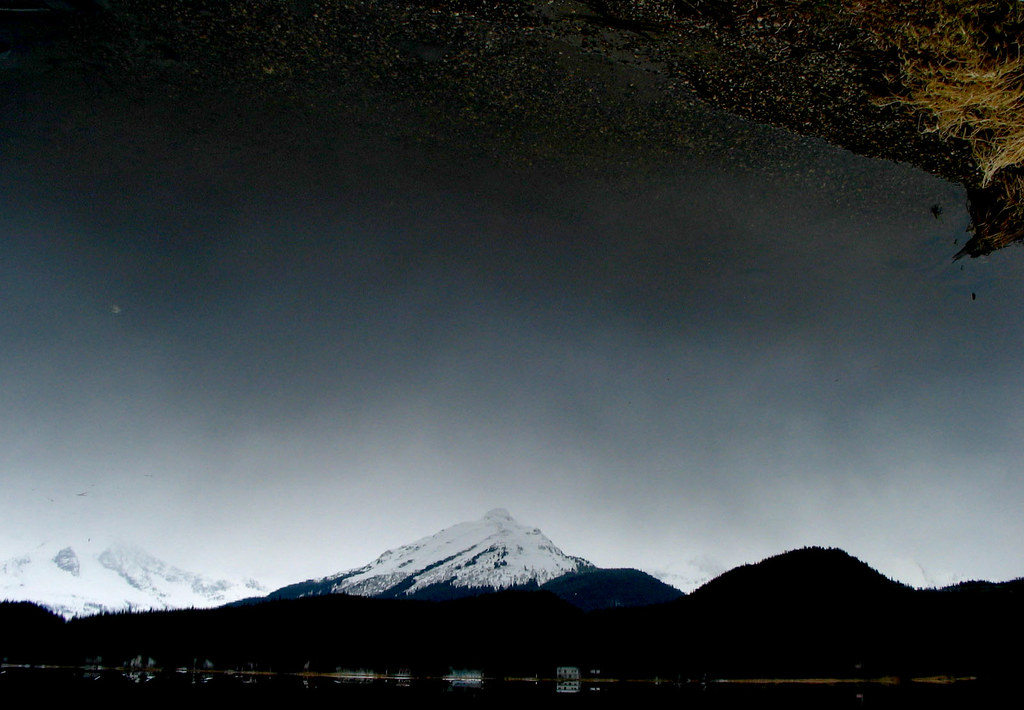
Lake Reflection by C.D. Sessums


Millennium People, I'm talking to you. This is how we make it happen: some news.

Several months ago I wrote about Iceland (saga style) after a trip there. At the national soil institute I remember staring at a massive volcano on the horizon and asking if it was dormant. "Far from it" the friendly scientist had replied "its long overdue for a really impressive explosion!"

That has happened.

Signs of the times: You can now direct an ad campaign from your desktop with Google TV ads – makes sense really. TV killed the radio, and now TV itself is being killed by the Internet. But does Google have too many moving parts? Cuba starts down the slippery slope to capitalism... Pulitzer won by online journalism - final proof (no pun) that print is no longer relevant in a digital world. Quite sad really. Yes indeed, the future is coming at us thick and fast (that's what she said); related, something that's done the rounds several times, from waaay back in 1995, we discover why the Internet will fail.


"Polar Night", by Gronsky.

Signs you're behind the times: 3 years ago some friends in Sydney asked me if I wanted to come to Earth Hour. I said no, it would never take off.The Vatican tries to justify linking paedophilia with homosexuality. Idiots. That's like saying a beard is the same thing as a scarf. Beard scarf. Catholic related, three-person IVF: its like there's a party in my egg and everyone's invited. Parent related, sob story / what constitutes a mother?


source unknown

Lightning makes mushrooms grow, apparently. Also the case in East London. Unrelated, what's going on inside your body? Eventual Ghost tells rock stars to pull their goddamn heads in. Related, inside the biggest fact-checking conference in the world; (Where else but Germany?); Its lonely in the modern world: Unhappy Hipsters. Very similar, but serious: ArchNow (a new one of those daily architecture sites); Street View time-lapse: an inevitable project; Project Daedalus (sci-fi art, kind of); Kodak Moments: image library of the last several decades (in colour). Related, Nevada Test Site Oral History; Early digital art; cheating is hurting China's reputation; Amazing images of old New York; also NY: Easter shootings in Times Square.

Finally, in the words of a great man: "let's add a layer of awesomeness!"


PIXELS by PATRICK JEAN.
Uploaded by onemoreprod. - Watch original web videos.

Saturday, 16 January 2010

nomadic banks


An MP original...

From all around the town, and from the hills above it, the good folk tumbled out of their homes, and collected in the square. The bank was in town. Anxiously, the people formed a queue, the ritual most strongly associated with this social institution.
Most had come to see the bank clerks employed in valuation: the Fortune Tellers as they were called. Behind their long trestle tables of mahogany, the Tellers would Tell, judging each object as it was presented to them, and passing comment on its interest to the bank.

It was on the basis of these proclamations that the people would decided whether to keep or destroy their belongings. Something that was useless to the bank was useless to society, because the bank was the storehouse for all social objects.
You never really owned anything anymore, but simply exchanged it for credit. An object given to the bank on loan equated to the possibility to loan something else in return. A constant fluctuation in social needs for certain items, furniture, vehicles, jewelry, clothes, ensured a constant exchange. The bank worked like a cooperative society for objects, with 80 million members...
The ease with which objects were deposited and retrieved from the bank very quickly loosened the ties people had with them. The inherent desire to hoard soon melted away.

People found that in time they did not miss any of these things they gave up, and never asked for them back. They remain to this day in the vaults of the bank, able to be viewed, like a still-living museum to our civilisation. The bank was a stepping stone to the objectless society.

Tuesday, 12 January 2010

fistful of links


70's space colony concept, via F*Mass, via Design Swan. I particularly like the indoor sun. Nice.

A fat, fat fistful from the future: some news.

2010 is apparently the Year of the 3D Television. Also technology: mobile phones from the future, related the bio-phone; 2009's sexiest geeks. (w-wait, did Jade win or not?); so now your keyboard knows if you're stressed; iPhone apps are crap. Why not use your phone to control a military spy plane instead? Related, iPhone fingerless gloves. Also future: the London Transport Future Generator (although just getting London Transport to work in the present would be nice). Related, Indian transport future; related, retro-future: Atomic Annihilation. A bit related, Airminded.

Hardcore technology: Web 2.0 suicide - the fastest way to permanently delete yourself from all social network sites. The Consumer Electronics Show was on in Japan this year. So cool. Microsoft obvious fail. I mean, look at the guy's jumper. Related, Microsoft Word 2010 parody. Also Japan, the suicide forest at the base of Mt. Fuji; Pimp your maps with Cloudmade.

Meanwhile, a look around the world: its so cold here in the UK pensioners are burning their books. Very Bradbury. Related, the Ballardian forum is up and running again. Winter is cruel: muppet suicides; not related, global warming solved by paint; super-sweet anti-whaling speedboat rammed by the Japanese recently. Now sunk; Australia still accidentally racist. America: NY's proposed cable-car network; Boston's abandoned subways; California: nudists upset over rotting seals buried at their beach. Also California, Arnie says prisons must be at least as good as schools (or something). In America, plane thieves get their own Facebook fan pages. How not to write about Africa. More globally: weird shit's going on with the Milky Way's Dark Matter.

Cool shit: beauty is she (models/fashion/SFW) in particular I think there is a shoot to be made on the subject of WW1 women; Interesting letterheads (Einstein, Hitler, Johnny Cash, etc); DIY Kung-fu film script; CGUnit (which I embarrassingly misread), a sort of CGI/graphic art/photography mega-site; the new book from Jason; 60's sex and style from Pour 15 Minutes d'Amour (for 15 minutes of love). Ne le regardez pas au travaille (NSFW); Related to you: mum and dad.

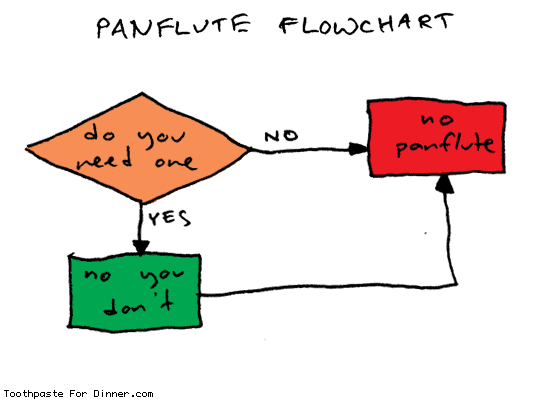
William Shatner reads Palin's tweets on Conan's show. Related, Palin gets a job with Fox; super cool Australian photography: bang bang dot dot; Chris Schaberg invokes Heidegger against airport delays; Hilobrow (because middle-brow is not the answer). Start here; the amazing photos of Richard Mosse. Really. Check him out; Apollo 12 lunar diary. Related, the Gemini 16 press release (pdf); I've always been a fan of Carlo Mollino's furniture (BLDG blog article), architecture, car design, etc, but had no idea he also took dirty polaroids; a 19th century flow-chart of all of human history. Related, a flowchart of whether you need a panflute; Body Mapping/Ghillie Suits at Mount Olympus.

And... finally,

Friday, 16 October 2009

prophetic visions


"When Burt Smallways" reads the blurb to Wells' 1907 classic " is accidentally whisked off to Germany in a balloon carrying plans for a top-secret aeroplane, he gets involved in Prince Karl Albert's massive airship raid on New York... the first step in a war which soon flares into world-wide catastrophe." The novel sees fearless and hapless Burt witness, from relative safety, the destruction of the Western world, before striving to make a new life for himself in a brutal and feudal post-war society of devastated Europe.

He tumbles into the balloon while assisting an eccentric inventor (a narrative technique perhaps borrowed from Verne's Mysterious Island?) and when, at length, the fog clears he finds himself bobbing between gargantuan Zeppelins – he lands in a German air park, described as an endless matrix of orthogonally aligned airships, each tied down to the ground by a mass of fuel pumps and strings of lights. The scene invokes a cross between Gulliver's Travels and Archigram's Instant Cities.

He sees the fire bombing of New York, a massive aerial battle over Niagara Falls, and only after many years of travel does he make it back to the small suburb where the story began. Civilisation is completely destroyed, and the novel ends with an interesting remark from one of the characters. As he stares up at the rusting monorail lines he realises that even if his children were to live to 100 they would never see the wonders of the society he grew up in.


Image via.

Wednesday, 14 October 2009

thames and tyburn


The lost rivers of London, via Strange Maps.

London has only very recently emerged from the tidal marshes and floodplains of the Thames Valley; only very recently ceased to be a site of soft clay pools and nomadic tribes of proto-humanoid hunters. Beginning with the Romans' wooden river defences and culminating with the 19th century embankment and 20th century River Barrier programs, the city has slowly re-claimed an inhospitable and humid landscape.

The dominance of the 'Dark River' over the city is absolute, and Londoners will not share its ancient and prestigious path with any rival. The Fleet, the Effra, the Falcon, all were made to disappear out of deference to the Thames. Even the lesser tributaries– the Black Ditch and Earl's Sluice, for example – are invisible. Although I can't help but suspect this has more to do with their role in the Great Stink of 1858.

But what would happen if these rivers were unburied? The Tyburn turned loose? In ancient times London used the source of the Tyburn as the site of immense gallows for the mass and public execution of criminals and political scapegoats (such as those brothers of the Charterhouse). Now Marble Arch blocks its way – could hangings take place there instead? Where now the river is only visible as it runs underneath Grey's Antiques, the uncovered Tyburn would spill down over Hyde Park in a deluge of destruction.

It would flood Buckingham Palace, turning the royal household into a tidal marshland ruin:


Buckingham Palace as it would sit on the tidal plains of the River Tyburn, via Time Team (UK only).

It would flow around the rise of Westminster City, as it used to, and once again set Thorney Island in the middle of the river.


Thorney Island, via the Museum of London.

Let's do it. Let's flood London.

Sunday, 4 October 2009

the data city + jules verne


Stark images of LA by David Maisel.
"The modern city is the data city. Architectural renderings and monographs present case studies in the context of information, with statistics and graphs supplementing the traditional projected view. The utopia of tomorrow will be saturated with information, and it is how we navigate this space that is the focus of so much contemporary speculation on technology and the city."
Via Things

A two part post today: if you don't like what you're reading, scroll down past the +++

There's an interesting post over at the much-loved Things, which might be summarised thus: urban interaction is becoming increasingly non-physical as we experience the city more and more through technologies of its representation (GPS, Twitter, Google Maps, etc) than through the actuality of its corporeal fabric. Nonetheless, Things recognises that our relation to the city is as a simulacrum – we are not replacing the real with the informatic, we are simply poorly imitating it: "the way virtual interfaces mimic physical spaces – desktops, pinboards, tables and surfaces you can post, pin, pinch and scatter content across – acknowledges our hunger for the tangible." They conclude: "The data city of the future will be unnavigable without technology, granted, but as a species we seem to be crying out for help remembering, unable to find things with the arsenal of digital tools and reliant, instead, on other people's recollections."

Contemporary data, being instant and always accessible, is also instantly forgettable. Couple this with declining attention spans (I wonder how many readers even make it to this point) and you arrive at an inescapable conclusion: in the future we will either learn to forge more ephemeral relationships to information (we won't remember, but we won't need to) or we will learn to handle information in a very different way.

Since, and this is my real point, the future is never merely a prolongation or projection of the conditions of the present, I would definitely consider the latter as more likely. The future is the data city, but it won't be accepted by people as the city of the future. To a certain extent the city has always been a 'data city', the possibility for the exchange of information (and obviously goods and services) is what intitially permitted for fixed settlements. And yet the way that data is handled by the city's citizens changes all the time, and to envisage the city of the future in the digital or informatic terms of today is as redundant as the utopias of the steampunk clique. To extend Things' conclusion – the rise of digital information might be weakening the reasons for the city's existence at all. In this future, the metropolis itself may one day become physically irrelevant.

In explaining the goals of Millennium People I often compare 2009 to 1909. When the people of this time envisaged the future they merely projected forward the industrialism of the late 19th century (not unlike the Steampunks). They could hardly have foreseen processes like computerisation, miniaturisation, post-Fordian society, globalisation, contemporary financial systems, because they lay so far outside their realm of reality as to be inconceivable. For them, the flying machine, made of canvas and wood, seemed like a pretty far-fetched idea.

By the same, to consider the metropolis of the future in traditional utopian terms – and especially to become overly fixated with the rise of the digital, is to limit oneself to a future that is really only a hi-tech version of today. This is not to say that the future is unimaginable: but it requires a very special mind, perhaps even greater than H.G. Wells or J.G. Ballard.


+++

My benchmark of futuristic thought is Jules Verne's novel Paris in the 20th Century. Considered too radical by his publisher in 1863, the book was locked away in a family vault for over a hundred years, and was only re-discovered by accident in the late 80's. Which is how I plucked my own copy from a box of freshly printed American first editions in 1996.

I won't spoil the plot, but in this remarkable story set in the year 1960 Verne envisages a city of glistening skyscrapers, each one air-conditioned. The streets are crammed with gas-powered cars, with rapid public transit covering the sub-terranean city. And yet these are only the more mundane visions: he foresees a worldwide 'telegraphic' communications network (the internet), a type of screen for viewing from a distance (television), elevators and an electronic, telephonic, document copier (fax machine).

Returning to the present day, it is this type of Vernian imagination that will carry us into the future. And the first step is to move beyond the 'data city', move beyond the delights of the digital and start scratching our heads about what is to come next. That's how we will become New Millennium People.

Thursday, 1 October 2009

post: apocalyptic futures


'Mike', 1952, via zvis.

I was recently interviewed for a "cult", and, to my surprise and delight, I was accepted. They call themselves Intermediate 7, and they are one of the 13 units being run as part of the second and third year design studios at the AA school of architecture, here in London. Inter 7's other title is: The End of the World and Other Bedtime Stories, and the focus for the year-long studio is visions of the future, post-apocalyptic societies, etc. Think ballardian fiction, sci-fi flicks. Their modus operandi is to slip in and out of the real and imagined, to produce falsified verity (by means of media or objects). For me this seems like a great excuse to re-watch old favourites like Forbidden Planet (hopefully more on that one day, I've got a killer angle on the plot), re-read the Red Mars trilogy, the War in the Air, and so on. This will all hinge around a unit trip to study emerging environmental and political tensions in Greenland (supposedly in November, although what we are likely to see in the unending night of the Arctic winter, I'm not sure).

But I also see this studio as an opportunity to sit ourselves down, take stock of our bearings and have some deep-and-meaningfuls about not just the future (and post-future) but also the present. I believe we will use our visions of the end of the world to perhaps give some shape to the embryonic Zeitgeist of this new decade, as we all become truly New Millennium People. This is a rather happy coincidence given the rubric of this blog, of which I need hardly remind the regular reader (if you're not one now, carpe diem is all I can say).

As an outburst of over-excitement and puerile anticipation of the day the real work begins, I thought I would make the bulk of this post a summary of my initial reflections on the 'Apocalypse'.

My first instinct is to examine a problem through its etymology A problem well articulated is a problem solved, as I believe Einstein once said (quiet nod to A.Verge, M.Tawa and S.Fung). The etymology of Apocalypse comes from 'kaluptein' which means 'to cover'. Apocalypse is therefore the act of 'uncovering'. In the medieval sense, this referred to the coming of JC and the era of Zion (see Revelations).

This set me thinking about a Heidegger paper about the origins of the word 'light' (amongst other things). He talks about heavy, then light, lightness, illumination (bringing oneself to light) and finally the word 'leathe'. This means 'to conceal, to cover' and its opposite 'aleathea' is the Greek word for 'truth'. Truth is an act of 'unconcealment'. The Apocalypse is an act of 'uncovering'. The Apocalypse is an act of truth.

And since it lies beyond the imagination ('ability to be depicted') of the present day, it is also an evidence (evidentia = ex + videre, or "out of sight"). The Apocalypse is evident, and its prediction is an act of previewing. It is to search for patterns in history, to define the present, to project into the future. 'Post-Apocalyptic' accordingly means 'after the unconcealment' – and could refer to either utopic or distopic situations. It could of course refer to neither, and simply mean 'the era following the unforeseen truth'.

So the core of the Apocalypse is not to fabricate or falsify the future, but to reveal, to expose and uncover... the truth, or a truth. This definition hinges on, and leaves open, the dimension of time. The Apocalypse is not a single occurrence (28 Days Later; The Day After Tomorrow; Deep Impact, etc) but can be any period of time necessary to unconceal a truth: the demise of the Roman Empire; the collapse of the Soviet Union; the end of petrol; the decline of the offline...

My goal for the studio-cult is, in no naive terms, to gestate an Apocalyptic truth.

Friday, 25 September 2009

back to basics


The retrospective epochal terminator, an MP orginal (more or less).

Millennium People. It is as it sounds: a blog for the People of the New Millennium.

But I thought I would just recap, for those latecomers at the back, and reiterate what MP is really all about: the uncertainty of the current architectural (and epochal) situation. Zaha's on the out, Dubai is quickly becoming a sandblasted stillborn, and I can faintly hear Ballard's Chelsea housewives murmuring into their martinis "someone really ought to do something".

Its a bad situation. Architects and theorists everywhere, lets take a moment to prop ourselves up on our unemployed elbows and take stock of the situation: the sub-prime crisis has come, and the boom has gone. Like so many Rip Van Winkels we naively now awake to the fact that China, the Gulf, and the endless stream of dubious commercial constructions we merrily knocked up, were morally moribund white elephants (or ivory towers).

Worse, the favourite pastime of so many students and young professionals – I am referring to digital formalism – has been murdered in its bed. No longer is there any hope that it will one day dominate the world of architectural construction, it has been relegated to nothing more than a stylistic dead end, like those typical of the beginning of last century (art nouveau, etc). On the upside, at least now when I speak out against meaningless form-finding I don't sound like a Luddite.

How are we rallying ourselves? MP is seeing two general trends in architectural thought emerge: the retrospective and the reactionary (I am simplifying by presenting the extremes, but I think the spectrum generally holds true).

The former have decided to seamlessly splice 1968 (and the years directly after it) to the present day. Through the re-examining of groups like archigram and the infamous lessons from Las Vegas they aim to by-pass all of that post-modernist, post-post-modernist, bullshit and reconnect with their roots. Soggy with nostalgia, they lovingly recount tales of simpler times – utopias were only a few years away and for a young architect anything seemed possible. Glorified is the architect-citizen, who told the Man where he could stick it (there is of course no mention of the architect's subsequent punishment, doomed to a half century of quibbling over occupational health and safety).

Then there is the reactionary camp, who seem to be led by the unlikely figure of Kengo Kuma (though there are certainly many others). This camp is following Toyo Ito's Digital Tarzan theories (of the city as the interface between the digital and physical realms) to their logical conclusion: by treating architecture as both a membrane for the individual/virtual and individual/real. In other words, a thinking founded in Heidegger's forest clearing (see The End of Philosophy and The Task of Thinking) and Levinas' Other.

I find this the more attractive of the two, and the discussion revolves mostly around the 'architectural object' (see Rosin-Melser's and my own exchange) and the notion of 'specular/speculative architecture'. The only problem with this movement is that it is a reaction to the current conditions. As such, it limits itself to merely describing the present. Where are the architectural revolutionaries? Where are the forward thinkers and dreamers for tomorrow?

In closing, I make mention to MP's wordy manifesto (as soon as the blog gets a regular editor it will probably be rephrased).

Thursday, 3 September 2009

metabolism: icons that are not objects


One of Kenzo Tange's early Metabolist (not yet Structuralist) projects, 1961.

From the point of view of its visionaries, Metabolism was a failure. Only a handful of buildings identified with the style were built, and (like the Archigram movement that followed it) the vast majority of projects remain to this day just dreams – the stuff of student reviews and utopian retrospectives.

Ironically, the key to the failure lies in the very basis of the movement: ephemerality (the Structuralists, who employed more or less the same ideals but without this quality were equally unsuccessful, but for other reasons). The Metabolists were trying to use architecture as a means to physically describe conditions of the metropolis that until then had remained intangible– though nonetheless extremely real– the ever-changing and ephemeral association of people, buildings, infrastructure, goods and information. The sum of these activities might be referred to as the ‘metropolitan flux’.

They recognised that the success of a city, and in broader terms of any species, was tied to how fast and with how much ease it could adapt to the needs of the moment, how capable it was of dealing with the metropolitan flux. They consequently proposed buildings that were comprised of adaptable modules bolted to permanent frames – this year the building is a tower block, but next year it might be a school or a hospital or a factory.

And there’s the rub: psychologically, people don’t like the idea that next year their home might be a factory. They like to feel that the structure they reside in is permanent. The Metabolists made the mistake of interpreting the city as being an essentially empty field filled with urban nomads. But the metropolitan flux is far more rooted than one might think: people still have a very strong sense of ‘mine’ and ‘thine’. The absurdity of this mentality is evidenced by the fact people are willing to buy McMansions with 25 year life-spans; it is after all not real permanence that the people seek, but the semblance of permanence.

Residential fluidity is thus impossible; public fluidity is not particularly welcomed – we like our civic spaces even more permanent than our domestic ones. Statues. Monuments. Important landmarks. All these form the basis of an urban fabric, and inform our relationship to it. The conceptual eternity of public space is an important factor the citizen's perception of belonging to a city.

Somewhat behind the times, I recently discovered that Kurokawa’s Nakagin Capsule Tower is slated for demolition. It is one of the few built examples of module/modular construction, and the building is an icon of its era. So what prevents it from being an ‘object’?

Its form, while wilful, it not arbitrary and has little in common with the form-finding exercises used to produce contemporary architecture (I am not only referring to the digital curves of Zaha, but quite equally the gracious profiles of Murcutt).

The form of a Metabolist structure is dictated largely by its module. And the way of thinking about the module is a product of an agenda about the future of society. Moreover, specular/speculative architecture is almost always positive, in that it describes a response to an existing social situation. In this respect the architectural object reinforces the social status quo, and belongs to the order of social commentary.

Conversely, the social arguments of a Metabolist building are normative – they describe how things ought to be, and in this respect Metabolist architecture proposes itself as a tool for change, and thus belongs to the order of social progress.

Capsule Tower: a powerful symbol of Japan's post-war cultural revival.

Monday, 31 August 2009

specular architecture


The Guggenheim effect – where specular/speculative architecture really began.

Today I am going to build upon the thoughts of Mark C. Taylor – who said that over the last century there has been a general correlation between forms of capitalism and architectural styles: Industrial capitalism had Modern architecture, Consumer capitalism had Postmodern architecture and Financial capitalism has (or had) Specular / Speculative architecture.

He was not the first to divide up capitalism into these three phases. At the end of the last millennium, the 'Great Man' of economics J.K Galbraith wrote extensively about the shift that was taking place. In one of his last works, entitled 'The Economics of Innocent Fraud', he pointed out how far we had come since the early days, when the economy was driven by actual capitalists – individuals with money who controlled the means of production.

Over time the cost of manufacturing goods fell, and subsequently so too did their value. Maintaining a dominant position in the market by simply controlling the production of something became increasingly difficult (and I am not really even referring to the activities that prompted legislation specifically targeted at breaking monopolies). So the impetus of the leading economies naturally shifted from the people who made the most to the people who sold the most. Above all were valued those individuals who could turn a superfluous luxury into a perceived necessity.

But with the global unification of markets, the digitisation of trading, and the new era of instant communications between financial institutions, it suddenly became possible to speculate in radically new ways. Money was capable of making lots more money, loans backed by securities that themselves were backed by other loans. And the market grew, and everyone won, and (almost) no one thought it would ever end.
And so when Fannie Mae went A-over-T, and kicked off all this business, it came as a bit of a shock.

So I think Taylor is drawing a fair, even predictable, comparison between architectural styles and the economic factors that produced them: the machine and industrial aesthetic of Modernism stemming from the factories and silos; the cultural critiques and pastiche styles of Postmodernism likewise finding their root in an increasingly global society absolutely saturated by the advertisement.

The real goal of this blog is to attempt to capture an epochal philosophy before the relentless wave of progress wipes it from our minds: a time that really began in the late 70's – before I was even born – and may still not have finished, but whose peak was undeniably between the collapse of the Towers and the collapse of the Sub-Prime.

The reasons for wanting to capture this essence are manifold: architecture is my profession, and it was treated as a bitch: the speculative scapegoat. That smarts. A profession that at the time was becoming increasingly image-based, and therefore itself increasingly speculative, began to be manipulated by the financial world – as an agent of financial speculation. How many luxury apartment blocks did architects really think the world needed? But need didn't come into it. Architecture had imploded into itself, there was no moral element, simply a quest to find a new look, and a look to sell more than the competition. And this quest essentially produced the same types of stylistic dead ends that were seen at the beginning of the 20th century (art nouveau, Gaudi, Hunterwasser, and so on).

Zaha is a prime example, though she still tends to divide opinions. But I think it is fairly safe to say that her time has come and gone. She is no longer (if she ever was) at the forefront of architectural discussion. It is nonetheless undeniable that she was an architect that rose to prominence not for actually constructing anything, but simply threatening to construct anything. Her powerfully iconic (but ultimately meaningless) forms epitomise this 'object' architecture – an architecture unrelated to humanity except by the coincidence that it was us that produced it. Always seen from a bird's eye view, it is an architecture of visual appeal (specular) and conjectural possibilities (speculative).

For the next month or so Millennium People is going to tackle the meaning of the architectural 'object', and its relevance to the future of architecture (the discussion will be mainly prospective rather than retrospective).
In particular the focus will be in the fields associated with the blog: psychogeography, landscape and the city.

Wednesday, 26 August 2009

terraforming


Drawing made using Terragen2, here.

Landscape rendering software is becoming increasingly powerful – several images in the Terragen gallery (like the one above) had me really pushing my face up against the screen trying to work out if they were photos or not (what a n00b). While I find renders of huts in the forest all very nice, the real question is: what is this good for? Is it art? Maybe. I don't know.

Separately, I was cruising through pictures from space and came across an article about how Venus used to be like Earth, with moderate temperatures and, very probably, open bodies of water. Then the greenhouse effect went mad, and turned the atmosphere into a carbon dioxide soup bowl, with sulphuric acid for rain. Venus can be thought of as either Earth's failed older sister, or possibly Earth's foreboding doppelganger. If it hadn't gone so pear-shaped, maybe we'd be digging ancient alien churches out of the Venusian volcanic rubble.


Venus, Earth's failed sister, via jpl.

This all set me thinking about an amazing trilogy I read when I was a kid, 'Red Mars, Green Mars, Blue Mars' by Kim Stanley Robinson (here's a good interview with the man over at Bldg Blog). He invented the concept of 'terraforming' – the human transformation of an entire planet's climate. He chose a rather predictable, and none too easy, subject: Mars. Low-oxygen modified plants, space reflectors to increase the amount of sunlight, nuclear melting of the permafrost and poles, all ultimately lead to a breathable atmosphere, vegetation, purple seas and complex weather patterns.

But why is it we are all so obsessed with getting further away from the sun? Terraforming Mars means starting from scratch, while Venus doesn't seem so different from our own planet –the act would give us two habitable planets in the solar system, quite close to each other. So why aren't we going there?


Left: Artist's conception of the surface of Venus (1968) via cosmographica; Right: A possible rendered vision for a terraformed Venus, via Fractal Landscapes.

What would a Venusian architecture be like? How do you respond to the history of a planet that has never supported life? I can only imagine flimsy constructions posed delicately on the highly volcanic surface, analogous to the early mining works of Australia (although the Europeans may have felt they were on Venus, they were in fact far from alone on that continent). But it may be very different – a massive and colourful vernacular that references the harsh sun and stunning landscapes (sounds more like Australia every minute).

We are only four months away from creating an artificial species, reports the Times. We are finally becoming God (it seems like we've been just playing around for ages) and actually inventing lifeforms. Now, couple that with Venus. Imagine a team of designers creating specific species to slowly turn the planet into a New Earth. Flora and fauna that once made will evolve and come to form a new planetary ecosystem quite unknown to us, and unique in the universe. Further, imagine bathing in an alien ocean or walking through a sulphur sink forest and knowing that every species is the work of Humanity.

Ego trip.

Monday, 24 August 2009

a fun palace for the people


Cedric Prices' 1961 project Fun Palace, at Mill Meads.


The site today, photo by Lara Almarcegui
The Fun Palace was to be a great open framework of steel lattice girders and towers, surmounted by a traveller crane... halls and galleries, snack bars and entertainment areas, linked by walkways, can be built and changed at will. People of all ages and interests will find space to enjoy their leisure, to relax or be active, at any time, day or night.'
12 Empty Spaces Await the London Olympics
Lara Almarcegui


Cedric Price envisaged a completely flexible program for the complex, "hanging rooms for dancing, music, and drama; mobile floors, walls, ceilings, and walkways; and advanced temperature systems that could disperse and control fog, warm air, and moisture were all intended to promote active 'fun.'" The revolutionary project was never built, though Rogers and Piano cite it as a major inspiration for their Centre Pompidou in Paris (certainly the similarities are striking). The site, which is in an ex-industrial backwater of the Lea Valley (East London), is today still empty. The only thing of note in the region is that the 2001 Big Brother studio is across the canal. The Canadian Centre for Architecture says:
On the one hand, Fun Palace was inspired by the egalitarian philosophy of 18th century English pleasure grounds, such as Vauxhall and Ranelagh, with their sprawling spaces for strolling, amusement, and gossip. On the other hand, Price’s unrealised project was up-to-the-minute, interpreting current Cybernetic theories, avant-garde theatrical principles, cutting edge technology, and a free-spirited, Monty Pythonesque sense of fun. The ultimate goal was a building capable of change in response to the wishes of users.
And I think this is really the crux of the issue: "egalitarian philosophy" meets "cutting edge technology". Modernism was founded on theories of social reform – a conscious rejection of the past. But by the end of the Second War it had deteriorated into an exercise in technological feats. Hoards of monolithic tower blocks were constructed because they could be, not because they should have been – that is, while they may have solved the immediate social and technological problems of the day, they avoided any long-term questions of social morality.

Moreover, the vast difference in amenity between new towns and old suburbs only heightened the age-old divisions of class and social status. Price is quoted as saying “technology is the answer, but what was the question?” – up until the Fun Palace the question had never been asked, technology was its own daisy chain of questions and answers. The separation of 'high-brow' and 'low-brow' entertainment continues today (there are no video arcades in our opera houses).

What Price proposed was an architecture not just capable of bringing Brave New World-esque pleasures to the popular classes, but the creation of a space that permitted for an equality of entertainment expression. By mixing avant-garde theatre with dodgems, or virtual reality simulators with book-readings, the possibilities for exchange would have become much more powerful. The exclusive world of intellectual art forms opened to the public.


Conceptual sketch, interesting for me because the most important (and flexible) part of the building is left blank. For some reason it reminded me of this article: "If you want to change society, don't build anything!"

Monday, 17 August 2009

re-burbia


The future of the suburbs: a desert cult of cars.

Sometimes you don't quite get round to doing something, and afterwards you really wish you had. Now that the finalists are up for the Re-Burbia competition (to propose the future of the apparently futureless suburbs), I feel a lot less insecure about my own proposal, which I did not submit because I decided to go on holiday instead.

"It was the urban regeneration schemes of the mid-21st century that spelled the beginning of the end for the concept of the suburbs. Re-zoning into ultra low-density rural and hi-density metropolitan effectively polarised the state, and the suburb as an architype was neither profitable (from an agricultural standpoint), nor sufficiently flexible to keep up with rapidly changing trends in social, and technological organisation. Of course, there was no mass-exodus, no overnight evacuation, no one abandoned their homes (although several economic waves of foreclosures certainly aided departures), only a gradual waning of the suburbs' political and social significance over several generations.

At first, it was simply a question of not having the power. Global production of power dipped significantly, and the cities were prioritised. The countryside had been self-sufficient for decades, leaving the suburbs to suffer. Community groups lobbied for aid, but within a few years the fringes of most cities were managed on a lottery system, determining which streets would be without electricity and for what periods. The rich grouped together to fund their own power plants, implementing elaborate security measures to keep the once-bourgeois proletariat from their stations. Eventually, the wealth of a suburb could be measured simply by counting the bulbs at dusk.

The next crisis was water: it became evident to the cities that the suburbs were occupying too much of the water catchments. Wholesale, but strategic, clearing of houses began with a view to raising the water tables, and reducing the amount of run-off disappearing into the sea. Salvageable materials were stockpiled, but most was left to rot. Urban centres that were not sufficiently dense were re-classified as suburbs – resulting in massive re-settlement plans. Riots broke out amongst those who refused to leave, the peasant children of businessmen quibbling for access to artesian wells.

Sometimes whole cities would burn, with no water or willing manpower to extinguish them. The descendents of these vast suburban landscapes took refuge in the sole infrastructure that endured: the highways. Long since emptied of cars, the mighty roads nonetheless provided order and communication. The suburban refugees restructured themselves into linear societies. Forms that had been designed for speed, efficiency, circulation, now took on other meanings: defence, visibility, advantage. A neo-medieval architecture suggested itself, in the wonderful patterns of a turnpike, or the graceful rise of an on-ramp."

Saturday, 8 August 2009

the parthenon's corners


The path to the parthenon.

On my way back from Hydra I spent a day in Athens. Faced with the Parthenon, my first thought was of something I read for a history class. Apparently, the major difference between Roman and Greek ideas of space and monumentality is the angle of approach – while Roman perspectival depth is frontal, the Greeks often relied on a 45 degree angle of incidence. A Roman temple is accordingly supposed to be seen from this view, and not this one.

The last time I was in Greece was February 2006, and I noticed that the reconstruction of the acropolis had advanced a good deal in 3 years. Not only have large portions been reconstructed, but a number of elements have been recreated. The aim is what many might call an in-situ replica. Out-of-situ replicas already exist, Nashville is famous for advertising just how far it can miss the point. My thoughts on the perpetuation of buildings…


I loved the effect of the scaffolding, which turns Pericles’ dreams into modernist masterpieces. The Temple of Athena Nike has become a Greek Pompidou Centre. Compare with Nashville. The layering of hessian screens, cranes and construction machinery over the ancient stones blurs the limit of the ruins, and allows for an ambiguity of form that is quite amazing. Could this be some new style of architecture, some post-post-modernist (after Graves, after Moore, after Stirling) – where the ancient orders are not simply semiotic references, but the uncertain centres of hi-tech machines?

Sunday, 19 July 2009

exploding plastic inevitable


This video made me think of Warhol's EPI, and his Electric Circus club, Fabrizio Fiumi, allatonceness, and superarchitecture. In short, everything that spoke to me about super-position of images onto the real, ambiguity of space, disintegration of matter, etc. We conceive of the relationship between space and time in a bizzare manner- where cardinal space is permanent and time is in flux. This is why we associate, say, the photograph of a Leningrad street in 1941 with the same street today, because even though time has passed we state that it is the same location (the same point, place, reference- in terms of long/lat, elevation, etc). In reality, no space is static, and everything is relative, so from micro-second to micro-second all certainty of place is non-existent. The past is non-extant. I am reminded of a Borges fable, the tale of the people of an imaginary planet. There space is not conceived as having duration in time, take:
"The hypothetical case of nine men who on nine successive nights experience a sharp pain. Would it not be absurd, they asked, to pretend that the men had suffered one and the same pain?"
The continuation of a similar pain in the same location over nine nights is coincidental, and not evidence that it is the same pain. The same would be true of an object: a coin seen in a room by nine men over nine successive nights is, materially, equally non-continuous. Further, to claim that a lost coin on monday and a found coin on friday (that bears the traces of having spent several days in the rain) are the same coin is nothing more than the 'association of ideas'. Classic Borges. This is why the spirit of place is non-continuous in time, but exists only for the moment it is experienced. Try returning to any childhood holiday site and see if the essence of the locale remains...

When we realise that our association of time with space is ridiculous we will understand physicality anew. We will construct suburbs of concrete cubes and project, like the castle, whatever form or atmosphere we care onto their facades. We will have broken the solidity of middle-class suburbia and exploded into an era of physical uncertainty. 'Precise location' will mean nothing, GPS will be the only means of navigation, and Occidental society will drift as nomads through a shape-shifting, dancing, urban forest of light and matter.

Unrelated, news from Austin, Texas. Everyone's favourite cinema-restaurant (you sit in rows, but before each row is a bench and order slip), the Alamo Drafthouse, has added to their celluloid passions the International Air Sex Championships, think Air Guitar, but mostly naked.